

130
Views & Citations10
Likes & Shares
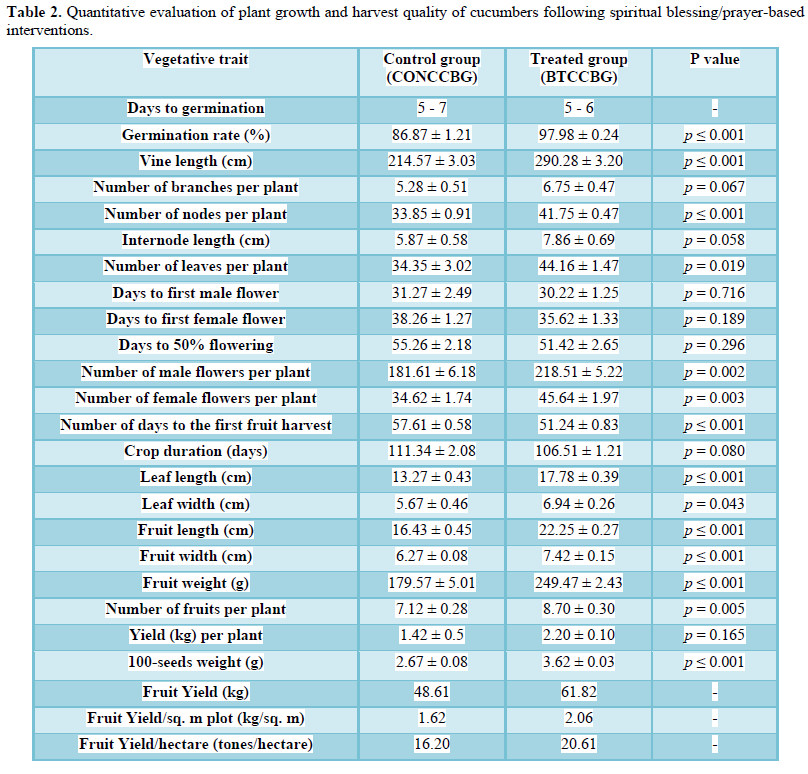
Results: Ten out of twelve qualitative vegetative traits were altered in the treatment group (defined as BTCCBG) compared to the control (defined as CONCCBG). Besides, phenological traits such as plant vine length, leaf length, fruit length, and fruit weight were significantly increased by 35.28% (p ≤ 0.001), 33.99% (p ≤ 0.001), 35.42% (p ≤ 0.001), 38.93% (p ≤ 0.001), respectively, in the BTCCBG compared to the control, CONCCBG. Furthermore, yield-related parameters such as 100-seed weight and fruit yield (tons per hectare) were also significantly increased by 35.58% (p ≤ 0.001) and 27.22%, respectively, in the BTCCBG compared to the CONCCBG.
Conclusion: The findings indicated a statistically significant correlation observed between the application of distant spiritual energy and accelerated phenological development and yield in cucumbers.
Keywords: cucumber, spiritual blessing, vegetative traits, yield, remote blessing
Despite these promising results in other cucurbits and solanaceous crops, there remains a critical gap in understanding how distant spiritual blessing energy specifically influences the phenological stages and yield components of Cucumis sativus under controlled field conditions. This study, therefore, aimed to evaluate the impact of distant spiritual blessing energy treatment on the germination, floral transition, and total yield of cucumbers, providing a novel perspective on sustainable agricultural intensification.
MATERIALS AND METHODS
Study site
Field investigations were conducted at Bhandarwadi, Sindhudurg district, situated within the Konkan agro-climatic zone of Maharashtra, India (15°37’–16°40’ N, 73°19’–74°13’ E; altitude 26 m). The regional climate is defined by tropical extremes, wherein pre-monsoon temperatures peak between 39°C and 42°C. Owing to substantial spatio-temporal rainfall heterogeneity, the area remains susceptible to acute soil moisture deficits. These abiotic stressors often intersect with sensitive phenological phases, potentially undermining fundamental physiological mechanisms and attainable crop productivity.
Test item and study design
Certified seeds of Cucumis sativus L. (cv. Dynasty-hybrid; Lot No. NU6220241) were partitioned into control and Blessing/Biofield Energy Treatment (BET) groups. Post-treatment, seeds were cultivated in randomized plots for the assessment of phenological and yield-contributing characteristics. To isolate the effects of BET, both cohorts received identical agronomic management, including standardized irrigation, fertilization, and IPM practices throughout the growth cycle.
Field layout
The experiment was conducted using a randomized complete block design (RCBD) consisting of two treatments. Each 10.0 m² plot (4.0 m × 2.5 m) was separated by 0.5 m buffer strips to minimize edge effects and inter-plot interference within the 70.0 m² experimental area. Cucumber (Cucumis sativus L.) seeds were sown at a uniform spacing of 0.5 m × 0.5 m. Prior to sowing, composite soil samples were analyzed to establish baseline physicochemical properties, including pH, organic matter, and available macronutrients (N, P, and K). This characterization confirmed edaphic homogeneity across the site, ensuring the minimization of confounding environmental variables.
Spiritual blessing (biofield/prayer) energy treatment strategy
The control group of cucumber seeds and plots (CONCCBG) did not receive any treatment. The treated group (cucumber seeds and land), referred to as BTCCBG, received a spiritual blessing (biofield) energy treatment (SBET) by a spiritual practitioner with over 12 years of experience, Ms Alice Branton, via remote/distance mode using a web-conference platform from Florida, USA, for approximately 4 minutes. The blessing involved the healer performing the laying on of hands and reciting prayers from USA, under conditions of 28 ± 2°C temperature and 65 ± 5% relative humidity to the cucumber seeds and land. During this procedure, the healer sought to channel divine energy from the Universe to the treated seeds and land.
Soil properties
Before the study began, composite topsoil samples collected from approximately 30 cm depth were obtained from each plot via five-point sampling. The collected material was air-dried, sieved (<2 mm), and refrigerated at 4 °C. Soil texture was characterized by the qualitative hand feel method [7], while pH was determined in a 1:2 (w/v) soil: distilled water suspension using a standardized, pre-calibrated pH meter.
Seed plantation, water and fertilizers management
Seeds were sown directly into the soil. Initially, during germination period water was provided manually for about one week. Thereafter, water provided through drip irrigation system (0.5 m spacing; 3 L/h flow rate). Before sowing fertilization consisted of 50:100:50 kg/ha of N:P:K, supplied using urea, single superphosphate (SSP), and muriate of potash (MOP) were mixed in the soil of both control and treatment plots. The entire quantities of SSP and MOP, along with 50% of the urea, were incorporated during pre-sowing, while the remaining 50% nitrogen was provided at 21 DAS. To control pest, Hamla 550 (chlorpyrifos 50% + cypermethrin 5%) obtained from Gharda Chemicals Ltd., India was applied at the rate of 2 mL/L at 21 and 49 DAS. At 70 DAS, five plants per plot were randomly sampled to quantify biometric growth parameters and yield components.
Plant growth parameters
The germplasm was characterized based on a comprehensive suite of qualitative and quantitative morphological traits. Qualitative descriptors defined vegetative and reproductive architecture, including plant vigor, growth habit, stem morphology, and leaf attributes such as pubescence, lobing depth, blade coloration, and maximum width. Diversity in fruit and seed phenology, specifically skin pigmentation, shape, seed colour, and density, was also evaluated. Quantitative assessment of crop development and productivity included vegetative parameters (vine length, primary branch count, nodes per vine, internode length, and stem diameter) and foliar dimensions. Phenological transition was recorded as days to 50% anthesis. Yield components were quantified by fruit mass and dimensions, total productivity (t/ha), and seed metrics (length and width).
Yield parameters
At physiological maturity, cucumbers were harvested to evaluate morphometric traits and yield components. Fruit length and diameter were measured using digital calipers, and individual fruit mass was determined using a precision electronic balance. Total productivity was assessed by sampling five representative plants per plot. Cumulative yield per net plot was recorded and normalized to tonnes per hectare (t/ha) to facilitate standardized comparisons.
Data analysis
We presented results as mean ± SEM and performed statistical comparisons between independent cohorts using an unpaired Student’s t-test. All data were analyzed in SigmaPlot (v14.0), with the alpha level for significance set at 0.05.
RESULTS
Soil properties analysis
Initial characterization of the experimental soil across both control and treatment plots identified a sandy loam texture with a strongly acidic profile (pH 5.01). This baseline acidity was associated with restricted cation exchange capacity (CEC) and diminished nutrient bioavailability. Post-harvest analysis revealed that the plots subjected to Spiritual Blessing (Biofield) Energy Treatment (SBET) exhibited a significant shift in soil pH to 5.16, transitioning the classification from strongly acidic to moderately acidic. These findings suggest that the intervention may modulate soil chemical properties, potentially by enhancing the buffering capacity or altering ionic concentrations within the soil matrix (Data not shown).
Morphology of cucumber plants
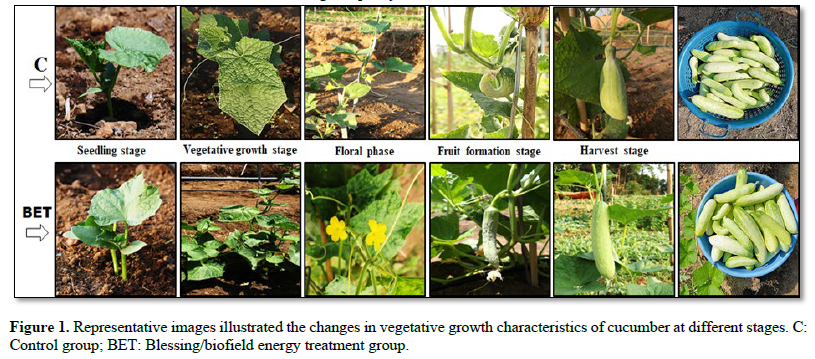
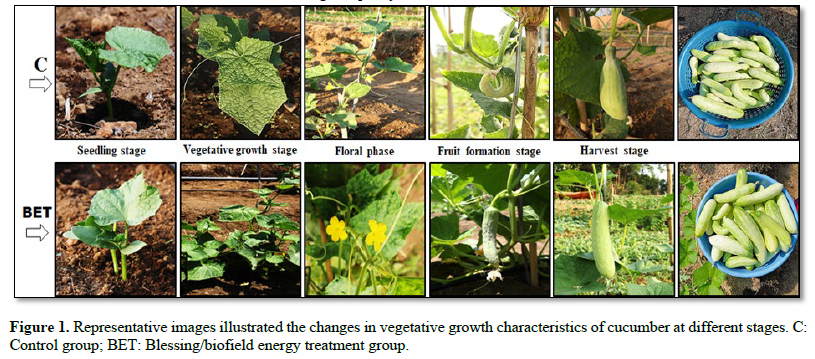
The morphological progress of cucumber was recorded through systematic observations at set intervals. This study assessed systematically from the initial germination, seedling phase vegetative growth stage, floral phase, fruit formation stage, and final harvest stage (Figure 1).
Comparative analysis of vegetative traits
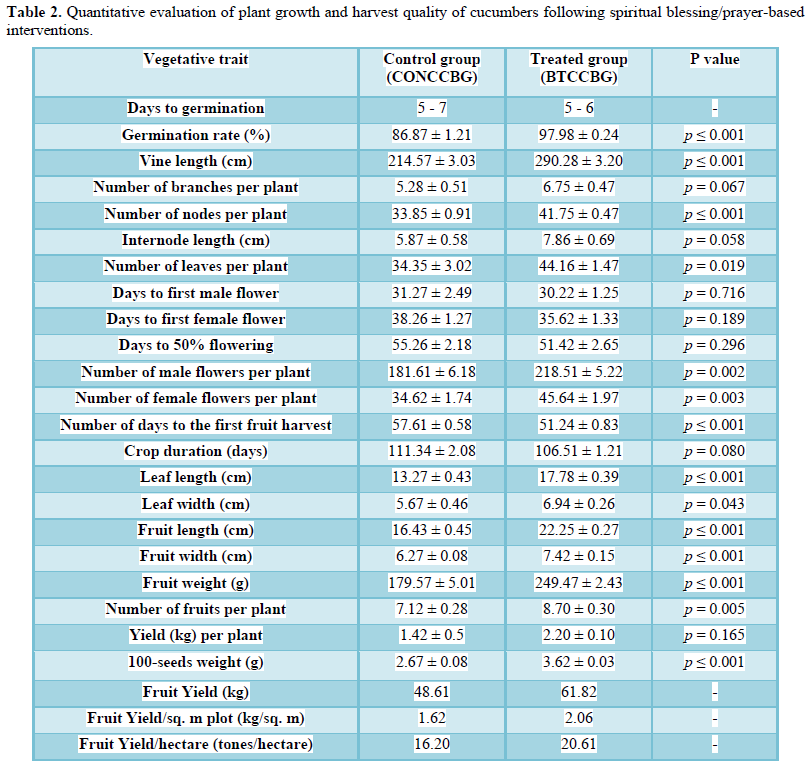
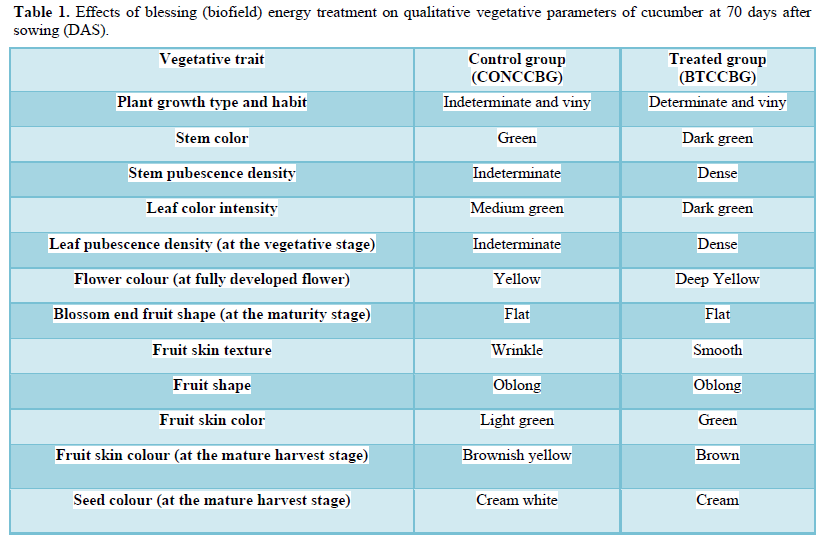
A fundamental shift was observed in the growth pattern. While the control group displayed an indeterminate habit and the treated group transitioned to a determinate habit. Both groups maintained a viny (climbing/creeping) nature. The treated plants exhibited a dark green stem colour compared to the standard green in the control. Furthermore, the stem pubescence density (hairiness) increased from indeterminate in the control to dense in the treated group, which often correlates with improved pest resistance and moisture retention. The leaves of the treated group (BTCCBG) showed a higher colour intensity (dark green) compared to the medium green of the control. Similar to the stem, the leaf pubescence density at the vegetative stage was significantly higher (dense) in the treated group compared to the indeterminate density in the control. At the fully developed stage, the flowers of the treated plants were a deep yellow, whereas the control group produced standard yellow flowers. This increased intensity can sometimes influence pollinator attraction. Other parameters such as blossom end fruit shape and the whole fruit shape did not show any alteration in the BTCCBG compared to the CONCCBG (Table 1).
Phenology and yield traits
The rate of germination and plant vine length were increased significantly (p ≤ 0.001) by 12.79% and 35.28%, respectively, in BTCCBG compared to the control, CONCCBG. Number of nodes per plant were significantly increased by 23.34% (p ≤ 0.001), respectively, in the BTCCBG compared to the control, CONCCBG. Number of leaves per plant rose by 28.56% (p = 0.019), supported by a 33.99% (p ≤ 0.001) increase in leaf length and 22.40% (p = 0.043) increase in leaf width in the BTCCBG than CONCCBG. Reproductive priming descriptors such as number of male and female flowers per plant were significantly increased in the BTCCBG by 20.32% (p = 0.002) and 31.83% (p = 0.003), respectively compared to the compared to the CONCCBG.
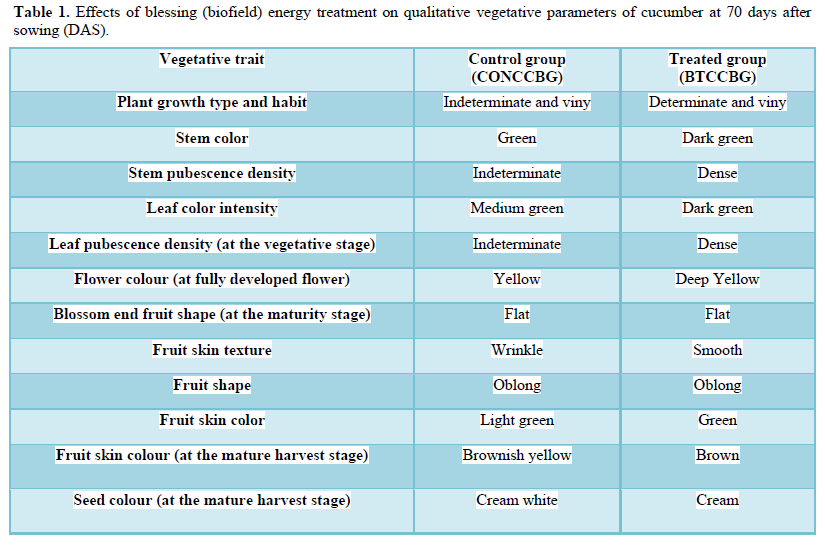
The most striking impact of the treatment was observed in final yield metrics. The fruit length, fruit width, and fruit weight were significantly increased by 35.42% (p ≤ 0.001), 18.34% (p ≤ 0.001), and 38.93% (p ≤ 0.001), respectively, in the BTCCBG with respect to the CONCCBG. Furthermore, in the BTCCBG number of fruits per plant and 100-seed weight were significantly increased by 22.19% (p = 0.005) and 35.58% (p ≤ 0.001), respectively, then CONCCBG. The harvest index was profoundly shifted; fruit yield (tons per hectare) rose by 27.22% in the treatment group (BTCCBG) compared to the control group. Other parameters such as number of branches per plant, internode length, days to first male flower, days to first female flower, days to 50% flowering, crop duration (days), and yield per plant were altered in the BTCCBG compared to the CONCCBG, while the data were non-significant (p >0.05) (Table 2).
DISCUSSION
According to recent findings, the application of Spiritual Blessing (Biofield) Energy Treatment (SBET) has been shown to significantly improve growth dynamics, specifically germination rates and vine length in cucumber (Cucumis sativus L.) under open-field conditions. This treatment is categorized as a bio-stimulatory intervention that triggers early metabolic activation, leading to enhanced cellular elongation and overall reproductive yield [8]. If we see the vegetative growth and canopy architecture, there was a significant expansion in leaf area, driven by increases in leaf number, length, and width, which suggests a higher photosynthetic capacity in the BTCCBG group. As reported by Mathur et al. 2014, an increase in leaf dimensions directly correlates with improved light interception and biomass accumulation [9, 10]. This vegetative vigor is further supported by the increase in the number of nodes, providing more sites for potential reproductive growth. The transition from vegetative to reproductive phases was marked by a substantial increase in both male (20.32%) and female (31.83%) flowers. This "reproductive priming" ensures a higher sink capacity, which is essential for final productivity. According to Verma et al. 2021, [11], the enhancement of floral sites is a critical determinant of harvestable yield in vine crops. The most striking results were observed in the fruit metrics of cucumber, where fruit weight and length surged by 38.93% and 35.42%, respectively. These improvements translated into a 27.22% increase in total cucumber yield (tons per hectare) [12], with bio-based treatments redistributing dry matter more efficiently toward reproductive organs, thereby improving the harvest index.
While parameters such as crop duration and days to 50% flowering showed changes, the lack of statistical significance (p > 0.05) suggests that the BTCCBG treatment increases growth and yield without substantially altering the plant's natural phenological timeline. This stability is advantageous for farmers, as it allows for higher yields within the traditional cropping window.
CONCLUSION
The application of SBET significantly enhanced the vegetative development, phenological growth, and yield of cucumber compared to the control group (CONCCBG). The high level of statistical significance across most parameters confirms that BTCCBG was a highly effective intervention for improving both the structural quality and the total economic yield of the crop. While the mechanism of action remains unidentified by standard biological models. These results warrant further interdisciplinary research into the potential effects of human intentionality on plant physiology.
ABBREVIATIONS
SBET: spiritual blessing energy treatment; CONCCBG: control cucumber group; BTCCBG: biofield energy-treated cucumber group; SSP: single super phosphate; MOP: muriate of potash; DAS: days after sowing
ACKNOWLEDGEMENT
The authors are grateful to Divine Connection Foundation for the assistance and support during the work.
CONFLICT OF INTERESTS
Author AB was employed by Trivedi Global, Inc. TBG, NRP, and VDK were employed by Shree Angarsiddha Shikshan Prasarak Mandal’s College of Agriculture, Sangulwadi, Mohitewadi, Maharashtra, India. Authors SM and SJ were employed by Trivedi Science Research Laboratory Pvt. Ltd.
FUNDING
The authors declare that no funds, grants, or other support were received during the preparation of this manuscript.
- Javid H, Fatima U, Rukhsar A, Hussain S, Bibi S, Bodlah MA, Shahzad HH, Dilshad M, Waqas M, Sharif A. Phytochemical, nutritional and medicinal profile of Cucumis sativus L. (Cucumber). Food Science and Engineering, 2024; 5(2): 358-377. https://doi.org/10.37256/fse.5220244795
- Zhang Y, He H, Song M, Chen A, Chen M, Lin W, Yang J, Luo D, Ye J, Xu F. Advances in physiological and molecular mechanisms of cucumber response to low-temperature stress. Horticulturae, 2025; 11(10): 1268. https://doi.org/10.3390/horticulturae11101268
- Megharaj KC, Ajjappalavara1 PS, Revanappa, Manjunathagowda DC, Bommesh JC. Sex manipulation in cucurbitaceous vegetables. International Journal of Current Microbiology and Applied Sciences, 2017; 6(9): 1839-1851. https://doi.org/10.20546/ijcmas.2017.609.227
- Thappa M, Kumar S, Rafiq R. Influence of plant growth regulators on morphological, floral and yield traits of cucumber (Cucumis sativus L.). Agriculture and Natural Resources, 2011; 45(2): 177-188.
- Camelo L. The role of consciousness in healing therapies: a brief history of ancestral energies, biofield and ultra-weak photon emission. Open Journal of Medical Psychology, 2022; 11: 39-56. https://doi.org/10.4236/ojmp.2022.112004
- Trivedi D, Trivedi MK, Branton A, Phutankar NR, Kadam VD, Gaikwad TB, Mondal S, Jana S. Impact of blessing/biofield energy treatment (BET) on the vegetative growth, phenology, and yield of eggplant (Solanum melongena L.), International Journal of Plant Research, 2026; 14(1): 1-7. https://doi.org/10.5923/j.plant.20261401.01
- Richer-de-Forges AC, Arrouays D, Poggio L, Chen SC, Lacoste M, Minasny B, Libohova Z, Roudier P, Mulder VL, Nédélec H, Martelet G, Lemercier B, Lagacherie P, Bourennane H. Hand-feel soil texture observations to evaluate the accuracy of digital soil maps for local prediction of soil particle size distribution: A case study in Central France. Pedosphere, 2023; 33(5): 731-743. https://doi.org/10.1016/j.pedsph.2022.07.009
- Pentoś K, Wondołowska-Grabowska A, Gajda G, Babij M, Chohura P, Zaleski A, Szpunar-Krok E, Jobczyk W, Romaniuk A, Gajda D. The effect on the germination vigour of cucumber seeds after receiving magnetic field treatment pre-sowing. Applied Sciences, 2022; 12(11): 5490. https://doi.org/10.3390/app12115490
- Mathur S, Agrawal D, Jajoo A. Photosynthesis: Response to high temperature stress. Journal of Photochemistry and Photobiology B: Biology, 2014; 137: 116-126. https://doi.org/10.1016/j.jphotobiol.2014.01.010
- Mohanan A, Kodigudla A, Raman DR, Bakka K, Challabathula D. Trehalose accumulation enhances drought tolerance by modulating photosynthesis and ROS-antioxidant balance in drought sensitive and tolerant rice cultivars. Physiology and Molecular Biology of Plants, 2023; 29(12): 2035-2049. https://doi.org/10.1007/s12298-023-01404-7
- Verma N, Kumar R, Kaur J, Thakur DS. Floral biology studies in cucumber (Cucumis sativus L.). Journal of Applied Horticulture, 2021; 23(3): 371-374. https://doi.org/10.37855/jah.2021.v23i03.68
- Mustapha AO, Awodun MA. Effects of biofertilizers on growth and yield of cucumber (Cucumis sativus L.) production: a species-level comparison. International Journal of Innovative Science and Research Technology, 2025; 10(8); 1728-1737. https://doi.org/10.38124/ijisrt/25aug226
-
 Table 1
 -
Table 2
QUICK LINKS
- SUBMIT MANUSCRIPT
- RECOMMEND THE JOURNAL
-
SUBSCRIBE FOR ALERTS
RELATED JOURNALS
- Journal of Nursing and Occupational Health (ISSN: 2640-0845)
- International Journal of Internal Medicine and Geriatrics (ISSN: 2689-7687)
- Journal of Blood Transfusions and Diseases (ISSN:2641-4023)
- Journal of Pathology and Toxicology Research
- Journal of Psychiatry and Psychology Research (ISSN:2640-6136)
- Chemotherapy Research Journal (ISSN:2642-0236)
- International Journal of Medical and Clinical Imaging (ISSN:2573-1084)