

66
Views & Citations10
Likes & Shares
Among these emerging frontiers, biofield energy treatments classified under complementary and alternative approach paradigms have garnered scientific interest [3-6]. This technique involves modulating the bio-energetic field surrounding living systems to trigger homeostatic regulation, accelerate cellular metabolism, and optimize genetic expression pathways without introducing external chemical stressors [7]. The objective of this study was to check the effectiveness of spiritual blessing (prayers/biofield) energy treatment on the vegetative growth and yield of pumpkin (BTPUMG) against untreated pumpkin commonly referred to as control group (CONPUMG).
MATERIALS AND METHODS
Experimental site details
The field experiment was conducted at Bhandarwadi, Sindhudurg, Maharashtra, India (15°37’–16°40’ N, 73°19’–74°13’ E; 26 m above mean sea level). Situated within the Konkan agro-climatic zone, the site was characterized by a tropical climate with mean maximum pre-monsoon temperatures ranging from 40°C to 42°C. Pronounced interannual rainfall variability frequently induces acute soil moisture deficits, exacerbating crop vulnerability to water stress and potentially compromising critical physiological processes during key phenological stages
Seed details and study design
Seeds of pumpkin (Cucurbita moschata cv. 'Red'; Lot No. NURDP099; Label: 17941) with 98% genetic purity were procured from Namdeo Umaji Agritech (India) Pvt. Ltd. The seed stock was randomly allocated into two experimental cohorts: a control pumpkin group (CONPUMG) and a biofield energy-treated pumpkin group (BTPUMG), with the latter subjected to a spiritual blessing energy treatment (SBET). To isolate the specific effects of the SBET intervention and eliminate potential confounding variables, all agronomic and environmental parameters including irrigation scheduling, fertilization regimens, and pest management protocols were kept strictly uniform across both groups for the duration of the investigation.
Layout of experimental plot
The field experiment was conducted using a randomized complete block design (RCBD) with two treatments replicated three times. The total experimental area of 70.0 m² was partitioned into three blocks, each containing two randomly allocated plots. The layout consisted of six, 10.0 m² plots (5.0 m × 2.0 m each) with a plant spacing of 0.5 m × 0.5 m, separated by a uniform 0.5 m buffer zone between adjacent plots and blocks. Prior to sowing, surface debris was removed from the site, and basal fertilizer was uniformly incorporated into the soil at the rates of 50, 100, and 50 kg ha⁻¹ for N, P, and K, respectively.
Spiritual blessing (prayer) energy treatment (SBET) strategy
Spiritual blessing (prayers/biofield) energy treatment (SBET) was provided by Mrs. Dahryn Trivedi in the BTPUMG (both pumpkin seeds and soil), while the CONPUMG (seeds and soil) did not receive any treatment with maintaining the following criteria/conditions –
- Blessing exposure time: approximately 4 minutes.
- Mode of blessing: in physical presence without touching the seeds and farming land.
- Distance maintains during blessing: approximately 0.5 meter.
- Practitioner’s experience: more than 12 years.
- Environmental conditions during blessing: temperature (28 ± 2°C) and relative humidity (65 ± 5%).
- Frequency of blessing: single
Soil features
To establish baseline physicochemical characteristics, composite soil samples were collected from a depth of 30 cm in each plot using a five-point sampling scheme. The samples were air-dried, sieved (< 2 mm) to ensure homogeneity, and stored at 4 °C prior to analysis. Soil particle size distribution was determined according to established protocols [8]. Soil pH was measured potentiometrically in a 1:2 (w/v) soil-to-distilled water suspension using a calibrated pH meter.
Crop management and agronomic practices
- Irrigation protocol: Following direct sowing, experimental plots were manually irrigated for a 7-day establishment period prior to initiating surface drip irrigation. The drip system utilized pressure-compensating emitters spaced 0.5 m apart with a discharge rate of 3 L h⁻¹.
- Fertilization regime: Basal fertilization was applied at a rate of 50:100:50 kg ha⁻¹ of N, P, and K, respectively. The initial basal application comprised the full doses of P [as single superphosphate (SSP)] and K [as muriate of potash (MOP)], combined with 50% of the total N [as urea]. The remaining 50% of N was side-dressed at 21 days after sowing (DAS).
- Crop protection: To ensure uniform crop protection across all treatments, insect pests were managed via a foliar application of a commercial insecticide mixture (50% chlorpyrifos + 5% cypermethrin; Hamla 550, Gharda Chemicals Ltd., Mumbai, India) at a concentration of 2 mL L⁻¹.
Growth and morphological characterization
To evaluate growth and developmental parameters, five plants were randomly selected from each plot at 80 DAS. Phenotypic evaluation encompassed both qualitative and quantitative agronomic traits. Qualitative attributes recorded included plant vigor, tendril type, tendril branching, vine stem color and thickness, leaf shape and color, leaf blade margin, flower color, fruit shape, fruit skin and flesh color, seed color, and seediness. Quantitative traits evaluated consisted of main vine length (m), number of primary branches per vine, number of nodes per vine, internode length (cm), vine stem diameter (cm), leaf blade length and width (cm), days to 50% flowering, fruit weight (g), fruit length and diameter (cm), seed length and width (cm), and total yield (t ha-1).
Yield parameters
Pumpkin fruits were harvested at physiological maturity. Fruit size (cm) and mass were determined using a digital weighing balance. Yield parameters were recorded from five randomly selected plants per plot. Total fruit yield per net plot (kg) was subsequently extrapolated to tonnes per hectare (t/ha) using a standard conversion factor.
Statistical analysis
Data are expressed as mean ± SEM. Differences between the two independent cohorts were evaluated via an unpaired, two-tailed Student’s t-test. Analyses were performed using SigmaPlot (v14.0), and significance was defined as p < 0.05.
RESULTS
Soil properties
Pedological assessment at baseline established a prominent sandy loam matrix (pH 5.01), structurally predisposed to a low effective cation exchange capacity (ECEC) and consequent nutrient leaching. Post-harvest quantification revealed that application of the SBET treatment elevated the pH to 5.90.
Morphology of pumpkin plants
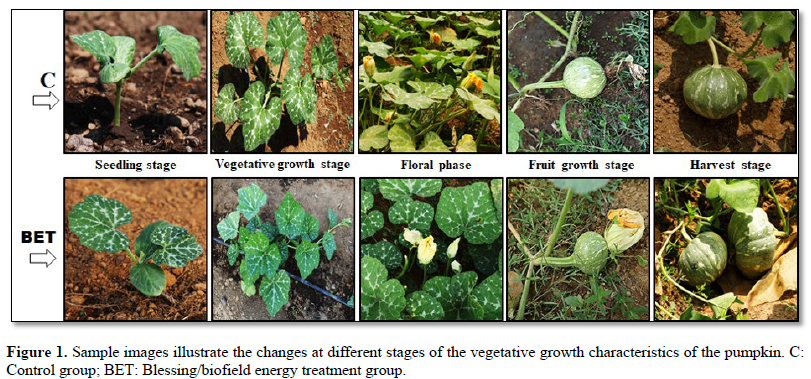
We documented the morphological characteristics of pumpkin (Cucurbita moschata) through systematic observations at defined intervals. The study tracked the complete phenological progression, from initial germination and the seedling phase through vegetative growth, floral initiation, fruit development, and the final harvest stage (Figure 1).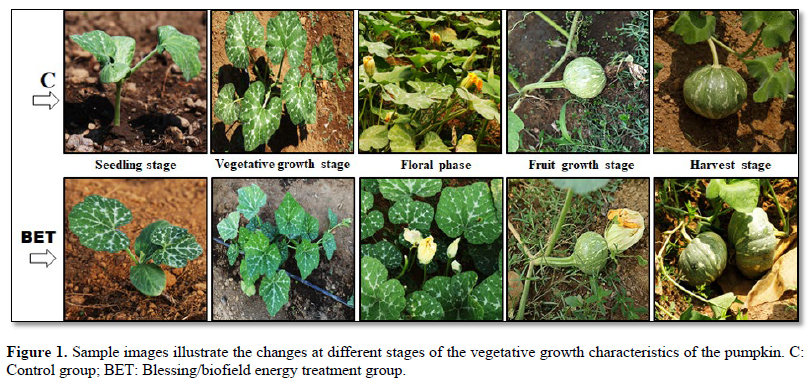
Morphological attributes
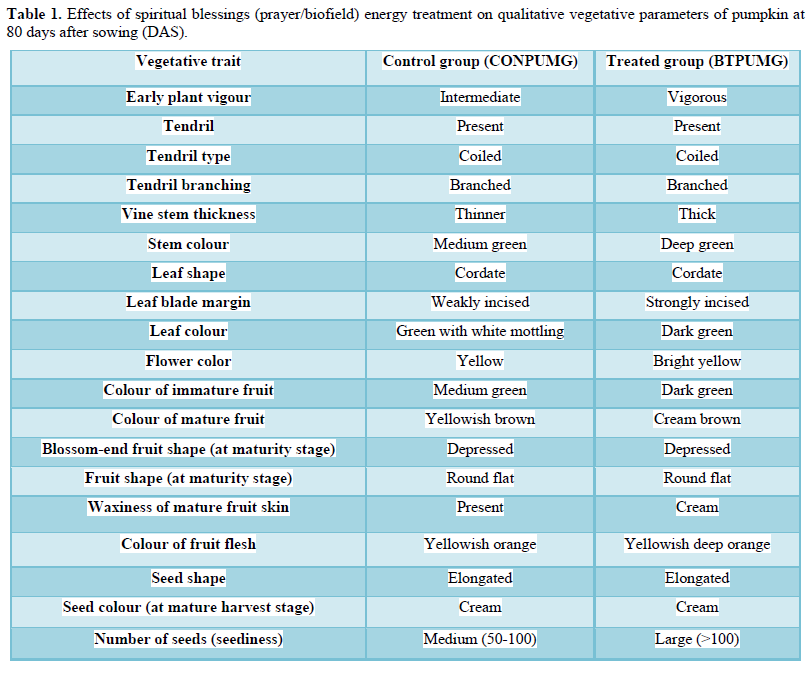
Morphological and vegetative traits were periodically evaluated throughout the cultivation period. The biofield energy-treated pumpkin group (BTPUMG) exhibited robust early plant vigour, enhanced vine stem thickness, and deep green stem pigmentation, whereas the control group (CONPUMG) displayed intermediate vigour, thinner stems, and medium green stems. Leaf morphology also varied distinctively between cohorts; the BTPUMG displayed uniformly dark green foliage with strongly incised blade margins, while the CONPUMG presented green leaves featuring white mottling and weakly incised margins. Additionally, reproductive and fruit phenotypic traits showed heightened coloration in the treated group, evidenced by bright yellow flowers and dark green immature fruits, contrasting with the standard yellow flowers and medium green immature fruits observed in the CONPUMG. At maturity, distinct phenotypic variations were observed between the BTPUMG and CONPUMG groups. The fruit exocarp (skin) of BTPUMG exhibited a creamy brown color and a creamy texture, whereas CONPUMG fruits displayed a yellowish-brown color with distinct waxiness. Waxiness of mature fruit skin was present in the CONPUMG while it was creamy in nature in the BTPUMG. Mesocarp (flesh) coloration also differed, appearing deep yellowish-orange in BTPUMG compared to the lighter yellowish-orange of CONPUMG. Furthermore, seed quantity per fruit varied significantly: BTPUMG fruits exhibited high seed abundance (>100 seeds), while CONPUMG fruits maintained a moderate range (50–100 seeds). No significant morphological alterations were observed between the two groups regarding tendril, tendril type, and tendril branching, leaf shape, fruit shape (at both the blossom-end and mature stages), or mature seed shape and coloration (Table 1).
Phenological and yield-related attributes
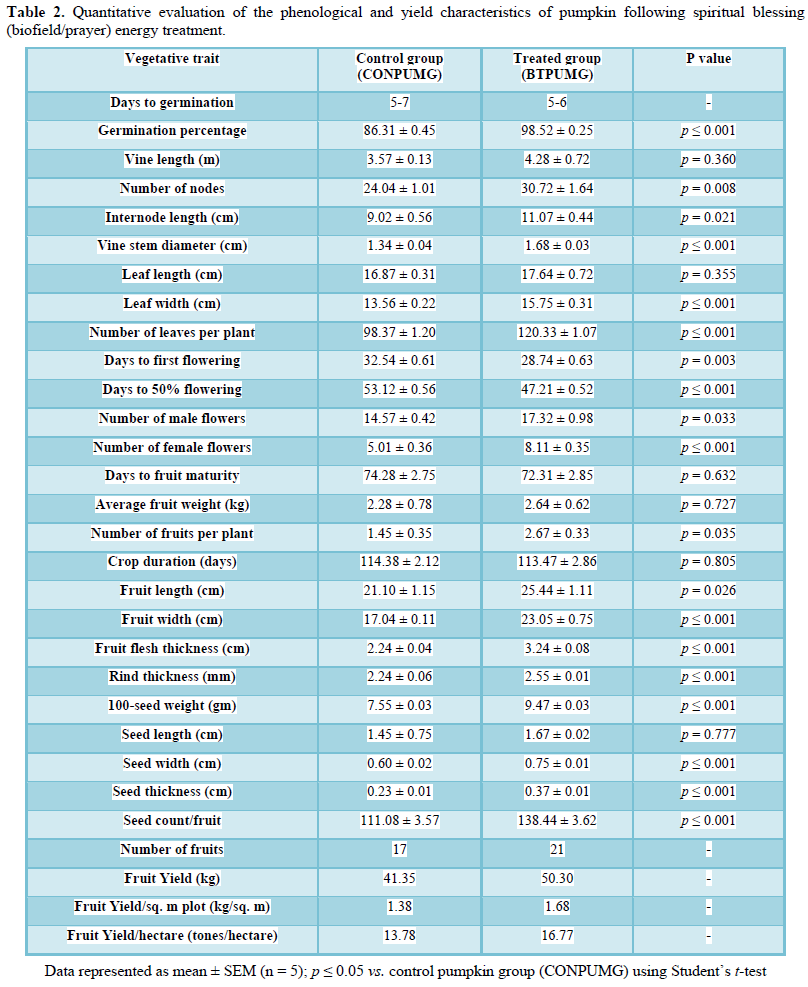
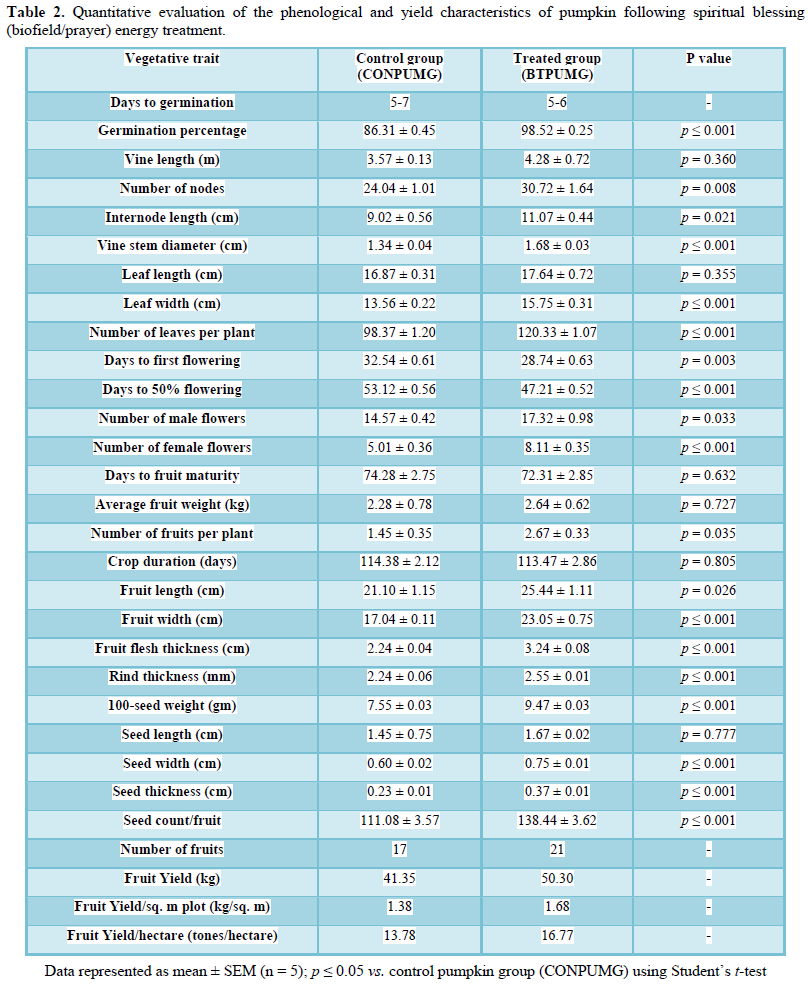
The germination rate exhibited a highly significant enhancement of 14.15% (p ≤ 0.001) in BTPUMG over the control, CONPUMG. Phenotypic structural traits, namely node number, internodal length, and vine stem diameter, demonstrated significant increments of 27.79% (p = 0.008), 22.73% (p = 0.021), and 25.37% (p ≤ 0.001), respectively, under BTPUMG treatment relative to control. Concurrently, vital parameters governing photosynthetic capacity, including leaf number per plant and leaf width, surged by 22.32% (p ≤ 0.001) and 16.15% (p ≤ 0.001), respectively, in BTPUMG versus CONPUMG. Reproductive ontogeny accelerated, as the days to first flowering and days to 50% flowering were prominently reduced by 11.68% (p = 0.003) and 11.13% (p ≤ 0.001), respectively, following BTPUMG application compared to CONPUMG. The number of male and female flowers rose by 18.87% (p = 0.033) and 61.88% (p ≤ 0.001), respectively. Among fruit parameters, significant increases were observed in number of fruits per plant (84.14%, p = 0.035), fruit length (20.57%, p = 0.026), fruit width (35.27%, p ≤ 0.001), flesh thickness (44.64%, p ≤ 0.001), and rind thickness (13.84%, p ≤ 0.001). All evaluated seed traits including 100-seed weight (25.43%, p ≤ 0.001), seed width (25.00%, p ≤ 0.001), seed thickness (60.87%, p ≤ 0.001), and seed count per fruit (24.63%, p ≤ 0.001) were similarly elevated. These improvements culminated in a 21.70% expansion in total fruit yield (t ha⁻¹) (Table 2).
DISCUSSION
The experimental results demonstrate that the application of SBET markedly alters the vegetative, floral, and structural profiles of the BTPUMG plant (Cucurbita spp.) compared with the untreated control (CONPUMG). The significant enhancement in the seed germination rate underscores the initial metabolic efficacy of the BTPUMG treatment. This accelerated development at the earliest growth stage aligns with findings by Yin et al. 2025, reported that optimized organic treatments radically activate essential soil nutrients, improve root-zone environmental health, and elevate early-stage nutrient absorption and crop assimilation [9]. Following successful establishment, the architectural development of the pumpkin vines under the BTPUMG regime showed highly synchronized architectural increments. The significant expansions in stem node numbers, internodal length, and vine stem diameter, highlight enhanced cell elongation and tissue accumulation. These structural transformations corroborate the investigations of Yin et al. 2025. They demonstrated that structured organic nutrition significantly impacts pumpkin vine extension and stem diameter by reinforcing dry matter accumulation rates during critical vegetative growth phases. This robust structural framework provides the primary physical foundation needed to support superior canopy expansion and heavy reproductive sinks [9].
Concurrently, the physiological indicators governing photosynthetic capacity surged significantly under the BTPUMG treatment. The total leaf count per plant grew and the leaf width expanded, that increased the total green canopy area. Enhanced source capacity was fundamental for driving downstream reproductive yield; as evaluated by Chen et al. 2022 [10], escalating total leaf area and improving vegetative nutrient supply effectively boosts source capacity and phloem translocation efficiency. This physiological upgrade ensures an abundant supply of photoassimilates to support rapidly growing structural and reproductive sinks.
The transition from vegetative growth to reproductive ontogeny was notably accelerated by the BTPUMG formulation. Days to first flowering and days to 50% flowering were prominently reduced. This compressed chronological window before anthesis was accompanied by a dramatic change in flower distribution, with male and female flower counts raised. According to Chen et al. 2022, controlling the reproductive cycle duration and reinforcing sink strength are vital strategies for modifying the synthesis and distribution of carbohydrates. The sharp 61.88% increase in female flowers directly expands the total potential fruit count, effectively multiplying the overall yield capacity of the plant [10]. These changes directly translated into massive improvements in final fruit development and overall morphology. The final number of fruits per plant expanded by 84.14%, backed by significant dimensional increases in fruit length, fruit width, flesh thickness, and rind thickness. This profound shift in fruit geometry and tissue thickness reflects a highly efficient allocation of resources to the developing fruits. As established by El-Hamed and Elwan (2011), total fruit counts, individual fruit sizes, and mean fruit weights were highly dependent parameters that dictate marketable pumpkin output, where optimized nutrient availability successfully offsets typical competitive stress among closely clustered fruit sinks [11].
Finally, the downstream transport of carbohydrates under SBET in the BTPUMG supported a comprehensive expansion of all seed traits. These substantial adjustments in embryo and seed coat dynamics demonstrate that nutrient supply remained optimal throughout the entire reproductive lifecycle. Collectively, these improvements in vegetative vigor, floral density, and individual fruit mass culminated in an expansion in total fruit yield (t/ha), confirming that BTPUMG acts as an efficient modulator of source-sink relationships in pumpkin cultivation.
CONCLUSION
In conclusion, Blessing/Biofield (prayer) Energy Treatment acts as a highly effective growth promoter and yield enhancer. It triggered early crop maturity, optimized reproductive sex expression in favor of fruit-bearing female flowers, and maximized photo-assimilate distribution to the fruits. This treatment holds substantial commercial and agronomic value for optimizing production efficiency in this crop species.
ABBREVIATIONS
SBET: spiritual blessing (biofield) energy treatment; CONPUMG: control pumpkin group; BTPUMG: biofield energy-treated pumpkin group; SSP: single super phosphate; MOP: muriate of potash
ACKNOWLEDGEMENT
The authors are grateful to Divine Connection Foundation for the assistance and support during the work.
CONFLICT OF INTERESTS
Author DT was employed by Trivedi Global, Inc. TBG, NRP, and VDK were employed by Shree Angarsiddha Shikshan Prasarak Mandal’s College of Agriculture, Sangulwadi, Mohitewadi, Maharashtra, India. Authors SM and SJ were employed by Trivedi Science Research Laboratory Pvt. Ltd.
FUNDING
The authors declare that no funds, grants, or other support were received during the preparation of this manuscript.
-
Nofianti T, Hidayati ND, Nurviana V, Ruswanto R, Yunda LR. Ethanol extract activity of yellow pumpkin flesh (Cucurbita moschata Duch) on the cataract formation. Conference: 2nd Bakti Tunas Husada-Health Science International Conference (BTH-HSIC 2019), Advances in Health Sciences Research,2020;26:118-123. https://doi.org/10.2991/ahsr.k.200523.029
-
Li Q, Zhang L, Chen P, Wu C, Zhang H, Yuan J, Zhou J, Li X. Genome-wide identification of APETALA2/ETHYLENE RESPONSIVE FACTOR transcription factors in Cucurbita moschata and their involvement in ethylene response. Frontiers in Plant Science, 2022;13:847754. https://doi.org/10.3389/fpls.2022.847754
-
Branton A, Trivedi MK, Trivedi D, Phutankar NR, Gaikwad TB, Kadam VD, Mondal S, Jana S. Blessing (biofield) energy treatment (BET) for superior growth and yield of bitter gourd. International Journal of Agricultural Research and Review, 2026;14(2):20-26. https://doi.org/10.54978
-
Trivedi D, Trivedi MK, Branton A, Phutankar NR, Kadam VD, Gaikwad TB, Mondal S, Jana S. Impact of blessing/biofield energy treatment (BET) on the vegetative growth, phenology, and yield of eggplant (Solanum melongena L.). International Journal of Plant Research, 2026;141:1-7. https://doi.org/10.5923/j.plant.20261401.01
-
Trivedi MK, Phutankar NR, Kadam VD, Gaikwad TB, Mondal, S, Jana S. Exploring the role of spiritual blessing energy treatment in enhancing growth and yield of bottle gourd (Lagenaria siceraria L.). Journal of Agricultural Economics, Extension and Rural Development, 2026;14(3):13-20. https://doi.org/10.54978/jaeerd
-
Nadig A, Jois SN, Prasad KN, Vinu V. Impact of pranic agriculture on germination and protein content of green gram (Vigna radiata). Indian Journal of Agricultural Research, 2021;55(3):369-373. https://doi.org/10.18805/IJARe.A-5508
-
Prasad KN, Vinu V, Jois SN. Application of pranic agriculture to improve growth and yield of banana (Musa sp. var. Nanjangud Rasa Bale)-A comparative field trial. Agricultural Science Digest, 2024;44(5):916-921. https://doi.org/10.18805/ag.D-5789
-
Richer-de-Forges AC, Arrouays D, Chen S, Dobarco MR, Libohova Z, Roudier P, Minasny B, Bourennane H. Hand-feel soil texture and particle-size distribution in central France. Relationships and implications, CATENA, 2022;213:106155. https://doi.org/10.1016/j.catena.2022.106155
-
Yin M, Zhang J, Du L, Ding L, Zhong T, Tian P, Yang R. Effects of irrigation and organic fertilizer on pumpkin yield, quality, and water-fertilizer use efficiency in arid northwest China. Frontiers in Plant Science,2025;16:1517761. https://doi.org/10.3389/fpls.2025.1517761
-
Chen C, Wu XM, Pan L, Yang YT, Dai HB, Hua B, Miao MM, Zhang ZP. Effects of exogenous α-Naphthaleneacetic acid and 24-Epibrassinolide on fruit size and assimilate metabolism-related sugars and enzyme activities in giant pumpkin. International Journal of Molecular Sciences, 2022;23(21):13157. https://doi.org/10.3390/ijms232113157
-
Abd El-Hamed KE, Elwan M. Dependence of pumpkin yield on plant density and variety. American Journal of Plant Sciences, 2011;02:636-643. https://doi.org/10.4236/ajps.2011.25075
-
 Table 1
 -
Table 2
QUICK LINKS
- SUBMIT MANUSCRIPT
- RECOMMEND THE JOURNAL
-
SUBSCRIBE FOR ALERTS
RELATED JOURNALS
- Journal of Rheumatology Research (ISSN:2641-6999)
- Journal of Oral Health and Dentistry (ISSN: 2638-499X)
- Journal of Carcinogenesis and Mutagenesis Research (ISSN: 2643-0541)
- International Journal of Diabetes (ISSN: 2644-3031)
- International Journal of Radiography Imaging & Radiation Therapy (ISSN:2642-0392)
- Journal of Nursing and Occupational Health (ISSN: 2640-0845)
- Archive of Obstetrics Gynecology and Reproductive Medicine (ISSN:2640-2297)