

| Mônica Andréa Probst*, Márcio Hiroaki Kume, Edson Peracchi and Carmen Austrália Paredes Marcondes Ribas |
| Corresponding Author: Mônica Andréa Probst, 80250-190, Iguassu Avenue, 1236, Brazil. |
| Received: October 19, 2026; Revised: October 22, 2026; Accepted: October 23, 2026 Available Online: October 24, 2026 |
| DOI: doi.org/10.5281/zenodo.23765602 |
| Citation: Probst MA, Kume MH, Peracchi E & Ribas CAPM. (2026) VITAL: A Five-Domain Classification of Host-Tissue Regenerative Reserve in Regenerative Gynecology. Stem Cell Res Ther, 9(1): 284-293. |
| Copyrights: ©2026 Probst MA, Kume MH, Peracchi E & Ribas CAPM. This is an open-access article distributed under the terms of the Creative Commons Attribution License, which permits unrestricted use, distribution, and reproduction in any medium, provided the original author and source are credited. |
| Share : |
37
Views & Citations10
Likes & Shares
Development. VITAL was derived by conceptual reasoning from Paget’s “seed and soil” principle, the oestrogen-dependent physiology of wound healing, the biology of radiation injury and pelvic senescence, and the inconsistencies observed in sham-controlled trials in regenerative gynecology. It was built to complement, not replace, the VAGINA-R phenotype model and the GRACE evidence classification previously proposed by the authors.
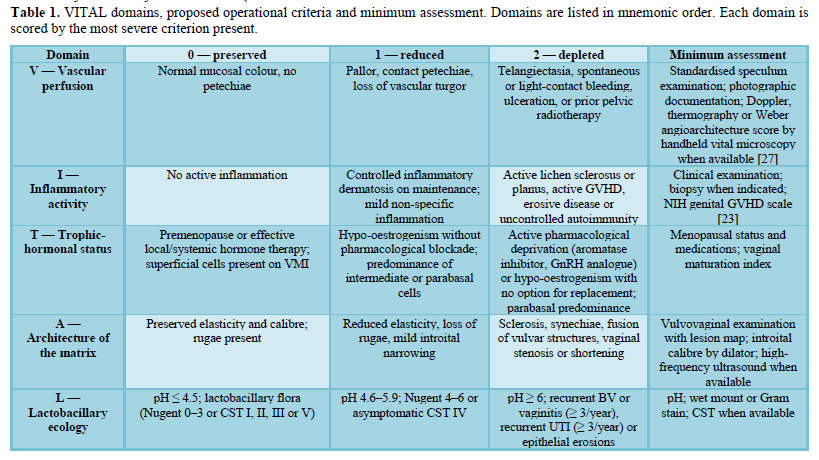
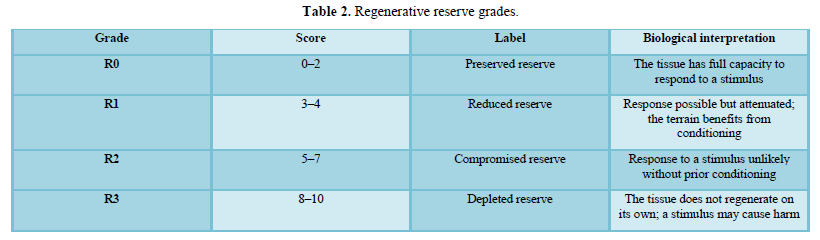
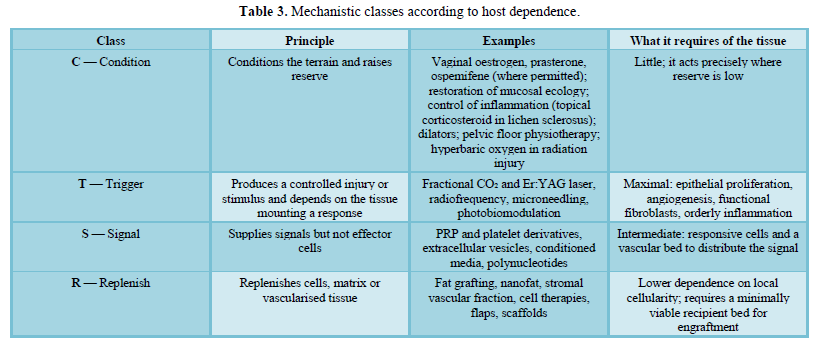
The framework. Five domains form the mnemonic VITAL: Vascular perfusion, Inflammatory activity, Trophic-hormonal status, Architecture of the extracellular matrix and Lactobacillary ecology. The mnemonic is deliberate: it asks whether the tissue is still vital enough to regenerate. Each domain is scored from 0 (preserved) to 2 (exhausted), giving a total of 0–10 and four reserve grades: R0 preserved, R1 reduced, R2 compromised and R3 depleted, with a mandatory override rule for the ischaemic-fibrotic pattern. Three modifiers record iatrogenic exposure (x), senescence and duration of deprivation (s), and systemic metabolic-vascular load (m). In parallel, interventions are re-classified by their dependence on the host into four mechanistic classes: C (Condition the terrain), T (Trigger a host response), S (Signal) and R (Replenish cells and matrix). The terrain–mechanism compatibility principle predicts that the efficacy of classes T and S declines as reserve falls, and that R2–R3 terrains must be conditioned (class C) or replenished (class R) before any stimulus.
Application. Re-reading published trials through VITAL shows that null results of laser in breast cancer survivors receiving aromatase inhibitors, and of platelet-rich plasma in active lichen sclerosus, are compatible with terrain–mechanism mismatch — a hypothesis that cannot be confirmed retrospectively and requires prospective testing.
Conclusion. VITAL shifts the clinical question from “which technology should be used?” to “can this tissue respond to this technology now?”. Four testable hypotheses and a four-phase validation programme are proposed before any routine clinical use.
Keywords: regenerative gynecology; regenerative reserve; genitourinary syndrome of menopause; vaginal laser; platelet-rich plasma; fat grafting; radiation injury; classification; precision medicine.
Abbreviations: BV, bacterial vaginosis; CST, community state type; FSFI, Female Sexual Function Index; GSM, genitourinary syndrome of menopause; GVHD, graft-versus-host disease; HSCT, haematopoietic stem cell transplantation; PRP, platelet-rich plasma; SASP, senescence-associated secretory phenotype; UTI, urinary tract infection; VHI, Vaginal Health Index; VMI, vaginal maturation index.
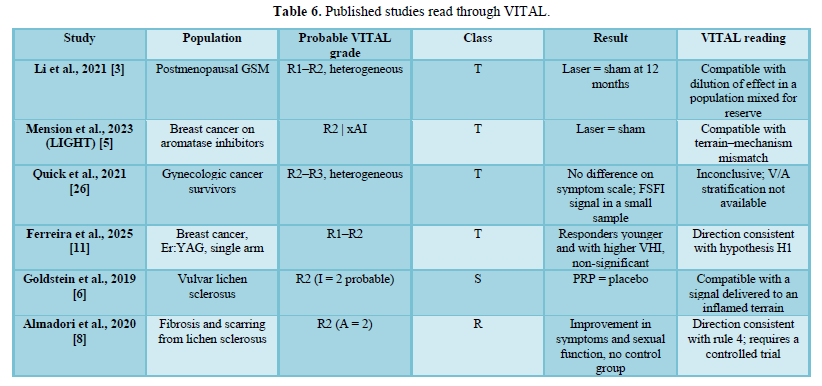
The clinical results of these interventions are strikingly inconsistent. For CO₂ laser in GSM, seven double-blind sham-controlled trials including 401 unique participants did not show a statistically significant advantage over sham [2]. The largest single trial, with 12 months of follow-up, found no difference in symptoms, quality of life or vaginal histology between laser and sham [3], and the 2025 AUA/SUFU/AUGS guideline concluded that the evidence does not demonstrate efficacy of energy-based therapies for any GSM symptom [4]. In breast cancer survivors receiving aromatase inhibitors, the LIGHT trial showed a 5.2-point improvement in the Female Sexual Function Index (FSFI) with laser versus 7.9 points with sham, with no significant difference [5]. In vulvar lichen sclerosus, the only double-blind placebo-controlled trial of PRP found histological improvement in 5 of 19 treated patients and in 5 of 10 controls (p = 0.542) [6].
At the same time, uncontrolled cohorts and smaller trials report meaningful improvement with the same technologies [7,8], and meta-analyses of laser versus vaginal oestrogen find similar results between arms [9]. The literature has tried to explain this heterogeneity through differences in device settings, product preparation or study design. In previous work we proposed two tools: VAGINA-R, a phenotype model based on the premise that women with GSM are not biologically homogeneous, and GRACE (Gynecologic Regenerative Axis Classification of Evidence), a five-axis classification coding anatomical compartment, clinical-biological phenotype, intervention, evidence maturity and anchor outcome [10].
These tools answer three questions: what the patient has, what is being applied and how solid the evidence is. They do not answer a fourth question that precedes the others: is this patient’s tissue capable, at this moment, of mounting the response that the intervention requires? The search for predictors of response illustrates the gap. A review of laser for incontinence and GSM refers to the tissue’s “collagen remodelling capacity” but records that predictive factors for the ideal CO₂ laser candidate were not identified [7]. In an Er:YAG study in breast cancer survivors, responders were younger at diagnosis (47.7 vs 59.7 years) and had a higher baseline Vaginal Health Index (VHI) (12.33 vs 9.33), without statistical significance in a small sample [11]. The signals exist, but there is no language to organise them.
This article proposes that language. VITAL grades the regenerative reserve of the vulvovaginal tissue terrain and crosses it with a re-classification of interventions according to how much they depend on the host. As far as we could determine from searches of the indexed literature and open sources, no published classification in regenerative gynecology addresses this object.
CONCEPTUAL BASIS: SEED, SOIL AND REGENERATION
Paget’s analogy
In 1889, Stephen Paget proposed that the distribution of breast cancer metastases depended on both the “seed” (the tumour cell) and the “soil” (the receiving organ) [12]. The analogy became one of the most enduring concepts in oncology. We propose applying it, in an inverted and therapeutic sense, to regenerative gynecology: the intervention is the seed and the vulvovaginal tissue is the soil. An excellent seed sown in barren soil does not germinate; an average seed in fertile soil may succeed.
Every regenerative intervention asks something of the tissue
Fractional laser produces controlled thermal microinjuries and relies on the tissue to initiate orderly inflammation, angiogenesis, epithelial proliferation and collagen synthesis. A study of fractional CO₂ laser showed increased collagen, elastic fibres and hyaluronic acid in the lamina propria, and a correlation between collagen gain and telomere lengthening in epithelial cells (r = 0.82) [13], suggesting that the response tracks the proliferative capacity of the epithelium. PRP provides growth factors but not the cells that respond to them. A meta-analysis of vaginal wound healing showed that basic fibroblast growth factor stimulates proliferation in vitro, and its authors noted that postmenopausal status impairs vaginal healing, which complicates clinical translation [14].
Determinants of reserve
Five documented biological processes condition the response capacity of vulvovaginal tissue:
- Vascular perfusion (V). In radiation injury, obliterative endarteritis leads to hypoxia, fragile neovessels and progressive fibrosis, and late injury inhibits the ability of irradiated tissue to repair itself [20,21]. In an animal model, vaginal blood flow fell after radiotherapy and epithelial thickness decreased by more than 50% at 9 weeks [22].
- Inflammation and senescence (I). Markers of the senescence-associated secretory phenotype (SASP) can be quantified in vaginal secretions and are highest in postmenopausal women with prolapse [24]. Accumulated senescent fibroblasts reduce the homeostatic and regenerative capacity of pelvic tissue. Chronic inflammation, as in active lichen sclerosus or GVHD, disrupts vulvar architecture and creates a hostile milieu for repair [23].
- Trophic-hormonal status (T). Oestrogen deprivation is a major determinant of age-related impaired tissue repair, and topical or systemic oestrogen reverses this defect in humans [15,16]. In skin, thickness falls by about 1.13% and collagen by about 2% per postmenopausal year [16]. Oestrogen stimulates collagen type I and III synthesis in pelvic floor fibroblasts through the oestrogen receptor-α pathway and exerts anti-senescence effects on pelvic connective tissue [17].
- Architecture of the matrix (A). Fibrosis, sclerosis and loss of elasticity physically alter the substrate in which regeneration should occur, as in cicatricial lichen sclerosus, graft-versus-host disease (GVHD) and post-radiation stenosis [20,23].
- Lactobacillary ecology (L). The vaginal microbiome is organised into community state types (CSTs), four dominated by Lactobacillus and one (CST IV) with higher diversity and higher pH [18]. Vaginal ageing combines dysbiosis, epithelial thinning, fibroblast activation, matrix remodelling and chronic inflammation; in 913 women, epithelial thickness fell by 47.3% across age groups [19].
These determinants are already measured separately in clinical practice (pH, vaginal maturation index, VHI, vulvar examination, radiotherapy history), but they have never been combined into a single reserve scale or linked to the choice of therapeutic mechanism.
DEVELOPMENT METHODS
VITAL is a conceptual proposal by the authors, not a consensus. It was developed in four steps:
- Problem identification, based on two prior syntheses by the authors (an umbrella review of regenerative and energy-based interventions in gynecology, and a comparative matrix of hormonal therapy versus regenerative interventions for GSM) and on the development of VAGINA-R and GRACE [10].
- Targeted narrative review of five fields: oestrogen physiology of healing, the vaginal microbiome, pelvic radiation injury, cicatricial vulvar diseases (lichen sclerosus and GVHD), and sham- or placebo-controlled trials in regenerative gynecology.
- Domain selection by three criteria: biological plausibility as a determinant of tissue response, measurability with office resources, and relative independence between domains.
- Preliminary operational definition of each level (0, 1, 2), deliberately based on instruments already in use to facilitate adoption and future calibration by Delphi consensus.
No patient data were collected. All cut-off points are proposed for validation and should be regarded as provisional.
THE VITAL CLASSIFICATION
General structure
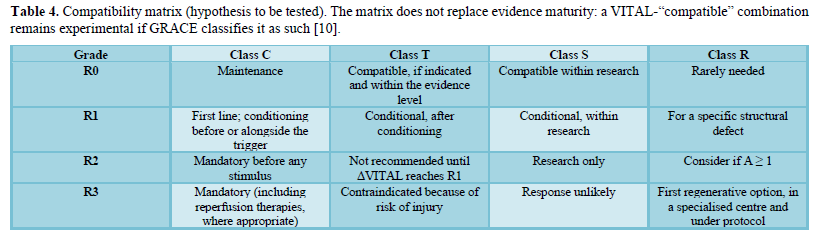
VITAL has two arms: grading of the terrain (five domains, total score, grade and modifiers) and mechanistic classification of interventions (four classes according to host dependence). Crossing the two arms produces a compatibility matrix.
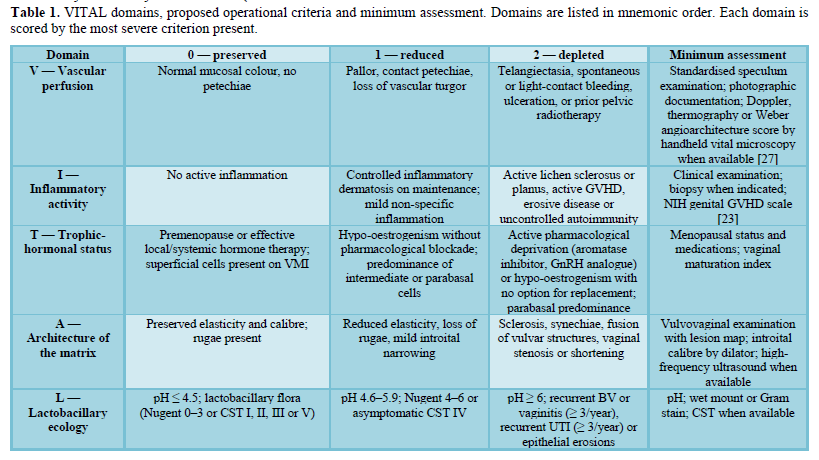
The five domains
The five domains were chosen first on biological grounds (Section 2.3) and then named so that their initials form an English word that carries the clinical question itself: is the tissue still VITAL enough to regenerate? Each initial corresponds to the standard English term already used in the literature for that determinant.
The separation between V and A is intentional. Perfusion and matrix deteriorate together in radiation injury, but they can dissociate: cicatricial lichen sclerosus may show a depleted matrix with relatively preserved perfusion, and advanced hypo-oestrogenism may reduce perfusion before architecture is altered.
Scoring and grades
The sum of the domains ranges from 0 to 10.
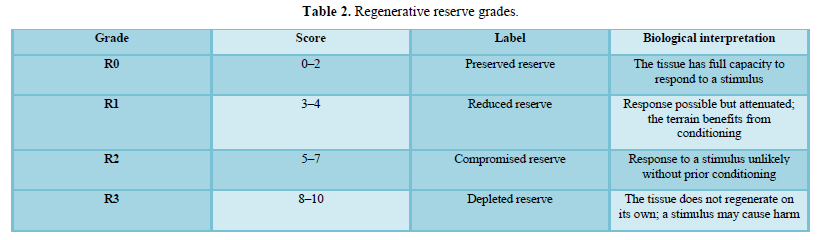 Mandatory override rule (ischaemic-fibrotic pattern). When V = 2 and A = 2 simultaneously, the terrain is classified as R3 regardless of the total score. The rule exists because the combination of ischaemia and fibrosis is the setting in which an ablative stimulus is most likely to produce ulceration or necrosis rather than repair [20,21].
Modifiers
Modifiers do not change the score, but they are recorded because they change interpretation, risk and stratification in research.
- x — iatrogenic exposure, with type specified: xRT (pelvic radiotherapy or brachytherapy), xAI (aromatase inhibitor), xCT (gonadotoxic chemotherapy), xHSCT (haematopoietic stem cell transplantation), xSURG (prior vaginal surgery or mesh).
- s — senescence and duration of deprivation: age ≥ 65 years or more than 10 years since menopause without hormone therapy.
- m — systemic metabolic-vascular load: diabetes with HbA1c ≥ 8%, active smoking, vasculopathy, chronic immunosuppression.
Notation
The VITAL code records each domain, the sum, the grade and the modifiers:
VITAL [V·I·T·A·L] = sum → grade | modifiers
Example: a breast cancer survivor on an aromatase inhibitor, with pH 6.2, pallor and petechiae, loss of rugae and no active dermatosis is coded as VITAL [1·0·2·1·2] = 6 → R2 | xAI.
Domain scores are written as “V = 2” rather than “V2” to avoid confusion with the ESHRE/ESGE vaginal anomaly sub-classes V0–V4.
Dynamic reserve: ΔVITAL
Reserve is not a fixed trait. VITAL should be re-applied after each therapeutic phase. The difference between two assessments (ΔVITAL) measures the effect of terrain conditioning and defines the regenerative window: the point at which the tissue has sufficient reserve to receive a class T or S intervention. We propose as an operational target a reduction of at least 2 points or a shift to R1 or R0.
MECHANISTIC CLASSIFICATION OF INTERVENTIONS
Existing classifications group interventions by technology or product. VITAL regroups them by what each one demands of the tissue. Each class is named with a plain English verb describing what the intervention does to the terrain: it Conditions, Triggers, Signals or Replenishes (C–T–S–R).
Class S is deliberately separated from class R. Both are called “biologics” in practice, but PRP depends entirely on host cells to act, whereas a fat graft brings stromal cells and matrix with it. This distinction offers a hypothesis for why cicatricial tissue may respond to fat and not to platelets.
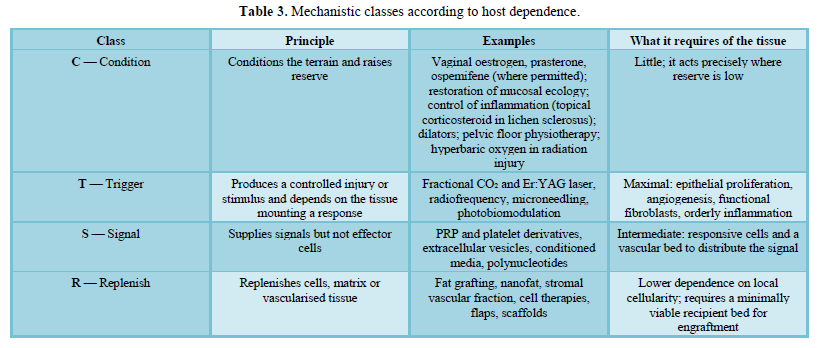 The terrain–mechanism compatibility principle
The core of the proposal is a simple rule: the lower the reserve, the less one should depend on the tissue and the more one should condition or replenish it.
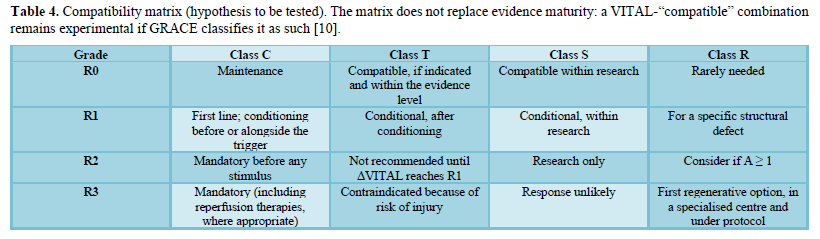
Four clinical rules follow from the matrix:
- Grade before treating. No class T, S or R intervention should be indicated without a recorded VITAL code.
- Condition before triggering. In R1 and R2, phase C comes first, with reassessment at 8–12 weeks.
- Do not trigger a depleted terrain. In R3, class T interventions are contraindicated.
- Replenish when the tissue cannot produce. When A = 2, class R precedes class S.
RELATIONSHIP WITH VAGINA-R AND GRACE
The three tools answer different questions and are designed to be used together.

There is apparent overlap between VITAL domains and VAGINA-R/GRACE phenotypes, for example in the hormonal and microbial components. The difference lies in function: in VAGINA-R, hypo-oestrogenism is a diagnostic target, the mechanism causing the symptom; in VITAL, it is a determinant of response, the condition limiting what the tissue can do. The same patient may have a dominant algesic phenotype in VAGINA-R and R2 reserve in VITAL. The first piece of information defines what to treat; the second defines in what order and with which type of mechanism.
In practice, a complete case record combines the three codes: phenotype (VAGINA-R / GRACE Axis P), terrain (VITAL), and intervention with its maturity level (GRACE).
ILLUSTRATIVE APPLICATIONS
The cases below are illustrative and do not represent real patients.
Case 1 — Natural GSM, salvageable terrain. A 56-year-old woman, four years postmenopausal, not on hormone therapy, with dryness and dyspareunia; pH 5.4, predominance of intermediate cells, mild pallor, reduced rugae, no dermatosis.
Code: VITAL [1·0·1·1·1] = 4 → R1.
Compatible management: phase C with vaginal oestrogen for 12 weeks, then reassessment; if the patient still wishes a class T intervention after partial response, consider it only under protocol, according to the GRACE level.
Case 2 — Breast cancer survivor on an aromatase inhibitor. A 49-year-old woman, pH 6.2, pale mucosa with petechiae, loss of rugae, no dermatosis.
Code: VITAL [1·0·2·1·2] = 6 → R2 | xAI.
Compatible management: non-hormonal phase C, or low-absorption local hormonal therapy subject to shared oncological decision; restoration of mucosal ecology; dilators and pelvic floor physiotherapy. Laser not recommended until ΔVITAL reaches R1. The LIGHT trial, conducted in exactly this population, found no benefit of laser over sham [5].
Case 3 — Sequelae of pelvic radiotherapy. A 52-year-old woman, five years after chemoradiation and brachytherapy for cervical cancer, with telangiectasia, contact bleeding, vaginal shortening and stenosis.
Code: VITAL [2·0·2·2·1] = 7 → R3 (ischaemic-fibrotic override) | xRT, xCT.
Compatible management: class T contraindicated; phase C with dilators and, when available and indicated, reperfusion therapy; class R (fat grafting) as the first regenerative option in a specialised centre. The use of lipoaspirate for radiation tissue damage has clinical precedent in plastic surgery [25].
Case 4 — Vulvar lichen sclerosus. A 61-year-old woman with biopsy-proven lichen sclerosus, active inflammation, partial fusion of the labia minora and clitoral burying.
Code in the active phase: VITAL [1·2·1·2·0] = 6 → R2.
Compatible management: phase C with topical corticosteroid until control (I falls to 1); then, if cicatricial sequelae persist with A = 2, consider class R under protocol. Class S in active disease is, according to the matrix, incompatible — consistent with the negative PRP trial [6] and with the favourable, still uncontrolled, signals of fat grafting for fibrosis in lichen sclerosus [8].
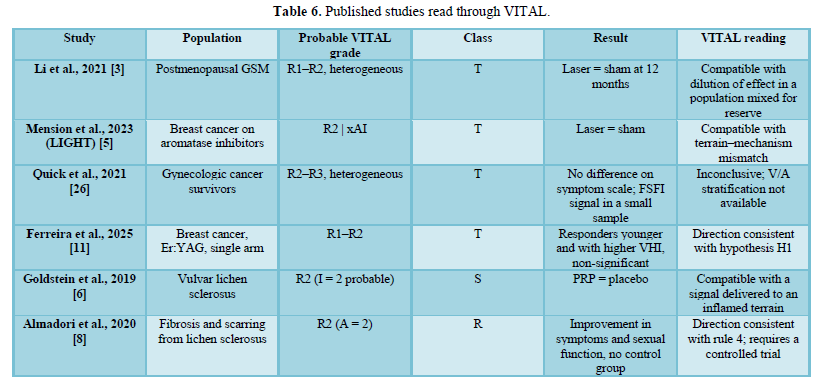
EXPLORATORY RE-READING OF THE LITERATURE
To test the internal coherence of the proposal, we approximately re-classified the populations of published studies based on their eligibility criteria and reported baseline characteristics. This is an interpretive exercise without individual patient data and is subject to hindsight bias; it does not constitute evidence in favour of VITAL.
The re-reading suggests that part of the heterogeneity attributed to device settings or products may reflect unmeasured heterogeneity of the terrain. It also exposes the risk of the proposal: any null result could be explained afterwards as a mismatch. For this reason, VITAL will only be of value if its predictions are specified before the data, as in the following section.
Testable hypotheses
- H1 — Reserve × mechanism interaction. In sham-controlled trials of class T interventions, the effect relative to sham will be greater in R0–R1 than in R2–R3 (significant interaction between VITAL grade and treatment arm).
- H2 — Terrain conditioning. Patients who achieve ΔVITAL ≥ 2 points after phase C will have a higher rate of clinically relevant response to a class T or S intervention than patients without conditioning.
- H3 — Replenishment in a depleted matrix. When A = 2, class R interventions will produce greater and more durable improvement in elasticity and calibre than class S interventions.
- H4 — Safety. The frequency of local adverse events after class T interventions will be higher in R3 than in R0–R2.
VALIDATION PROGRAMME
Phase 1 — Modified Delphi consensus. An international panel of gynecologists, urogynecologists, oncologists, radiation oncologists, vulvar dermatologists and methodologists, over at least two rounds, with ≥ 70% agreement required to retain each domain, criterion and cut-off point.
Phase 2 — Reliability. Independent assessment by two examiners blinded to each other, in a consecutive sample including all four grades; proposed targets of an intraclass correlation coefficient ≥ 0.75 for the total score and a weighted kappa ≥ 0.60 for each domain.
Phase 3 — Construct validity. Correlation of the VITAL score with independent measures of reserve: epithelial and lamina propria thickness by high-frequency ultrasound, microvascular and collagen density on biopsy, perfusion by Doppler and, in an exploratory sub-study, SASP markers in vaginal secretions [24].
Phase 4 — Predictive validity. (a) Secondary analysis, with individual patient data, of published sham-controlled trials, where baseline variables allow the domains to be reconstructed; (b) a prospective cohort with prior registration of hypotheses H1–H4 and stratification of randomisation by VITAL grade in trials of class T, S and C interventions. Because interaction tests require substantially larger samples than main-effect tests, a multicentre study or prospective meta-analysis is recommended.
Until Phases 1 and 2 are completed, VITAL should be used only as a research and reporting instrument.
DISCUSSION
The central contribution of VITAL is to make explicit an assumption that regenerative gynecology has left implicit: that the treated tissue is capable of responding. This assumption is reasonable in a 52-year-old woman in early menopause and doubtful in a cancer survivor under pharmacological oestrogen deprivation or in a patient after pelvic irradiation. Yet trials commonly pool these populations under the same diagnosis, and protocols commonly apply the same technology, with the same settings, to biologically opposite terrains.
The proposal has three practical implications. The first is sequential: the question is no longer “laser or PRP?” but “condition, trigger, signal or replenish?”. The second concerns safety: the ischaemic-fibrotic rule and the contraindication of triggering in R3 protect precisely the patients most vulnerable to injury from excessive stimulation. The third is methodological: stratification by VITAL grade allows future trials to distinguish absence of effect from a diluted effect.
VITAL also offers a different reading of the so-called sham gradient — the shrinkage of effect as the control becomes more rigorous — described in our umbrella review [10]. Part of this gradient is undoubtedly explained by placebo response, regression to the mean and measurement bias. VITAL adds a complementary and testable explanation: larger and more rigorous trials tend to include populations more heterogeneous in reserve, in which responders with preserved terrain are diluted by non-responders with compromised terrain.
It is important to state what VITAL does not do. It does not raise the evidence level of any intervention: a compatible combination remains experimental if GRACE classifies it as such. It does not authorise hormonal treatment in patients with an oncological contraindication; in such cases phase C should be non-hormonal or decided together with the oncology team. And it does not replace diagnosis: a patient with vestibular pain of neuromuscular origin does not benefit from a R0 terrain if the dominant problem is not tissue-related.
LIMITATIONS
VITAL was developed by a single author group without formal consensus. Cut-off points are provisional. Equal weighting of the five domains is a simplification: the V domain probably influences the response to class T interventions more than the L domain, and validation may lead to different weights. Some criteria depend on tests that are not universally available, such as CST determination and Doppler, which is why each domain has a minimum office-based version. The classification was designed for the vulvar and vaginal compartments; its extension to the endometrium and ovary, where the concept of reserve has different biological foundations, will require separate work. Finally, the literature re-reading is retrospective and approximate and cannot be used as evidence of validity.
CONCLUSION
VITAL proposes that, in regenerative gynecology, the tissue terrain be graded before the intervention is chosen, and that the intervention be chosen by what it demands of the tissue rather than by the technology it uses. Five domains (vascular perfusion, inflammatory activity, trophic-hormonal status, architecture of the matrix and lactobacillary ecology), four reserve grades and four mechanistic classes form a language that complements VAGINA-R and GRACE. The proposal generates falsifiable hypotheses and a validation programme; until that programme is completed, it should remain a research instrument.
DECLARATIONS
Author contributions. MAP: conceptualisation, coding rules and drafting. MAP and MHK: critical revision of the rules, checklist and manuscript. All authors approved the final version.
Conflicts of interest. None
Funding. This research received no specific grant from any funding agency.
Ethics approval. Not applicable: conceptual proposal without collection of patient data. Clinical cases are fictitious.
Data availability. Not applicable.
Originality statement. VAGINA-R and GRACE are previous, not yet validated, proposals by the same authors. The VITAL mnemonic, its domains and the C–T–S–R intervention classes are original to this proposal; the “seed and soil” analogy is attributed to Paget [12].
Use of artificial intelligence. An AI-based writing assistant was used to support drafting and language editing. The authors verified all statements and references against the primary sources and accept full responsibility for the content.- Portman DJ, Gass ML; Vulvovaginal Atrophy Terminology Consensus Conference Panel. Genitourinary syndrome of menopause: new terminology for vulvovaginal atrophy from the International Society for the Study of Women’s Sexual Health and the North American Menopause Society. Menopause. 2014;21(10):1063–1068. doi:10.1097/GME.0000000000000329. https://pubmed.ncbi.nlm.nih.gov/25160739/
- Li FG, Abbott J. Laser for genitourinary syndrome of menopause: what we know and what we need to know. Climacteric. 2025;28(4):414–422. doi:10.1080/13697137.2025.2455186. https://www.tandfonline.com/doi/full/10.1080/13697137.2025.2455186
- Li FG, Maheux-Lacroix S, Deans R, et al. Effect of fractional carbon dioxide laser vs sham treatment on symptom severity in women with postmenopausal vaginal symptoms: a randomized clinical trial. JAMA. 2021;326(14):1381–1389. doi:10.1001/jama.2021.14892. https://doi.org/10.1001/jama.2021.14892
- American Urological Association; Society of Urodynamics, Female Pelvic Medicine & Urogenital Reconstruction; American Urogynecologic Society. Genitourinary Syndrome of Menopause: AUA/SUFU/AUGS Guideline. 2025. https://www.auanet.org/guidelines-and-quality/guidelines/genitourinary-syndrome-of-menopause
- Mension E, Alonso I, Anglès-Acedo S, et al. Effect of fractional carbon dioxide vs sham laser on sexual function in survivors of breast cancer receiving aromatase inhibitors for genitourinary syndrome of menopause: the LIGHT randomized clinical trial. JAMA Netw Open. 2023;6(2):e2255697. doi:10.1001/jamanetworkopen.2022.55697. https://pubmed.ncbi.nlm.nih.gov/36763359/
- Goldstein AT, Mitchell L, Govind V, Heller D. A randomized double-blind placebo-controlled trial of autologous platelet-rich plasma intradermal injections for the treatment of vulvar lichen sclerosus. J Am Acad Dermatol. 2019;80(6):1788–1789. doi:10.1016/j.jaad.2018.12.060. https://pubmed.ncbi.nlm.nih.gov/30639885/
- Franić D, Fistonić I. Laser therapy in the treatment of female urinary incontinence and genitourinary syndrome of menopause: an update. Biomed Res Int. 2019;2019:1576359. doi:10.1155/2019/1576359. https://pmc.ncbi.nlm.nih.gov/articles/PMC6582847/
- Almadori A, Hansen E, Boyle D, et al. Fat grafting improves fibrosis and scarring in vulvar lichen sclerosus: results from a prospective cohort study. J Low Genit Tract Dis. 2020;24(3):305–310. doi:10.1097/LGT.0000000000000520. https://pubmed.ncbi.nlm.nih.gov/32205767/
- Jang YC, Leung CY, Huang HL. Comparison of severity of genitourinary syndrome of menopause symptoms after carbon dioxide laser vs vaginal estrogen therapy: a systematic review and meta-analysis. JAMA Netw Open. 2022;5(9):e2232563. doi:10.1001/jamanetworkopen.2022.32563. https://jamanetwork.com/journals/jamanetworkopen/fullarticle/2796567
- Kume MH, et al. GRACE — Gynecologic Regenerative Axis Classification of Evidence: a five-axis position framework in regenerative gynecology. Manuscript in preparation for the Journal of Stem Cell Research; 2026.
- Ferreira KST, Lopes GA, Barbosa LA, et al. Effectiveness of Erbium:YAG laser in the treatment of vulvovaginal atrophy in women who survived breast cancer. J Cosmet Dermatol. 2025;24(9):e70424. doi:10.1111/jocd.70424. https://pmc.ncbi.nlm.nih.gov/articles/PMC12426812/
- Paget S. The distribution of secondary growths in cancer of the breast. Lancet. 1889;133(3421):571–573. Historical context: https://link.springer.com/chapter/10.1007/978-0-387-69219-7_9
- Benitez-Roig V, Martínez-Carpio PA, Trelles MA, et al. Clinical and laboratory results in vaginal wall restoration using a fractional-pixel-CO₂ laser: histological findings and changes in the Ki67 protein and telomere length. Lasers Med Sci. 2023;38:206. doi:10.1007/s10103-023-03875-2. https://link.springer.com/article/10.1007/s10103-023-03875-2
- van Velthoven MJJ, Gudde AN, Struijs F, et al. The effect of growth factors on vaginal wound healing: a systematic review and meta-analysis. Tissue Eng Part B Rev. 2023;29(4):429–440. doi:10.1089/ten.teb.2022.0225. https://pmc.ncbi.nlm.nih.gov/articles/PMC10701546/
- Ashcroft GS, Dodsworth J, van Boxtel E, et al. Estrogen accelerates cutaneous wound healing associated with an increase in TGF-β1 levels. Nat Med. 1997;3(11):1209–1215. Reviewed in: https://pmc.ncbi.nlm.nih.gov/articles/PMC5713294/
- Thornton MJ. Estrogens and aging skin. 2013;5(2):264–270. doi:10.4161/derm.23872. https://pmc.ncbi.nlm.nih.gov/articles/PMC3772914/
- Wang L, Geng M, Wei L, et al. Multidimensional regulation of estrogen signaling in pelvic floor connective tissue homeostasis and remodeling. Front Immunol. 2026;17:1742246. doi:10.3389/fimmu.2026.1742246. https://www.frontiersin.org/journals/immunology/articles/10.3389/fimmu.2026.1742246/full
- Ravel J, Gajer P, Abdo Z, et al. Vaginal microbiome of reproductive-age women. Proc Natl Acad Sci USA. 2011;108(Suppl 1):4680–4687. doi:10.1073/pnas.1002611107. https://www.pnas.org/doi/pdf/10.1073/pnas.1002611107
- Wu T, Huang Y, Li R, et al. Vaginal aging: from concealed symptoms to defined biomarkers. npj Aging. 2026;12(1):104. doi:10.1038/s41514-026-00404-7. https://pmc.ncbi.nlm.nih.gov/articles/PMC13434604/
- Fijardo M, Kwan JYY, Bissey PA, et al. The clinical manifestations and molecular pathogenesis of radiation fibrosis. eBioMedicine. 2024. https://www.thelancet.com/journals/ebiom/article/PIIS2352-3964(24)00124-5/fulltext
- Alberta Health Services. Hyperbaric oxygen therapy for late radiation therapy tissue injury (gynecologic). Clinical guidance. https://www.albertahealthservices.ca/assets/info/hp/cancer/if-hp-cancer-guide-gyne003-hbot-for-lrti.pdf
- Peters B, Powers SA, Burleson LK, et al. Preclinical female model of urogenital dysfunction and pathophysiological changes after pelvic radiation therapy. 2024;16(8):e66374. doi:10.7759/cureus.66374. https://pmc.ncbi.nlm.nih.gov/articles/PMC11379420/
- Jagasia MH, Greinix HT, Arora M, et al. National Institutes of Health consensus development project on criteria for clinical trials in chronic graft-versus-host disease: I. The 2014 Diagnosis and Staging Working Group report. Biol Blood Marrow Transplant. 2015;21(3):389–401. Genital scale reviewed in: https://pmc.ncbi.nlm.nih.gov/articles/PMC8504929/
- Sawyer P, Shi H, Keller P, et al. Quantification of senescence-associated secretory phenotype proteins in the vaginal secretions of pre- and postmenopausal women with and without prolapse. Aging Med. 2023;6:124–131. doi:10.1002/agm2.12255. https://pmc.ncbi.nlm.nih.gov/articles/PMC10242250/
- Rigotti G, Marchi A, Galiè M, et al. Clinical treatment of radiotherapy tissue damage by lipoaspirate transplant: a healing process mediated by adipose-derived adult stem cells. Plast Reconstr Surg. 2007;119(5):1409–1422.
- Quick AM, Dockter T, Le-Rademacher J, et al. Pilot study of fractional CO₂ laser therapy for genitourinary syndrome of menopause in gynecologic cancer survivors. 2021;144:37–44. doi:10.1016/j.maturitas.2020.10.018. https://pubmed.ncbi.nlm.nih.gov/33358206/
- Weber MA, Milstein DMJ, Ince C, Oude Rengerink K, Roovers JPWR. Vaginal microcirculation: non-invasive anatomical examination of the micro-vessel architecture, tortuosity and capillary density. Neurourol Urodyn. 2015;34(8):723–729. doi:10.1002/nau.22662. Applied in: Maljaars LP, et al. Gynecol Obstet Invest. 2023;88(5):302–309. https://pmc.ncbi.nlm.nih.gov/articles/PMC10658999/
-
 Table 1
-
Table 2
-
Table 3
-
Table 4
-
Table 5
-
Table 6

QUICK LINKS
- SUBMIT MANUSCRIPT
- RECOMMEND THE JOURNAL
-
SUBSCRIBE FOR ALERTS
RELATED JOURNALS
- Journal of Alcoholism Clinical Research
- Dermatology Clinics and Research (ISSN:2380-5609)
- Journal of Spine Diseases
- Journal of Cell Signaling & Damage-Associated Molecular Patterns
- Journal of Forensic Research and Criminal Investigation (ISSN: 2640-0846)
- International Journal of Clinical Case Studies and Reports (ISSN:2641-5771)
- Journal of Clinical Trials and Research (ISSN:2637-7373)