

| Mônica Andréa Probst*, Márcio Hiroaki Kume, Edson Peracchi and Carmen Austrália Paredes Marcondes Ribas |
| Corresponding Author: Mônica Andréa Probst, 80250-190, Iguassu Avenue, 1236, Brazil. |
| Received: October 19, 2026; Revised: October 22, 2026; Accepted: October 23, 2026 Available Online: October 24, 2026 |
| DOI: doi.org/10.5281/zenodo.23765330 |
| Citation: Probst MA, Kume MH, Peracchi E & Ribas CAPM. (2026) VAGINA-R: A Clinical-Biological Phenotype Classification for the Genitourinary Syndrome of Menopause, With a Protocol for Phenotype-Guided Regenerative Care (The REGEN-VAG Study). Stem Cell Res Ther, 9(1): 276-283. |
| Copyrights: ©2026 Probst MA, Kume MH, Peracchi E & Ribas CAPM. This is an open-access article distributed under the terms of the Creative Commons Attribution License, which permits unrestricted use, distribution, and reproduction in any medium, provided the original author and source are credited. |
| Share : |
24
Views & Citations10
Likes & Shares
Protocol. Phase 1 is a modified Delphi consensus followed by an inter-rater reliability study. Phase 2 is a pragmatic randomised trial comparing phenotype-guided care with standard guideline-based care, with the primary outcome a clinically important improvement in the most bothersome symptom at 6 months, and follow-up to 12 months. A nested, sham-controlled pilot tests a fully characterised PRP product as an adjunct in women with V or I phenotypes that are refractory to first-line therapy. A biological sub-study explores the vaginal microbiome (16S rRNA sequencing), cytokines and matrix metalloproteinases.
Conclusions. VAGINA-R is a hypothesis-generating proposal and has not been validated. If phenotypes prove reliable and predictive, they could explain part of the inconsistency in the regenerative GSM literature and support more precise trial enrolment. Regenerative interventions remain research-only in this protocol.
Keywords: genitourinary syndrome of menopause; phenotype; classification; precision medicine; platelet-rich plasma; vaginal laser; vaginal microbiome; Delphi; study protocol.
The definition is deliberately broad. It joins under one name a woman with dryness and a raised vaginal pH, a woman whose main complaint is provoked pain at the vestibule with an overactive pelvic floor, a woman with recurrent cystitis, and a breast cancer survivor on an aromatase inhibitor whose symptoms are severe and whose hormonal options are restricted.
In a survey of women with breast cancer, 69% reported at least one genitourinary symptom and 47% at least one moderate or severe symptom [3]; aromatase inhibitors are associated with more severe symptoms than tamoxifen [4].
Treatment guidelines respond to this breadth with a stepwise logic: non-hormonal lubricants and moisturisers, then low-dose vaginal estrogen, vaginal DHEA or ospemifene [2,5]. The 2025 AUA/SUFU/AUGS guideline recommends offering low-dose vaginal estrogen (strong recommendation) and advises that the evidence does not support CO₂ laser, Er:YAG laser or radiofrequency for GSM symptoms; CO₂ laser may be considered only within shared decision-making and with disclosure that it is experimental outside clinical trials [5]. In our own analysis of conventional hormonal therapy versus emerging regenerative interventions for GSM, we proposed a three-tier model that places hormonal therapy in Tier 1, energy-based devices in Tier 2 (conditional, after documented failure of or contraindication to Tier 1) and PRP in Tier 3 (research only) [6]; the GRACE classification later carried these tiers forward as evidence-maturity levels M1 to M3 and added a preclinical level, M4 [15]. In the PRP evidence base for GSM, we found only four sham- or placebo-controlled trials, with 187 participants in total, three of which were null [6].
One explanation for null sham-controlled results is that the interventions do not work. Another, not mutually exclusive, is that they have been tested in populations in which only a minority has the mechanism the intervention targets. A treatment intended to restore epithelium and lamina propria would not be expected to help a woman whose dominant problem is pelvic-floor overactivity, and its effect in the minority who could benefit would be diluted in an unselected trial. This second explanation is a hypothesis, not a finding. It can only be tested if GSM phenotypes are defined, measured reliably and used to stratify patients. VAGINA-R is a proposal to do that.
THE VAGINA-R CLASSIFICATION
Principles
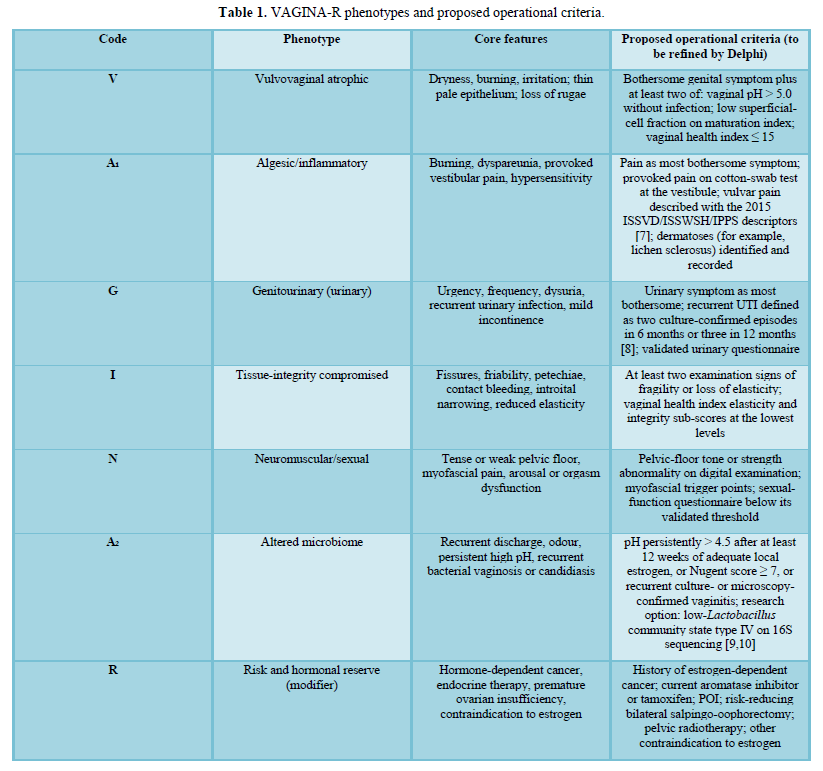
VAGINA-R rests on four principles.
- Mechanism over label. The classification describes the dominant biological or functional mechanism, not the presenting word (“dryness”, “pain”, “laxity”).
- Multi-label by design. A woman can carry more than one phenotype. One phenotype is designated dominant — the one most responsible for the most bothersome symptom — and the others are recorded as secondary.
- Measurable with simple tools. Each phenotype should be assignable in an ordinary gynecology clinic with history, examination, pH, a wet mount or Gram stain and validated questionnaires. Advanced tests (for example, 16S sequencing) support research but are not required for classification.
- Context modifies options. The R phenotype describes a context — cancer history, endocrine therapy, premature ovarian insufficiency — that changes which pathways are permitted. It is recorded as a modifier (R+) alongside the dominant mechanism.
The seven phenotypes
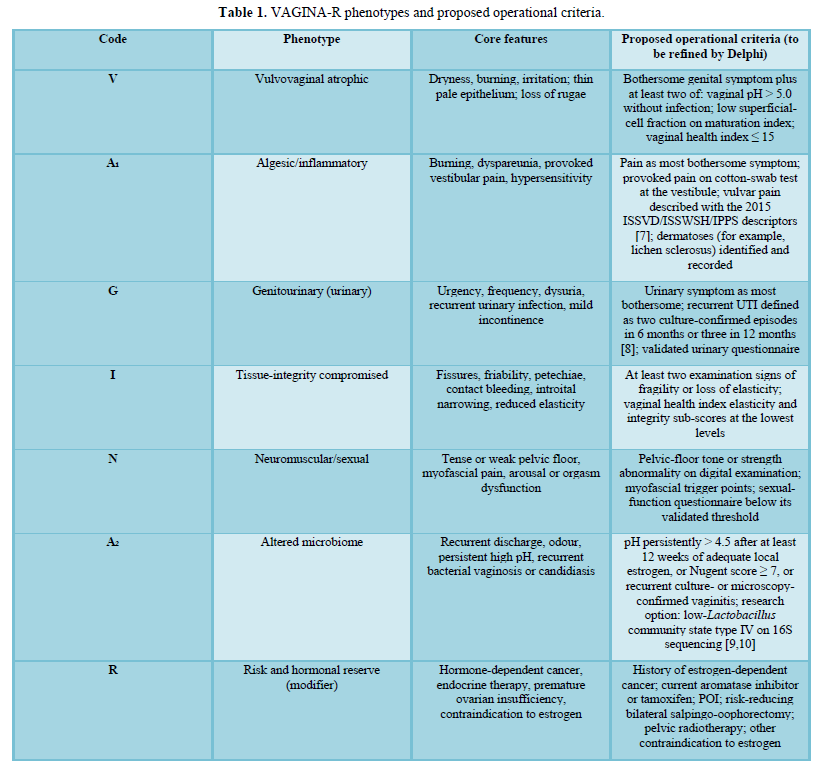
The thresholds in Table 1 are working proposals, drawn from common clinical practice and the cited consensus documents. They are expected to change during Phase 1. In particular, the 2020 NAMS position statement notes that vaginal pH and the maturation index are not essential components of GSM diagnosis, which rests on symptoms and examination [2,11]; VAGINA-R uses these tests to separate phenotypes, not to diagnose GSM.
Writing a VAGINA-R profile
A profile lists the dominant phenotype first, secondary phenotypes in parentheses and the R modifier last. For example:
- V(I) — atrophic GSM with tissue fragility, no restricting context.
- A₁(N) — pain-dominant presentation with pelvic-floor overactivity.
- G(V)·R+ — recurrent urinary infection with atrophy in a woman on an aromatase inhibitor.
- A₂(V) — persistent dysbiosis despite estrogenisation.
The profile is recorded at baseline and repeated at each scheduled visit, because phenotypes can change with treatment. A V phenotype that resolves on vaginal estrogen may leave a residual N or A₁ phenotype that was previously masked.
Why the microbial phenotype matters
The vaginal microbiome changes with menopause. Ravel and colleagues described five community state types in reproductive-age women, four dominated by Lactobacillus species and one (CST IV) with fewer lactic-acid bacteria, more strict anaerobes and a higher pH [9]. In a cohort of pre-, peri- and postmenopausal women, women with signs of vulvovaginal atrophy had markedly higher odds of a CST IV-A community than of an L. crispatus-dominated one [10]. Estrogen therapy increases Lactobacillus abundance in postmenopausal women [12]. The A₂ phenotype is defined not by dysbiosis alone — which is common and partly physiological after menopause — but by dysbiosis that persists after adequate estrogenisation, because that is the subgroup in which an atrophic explanation is no longer sufficient.
Why R is a modifier
Women with a history of estrogen-dependent breast cancer are a distinct clinical group. ACOG recommends non-hormonal methods as first line; if they fail, low-dose vaginal estrogen may be used after discussion of risks and benefits, including in women taking tamoxifen, and in women taking aromatase inhibitors after shared decision-making between the patient, gynecologist and oncologist; vaginal DHEA or testosterone may be considered if estrogen is not an option [13]. Premature ovarian insufficiency carries its own pathway: hormone therapy is recommended until the usual age of menopause, with vaginal estrogen added if genitourinary symptoms are not relieved by systemic therapy [14]. These contexts do not describe a mechanism of symptoms; they change the permissible treatments. Recording R as a modifier keeps the mechanism and the context separate.
PHENOTYPE-GUIDED PATHWAYS
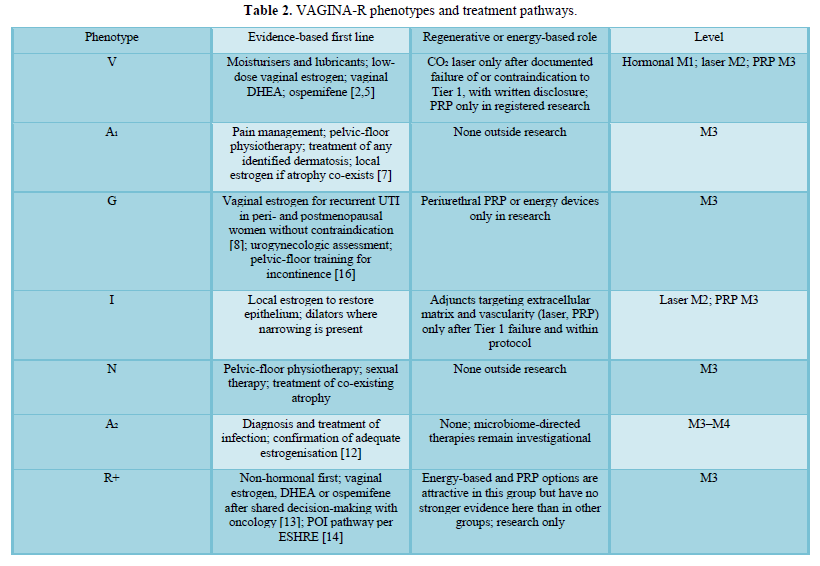
Table 2 links each phenotype to evidence-based first-line care and to the role, if any, of regenerative or energy-based interventions. Maturity labels (M1 to M4) follow the GRACE classification [15], which extends our three-tier GSM model [6].
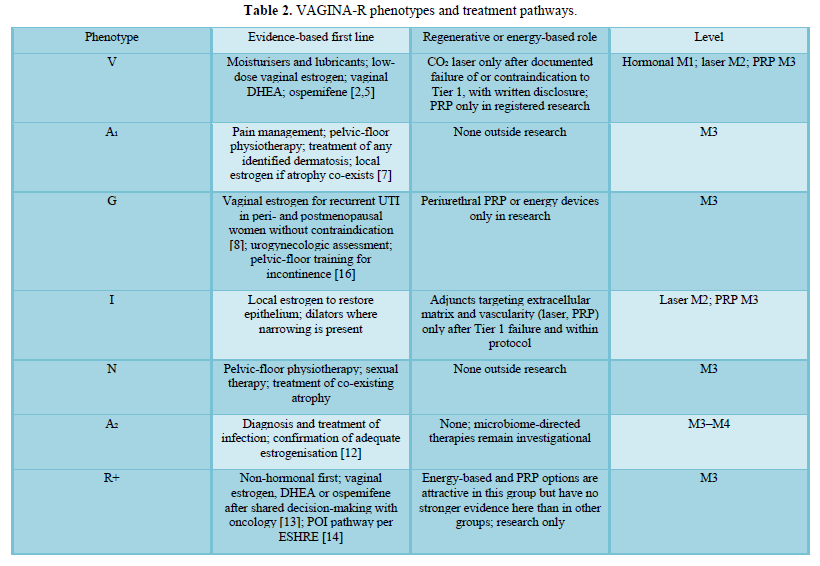
Two rules apply across the table. First, every pathway begins with Tier 1 care where it is permitted; failure of Tier 1 is declared only after at least 12 weeks of documented adherence with repeat pH and cytology [6]. Second, no regenerative intervention is offered as established therapy for any phenotype.
THE REGEN-VAG STUDY PROTOCOL
Aims
- To reach international consensus on the VAGINA-R phenotypes, their operational criteria and the profile notation (Phase 1a).
- To estimate inter-rater reliability of VAGINA-R phenotype assignment (Phase 1b).
- To test whether phenotype-guided care improves the proportion of women with a clinically important improvement in their most bothersome symptom at 6 months, compared with standard guideline-based care (Phase 2, main trial).
- To estimate the feasibility and effect size of a fully characterised PRP adjunct, against sham, in women with V or I phenotypes refractory to Tier 1 care (Phase 2, nested pilot).
- To explore biological correlates of phenotype and response (biological sub-study).
Phase 1a — Modified Delphi consensus
Panel. Gynecologists, urogynecologists, menopause specialists, sexual-medicine specialists, pelvic-floor physiotherapists, oncologists with survivorship practice, microbiologists, methodologists and women with lived experience of GSM. The panel will be international, with a target of at least 40 panellists across at least three continents.
Process. Two to three online rounds. Items will cover the phenotype list, each operational criterion and threshold, the dominant/secondary rule, the treatment of R as a modifier and the notation. Items will be rated on a nine-point scale. Consensus will be defined in advance (for example, at least 70% of ratings in the 7–9 range and no more than 15% in the 1–3 range), following published recommendations on defining consensus in Delphi studies [17]. A final virtual meeting will resolve items without consensus. The process will be reported according to the ACCORD guideline [18].
Phase 1b — Inter-rater reliability
Design. Cross-sectional reliability study in at least two centres.
Participants. Consecutive postmenopausal women, or women with iatrogenic or premature hypoestrogenism, presenting with bothersome genitourinary symptoms.
Procedure. Two trained clinicians will assess each woman independently, on the same day and blinded to each other’s results, using the consensus criteria. Each clinician will assign a dominant phenotype, secondary phenotypes and the R modifier.
Analysis. Agreement on the dominant phenotype will be estimated with Cohen’s kappa; agreement on each phenotype as present or absent with kappa per phenotype; and multi-rater agreement, if more than two raters are used, with Fleiss’ kappa. Interpretation will use conventional thresholds [19]. A kappa of at least 0.61 for the dominant phenotype will be required before Phase 2 begins; phenotypes below that threshold will be revised or merged. The sample size (planning estimate approximately 100–150 women) will be calculated by the study statistician for the target and null kappa values and the expected phenotype prevalence.
Phase 2 — Main trial
Design. Multicentre, pragmatic, parallel-group randomised controlled trial with blinded outcome assessment. Randomisation 1:1, stratified by centre and by R status, using concealed computer-generated allocation.
Participants. Inclusion: women aged 40 years or older who are postmenopausal, or women of any adult age with iatrogenic or premature hypoestrogenism; at least one bothersome genitourinary symptom for at least 3 months; ability to complete questionnaires. Exclusion: active genital infection at baseline (until treated); undiagnosed genital bleeding; current pregnancy; pelvic malignancy under active treatment; pelvic surgery within the previous 6 months; inability to consent.
Interventions.
- Standard care (control): management according to current guidelines [2,5,13], without phenotype assessment, delivered by the usual clinician.
- Phenotype-guided care (intervention): VAGINA-R profiling at baseline and at each visit, with treatment selected according to the pathways in Table 2. Regenerative or energy-based interventions are not part of the main trial intervention; they are tested only in the nested pilot (Section 4.5). This keeps the main comparison focused on whether phenotyping itself improves care.
Visits. Baseline, 3, 6 and 12 months.
Primary outcome. Proportion of women with a clinically important improvement in the most bothersome symptom at 6 months, measured on a validated 0–10 or ordinal severity scale, with the threshold for clinically important improvement pre-specified in the statistical analysis plan.
Secondary outcomes. The eight COMMA core outcomes for genitourinary symptoms: pain with sex, vulvovaginal dryness, vulvovaginal discomfort or irritation, discomfort or pain on urination, change in most bothersome symptom, distress or interference, satisfaction with treatment, and side effects [20]; vaginal health index; vaginal maturation index; vaginal pH; Female Sexual Function Index; ICIQ-SF; number of culture-confirmed UTIs; all outcomes at 3, 6 and 12 months; adverse events throughout.
Sample size (planning assumptions). If 45% of women in standard care and 60% in phenotype-guided care achieve the primary outcome, 173 women per group are needed for 80% power at a two-sided α of 0.05. Allowing for 15% attrition, the planning target is approximately 205 women per group (about 410 in total). These assumptions are illustrative and will be revised using response proportions observed in Phase 1b and published trials before the protocol is finalised.
Statistical analysis. Intention-to-treat analysis with logistic regression adjusted for stratification factors. Pre-specified subgroup analyses by dominant phenotype and R status, with interaction tests, will address the central hypothesis that the benefit of phenotype-guided care differs by phenotype. Missing data will be handled by multiple imputation under a missing-at-random assumption, with sensitivity analyses.
Nested sham-controlled pilot — characterised PRP adjunct
Rationale. PRP is a Tier 3 (GRACE M3) intervention for GSM [6]. The most plausible target, on biological grounds, is a woman whose dominant mechanism is epithelial and stromal (V or I) and who has not responded to adequate Tier 1 care. Testing PRP in this enriched group, against sham, is the most direct way to see whether phenotype selection reveals an effect that unselected trials have missed.
Participants. Women in either trial arm with a V or I dominant phenotype whose symptoms persist after at least 12 weeks of documented adherence to Tier 1 therapy, and who give separate research consent.
Intervention. Autologous PRP, prepared with a single standardised protocol and characterised for each participant with the PAW and MARSPILL descriptors (platelet concentration, leukocyte content, red-cell content, activation, spins, method) [21,22], with fixed volume, injection sites and schedule. Tier 1 therapy continues.
Comparator. Sham procedure with blood draw and injection of sterile saline at the same sites and schedule, so that participants and outcome assessors remain blinded.
Outcomes. Feasibility (recruitment, retention, blinding success); change in the most bothersome symptom and vaginal health index at 6 and 12 months; adverse events.
Sample size. Approximately 30 women per group, as a pilot to estimate variability and effect size for a definitive trial, not to test efficacy.
Biological sub-study
In consenting participants at selected centres, vaginal swabs will be collected at baseline, 6 and 12 months for 16S rRNA gene sequencing (community state type assignment) [9,10], and vaginal fluid for cytokine panels and matrix metalloproteinases. These analyses are exploratory: they will test whether biological profiles differ between phenotypes and whether baseline profiles predict response.
Ethics, safety and registration
The protocol will be approved by the relevant research ethics committees before enrolment and registered in a public trial registry. All participants will give written informed consent; the nested PRP pilot will require separate consent stating that PRP is an experimental intervention for GSM and that participants will not be charged for it. Adverse events will be recorded and graded; serious adverse events will be reported according to local regulations. An independent data monitoring committee will review safety data for the nested pilot. The trial will be reported according to CONSORT, and the protocol according to SPIRIT.
DISCUSSION
What VAGINA-R adds
VAGINA-R does not replace the GSM definition [1]; it works inside it. Its contribution is to give clinicians and researchers a shared vocabulary for the differences between women who meet the same definition. In clinical practice, that vocabulary helps explain why a treatment that works for one patient fails for another and points to the next step — for example, pelvic-floor physiotherapy for a residual N phenotype after estrogen has corrected a V phenotype. In research, it allows trials to enrol the phenotype that an intervention targets, to stratify randomisation and to test whether effects differ by phenotype.
Relationship to GRACE
VAGINA-R is condition-specific. The GRACE classification is a separate, broader framework that describes any regenerative or energy-based gynecologic intervention along five axes — compartment, phenotype, intervention, evidence maturity and anchor outcome [15]. Within GSM, a VAGINA-R profile can be written in the GRACE phenotype position. The two systems are reported separately so that each can be validated on its own terms.
What VAGINA-R does not claim
VAGINA-R does not claim that regenerative interventions work in any phenotype. It claims only that, if they work, they are more likely to show it in a well-defined target group than in an undifferentiated population, and that this can be tested. The protocol keeps regenerative interventions research-only and compares them against sham.
LIMITATIONS
First, the classification is author-generated and its criteria are provisional; Phase 1 exists to test and revise them. Second, the phenotypes overlap, and some women will be difficult to classify; the multi-label rule reduces but does not remove this problem. Third, several criteria depend on examination, which varies between clinicians; the reliability study is designed to measure this, and phenotypes that cannot be assigned reliably will be revised or merged. Fourth, the sample size assumptions for Phase 2 are illustrative. Fifth, the biological sub-study is exploratory and is not powered for formal hypothesis testing. Finally, a pragmatic trial of a classification-based strategy cannot separate the effect of phenotyping from the effect of more structured follow-up; the visit schedule is the same in both arms to limit this.
CONCLUSION
GSM is one syndrome with several mechanisms. VAGINA-R proposes seven phenotypes, a multi-label notation and an explicit modifier for the clinical contexts that restrict treatment. REGEN-VAG proposes to validate the classification, test whether phenotype-guided care improves outcomes, and give regenerative interventions a fair test in the patients most likely to benefit — against sham, and within research.
DECLARATIONS
Ethics approval and consent to participate. This article describes a proposed study. Ethics approval will be obtained before enrolment; see Section 4.7.
Consent for publication. Not applicable.
Availability of data and materials. Not applicable; no data have yet been collected.
Competing interests. The authors have no relationship with manufacturers of vaginal energy-based devices, platelet-rich plasma systems, cell-based or exosome products, or menopausal hormone therapy products.
Funding. This research received no specific grant from any funding agency.
Authors’ contributions. MAP: conceptualisation, classification design, protocol design and drafting. MAP and MHK: critical revision of the classification, protocol and manuscript. All authors approved the final version.
Use of artificial intelligence. An AI-based writing assistant was used to support drafting and language editing. The authors verified all statements and references against the primary sources and accept full responsibility for the content.
Acknowledgements. None.
- Portman DJ, Gass MLS; Vulvovaginal Atrophy Terminology Consensus Conference Panel. Genitourinary syndrome of menopause: new terminology for vulvovaginal atrophy from the International Society for the Study of Women’s Sexual Health and The North American Menopause Society. Menopause. 2014;21(10):1063–1068. https://pubmed.ncbi.nlm.nih.gov/25160739/
- The NAMS 2020 GSM Position Statement Editorial Panel. The 2020 genitourinary syndrome of menopause position statement of The North American Menopause Society. Menopause. 2020;27(9):976–992. https://menopause.org/wp-content/uploads/default-document-library/2020-gsm-ps.pdf
- Genitourinary symptoms in women with breast cancer: frequency, severity and impact. Support Care Cancer. 2025. https://link.springer.com/article/10.1007/s00520-025-09297-w
- Enhancing quality of life: addressing vulvovaginal atrophy and urinary tract symptoms. Climacteric. 2025. https://www.tandfonline.com/doi/full/10.1080/13697137.2025.2514029
- Kaufman MR, Ackerman LA, Amin KA, et al. The AUA/SUFU/AUGS guideline on genitourinary syndrome of menopause. J Urol. 2025;214(3):242–250. https://pubmed.ncbi.nlm.nih.gov/40298120/ ; full guideline: https://www.auanet.org/guidelines-and-quality/guidelines/genitourinary-syndrome-of-menopause
- Probst MA, Kume MH, Peracchi E, Ribas CAPM. Conventional hormonal therapy versus emerging regenerative interventions for genitourinary syndrome of menopause: a technical comparative matrix and evidence-tiered feasibility analysis of 2024–2026 systematic reviews and meta-analyses. J Clin Pract Med Case Rep. 2026;3(1):1–21. doi:10.52793/JCPMCR.2026.3(1)-38. https://www.genesispub.org/jcpmcr/conventional-hormonal-therapy-versus-emerging-regenerative-interventions-for-genitourinary-syndrome-of-menopause-a-technical-comparative-matrix-and-evidence-tiered-feasibility-analysis-of-2024-2026-systematic-reviews-and-meta-analyses
- Bornstein J, Goldstein AT, Stockdale CK, et al. 2015 ISSVD, ISSWSH and IPPS consensus terminology and classification of persistent vulvar pain and vulvodynia. Obstet Gynecol. 2016;127(4):745–751. https://pubmed.ncbi.nlm.nih.gov/27008217/
- American Urological Association. Recurrent uncomplicated urinary tract infections in women: AUA/CUA/SUFU guideline (amended 2022; updated 2025). https://www.auanet.org/guidelines-and-quality/guidelines/recurrent-uti ; definition of rUTI summarised in: https://auanews.net/issues/articles/2025/october-2025/updates-to-the-aua/cua/sufu-guideline-on-recurrent-uncomplicated-urinary-tract-infections-in-women
- Ravel J, Gajer P, Abdo Z, et al. Vaginal microbiome of reproductive-age women. Proc Natl Acad Sci USA. 2011;108(Suppl 1):4680–4687. https://pubmed.ncbi.nlm.nih.gov/20534435/
- Brotman RM, Shardell MD, Gajer P, et al. Association between the vaginal microbiota, menopause status, and signs of vulvovaginal atrophy. Menopause. 2014;21(5):450–458. Summarised in: https://www.ncbi.nlm.nih.gov/pmc/articles/PMC10438897/
- Genitourinary syndrome of menopause. StatPearls. NCBI Bookshelf. https://www.ncbi.nlm.nih.gov/books/NBK559297/
- The postmenopausal vaginal microbiome and genitourinary syndrome of menopause. Review. https://pmc.ncbi.nlm.nih.gov/articles/PMC10873068/
- American College of Obstetricians and Gynecologists. Treatment of urogenital symptoms in individuals with a history of estrogen-dependent breast cancer: clinical consensus no. 2. Obstet Gynecol. 2021;138(6):950–960. https://www.acog.org/clinical/clinical-guidance/clinical-consensus/articles/2021/12/treatment-of-urogenital-symptoms-in-individuals-with-a-history-of-estrogen-dependent-breast-cancer
- Panay N, Anderson RA, Bennie A, et al.; ESHRE, ASRM, CREWHIRL and IMS Guideline Group on POI. Evidence-based guideline: premature ovarian insufficiency. Hum Reprod Open. 2024;2024(4):hoae065. https://pubmed.ncbi.nlm.nih.gov/39660328/ ; clinician toolkit: https://www.eshre.eu/-/media/sitecore-files/Guidelines/POI/2024/POI-GUIDELINE_HCP-Toolkit-2024.pdf
- Kume MH, Probst MA, Ribas CAPM. GRACE: a five-axis classification of evidence for regenerative and energy-based gynecology — compartment, phenotype, intervention, maturity and anchor outcome. Position paper. Manuscript submitted to J Stem Cell Res; 2026.
- Dumoulin C, Cacciari LP, Hay-Smith EJC. Pelvic floor muscle training versus no treatment, or inactive control treatments, for urinary incontinence in women. Cochrane Database Syst Rev. 2018;10:CD005654. https://www.cochrane.org/evidence/CD005654_pelvic-floor-muscle-training-urinary-incontinence-women
- Diamond IR, Grant RC, Feldman BM, et al. Defining consensus: a systematic review recommends methodologic criteria for reporting of Delphi studies. J Clin Epidemiol. 2014;67(4):401–409.
- Gattrell WT, Logullo P, van Zuuren EJ, et al. ACCORD (ACcurate COnsensus Reporting Document): a reporting guideline for consensus methods in biomedicine developed via a modified Delphi. PLoS Med. 2024;21(1):e1004326. https://pubmed.ncbi.nlm.nih.gov/38261576/
- Landis JR, Koch GG. The measurement of observer agreement for categorical data. Biometrics. 1977;33(1):159–174. https://pubmed.ncbi.nlm.nih.gov/843571/
- Lensen S, Bell RJ, Carpenter JS, et al. A core outcome set for genitourinary symptoms associated with menopause: the COMMA (Core Outcomes in Menopause) global initiative. Menopause. 2021;28(8):859–866. https://pubmed.ncbi.nlm.nih.gov/33973541/
- DeLong JM, Russell RP, Mazzocca AD. Platelet-rich plasma: the PAW classification system. Arthroscopy. 2012;28(7):998–1009. https://pubmed.ncbi.nlm.nih.gov/22738751/
- Lana JFSD, Purita J, Paulus C, et al. Contributions for classification of platelet rich plasma – proposal of a new classification: MARSPILL. Regen Med. 2017;12(5):565–574. https://pubmed.ncbi.nlm.nih.gov/28758836/
-
 Table 1
-
Table 2
QUICK LINKS
- SUBMIT MANUSCRIPT
- RECOMMEND THE JOURNAL
-
SUBSCRIBE FOR ALERTS
RELATED JOURNALS
- Journal of Cardiology and Diagnostics Research (ISSN:2639-4634)
- Journal of Forensic Research and Criminal Investigation (ISSN: 2640-0846)
- International Journal of Anaesthesia and Research (ISSN:2641-399X)
- Journal of Cell Signaling & Damage-Associated Molecular Patterns
- International Journal of AIDS (ISSN: 2644-3023)
- Journal of Alcoholism Clinical Research
- Journal of Immunology Research and Therapy (ISSN:2472-727X)