

| Mônica Andréa Probst*, Márcio Hiroaki Kume, Edson Peracchi and Carmen Austrália Paredes Marcondes Ribas |
| Corresponding Author: Mônica Andréa Probst, 80250-190, Iguassu Avenue, 1236, Brazil. |
| Received: October 19, 2026; Revised: October 22, 2026; Accepted: October 23, 2026 Available Online: October 24, 2026 |
| DOI: doi.org/10.5281/zenodo.23764467 |
| Citation: Probst MA, Kume MH, Peracchi E & Ribas CAPM. (2026) GRACE: A Five-Axis Classification of Evidence for Regenerative and Energy-Based Gynecology — Compartment, Phenotype, Intervention, Maturity and Anchor Outcome. Stem Cell Res Ther, 9(1): 253-263. |
| Copyrights: ©2026 Probst MA, Kume MH, Peracchi E & Ribas CAPM. This is an open-access article distributed under the terms of the Creative Commons Attribution License, which permits unrestricted use, distribution, and reproduction in any medium, provided the original author and source are credited. |
| Share : |
30
Views & Citations10
Likes & Shares
Development. GRACE was derived from two prior evidence syntheses by the authors — an umbrella review of regenerative and energy-based gynecology, which identified a sham gradient, a surrogate–outcome gap and instability of pooled estimates, and a comparative matrix of hormonal versus regenerative therapy for GSM, which produced a three-tier feasibility model — together with the VAGINA-R phenotype model (reported separately) and established platelet-product, GSM-terminology, vulvar-pain and core-outcome methodologies.
The framework. Each application is coded as Compartment–Phenotype / Intervention[descriptor] / Maturity / Outcome anchor. Axis C identifies six anatomical compartments; Axis P defines ten clinical-biological phenotypes plus a hormonal-risk modifier, mapped to the separately published VAGINA-R model; Axis I classifies standard, hormonal, biologic and energy-based interventions and makes product or dose descriptors mandatory; Axis M assigns one of four maturity levels (M1 endorsed, M2 signal-positive but not endorsed, M3 experimental, M4 preclinical) to each compartment–phenotype–intervention triplet; and Axis O specifies the anchor outcomes, with live birth as the obligatory anchor for reproductive phenotypes and at least 12-month durability for all.
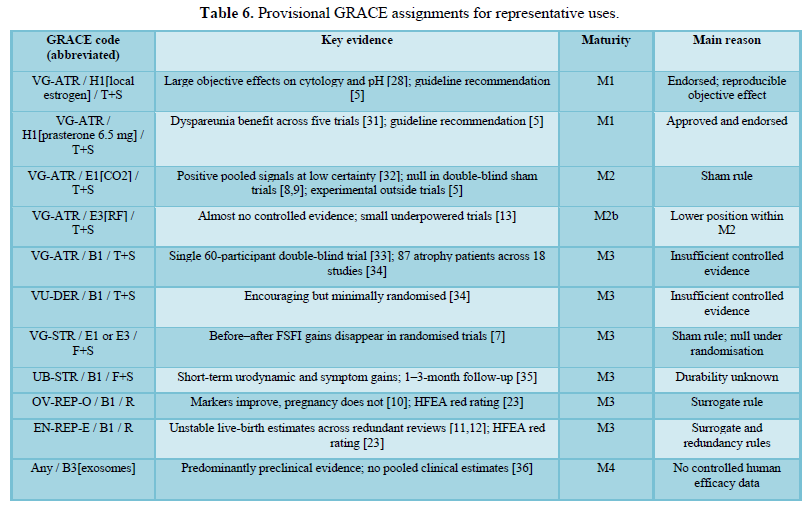
Application. Applied to current evidence, local estrogen and vaginal prasterone for atrophic GSM are M1; vaginal laser for GSM is M2; radiofrequency occupies a lower M2 position; PRP for GSM, lichen sclerosus, stress urinary incontinence, ovarian reserve and implantation failure is M3; and exosome products are M4.
Conclusion. GRACE replaces marketing categories such as 'rejuvenation' with codable clinical entities and makes the evidential status of each regenerative claim explicit. A four-phase validation programme — modified Delphi consensus, inter-rater reliability testing, retrospective recoding of published studies and prospective validation within a phenotype-guided trial — is proposed before GRACE is recommended for routine use.
Keywords: Regenerative gynecology; classification; platelet-rich plasma; genitourinary syndrome of menopause; vaginal laser; radiofrequency; phenotype; evidence maturity; core outcome set; reporting standards.
Abbreviations: AE, adverse event; AMH, anti-Müllerian hormone; AUA, American Urological Association; AUGS, American Urogynecologic Society; CST, community state type; DHEA, dehydroepiandrosterone; FSFI, Female Sexual Function Index; GRACE, Gynecologic Regenerative Axis Classification of Evidence; GRADE, Grading of Recommendations Assessment, Development and Evaluation; GSM, genitourinary syndrome of menopause; HFEA, Human Fertilisation and Embryology Authority; ICIQ-SF, International Consultation on Incontinence Questionnaire–Short Form; MCID, minimal clinically important difference; PGI-I, Patient Global Impression of Improvement; PRP, platelet-rich plasma; RCT, randomised controlled trial; RF, radiofrequency; RIF, recurrent implantation failure; SUI, stress urinary incontinence; UDI-6, Urogenital Distress Inventory-6; VHI, Vaginal Health Index; VMI, vaginal maturation index.
In two preceding syntheses we examined this field from complementary angles. An umbrella review of regenerative and energy-based interventions across gynecology [6] identified three recurrent evidential pathologies. The first is a sham gradient: effect sizes shrink and often disappear as comparators move from before–after designs to active controls and then to double-blind sham. Sexual-function gains of roughly six FSFI points in before–after pooling vanish when analysis is restricted to randomised trials [7], and double-blind sham-controlled trials do not support fractional CO2 laser for GSM [8,9]. The second is a surrogate–outcome gap: intraovarian PRP improves AMH, FSH and antral follicle count in randomised trials without a demonstrated pregnancy benefit [10], and in recurrent implantation failure PRP improves clinical pregnancy in most meta-analyses but live birth in only one of five [11]. The third is estimate instability: 25 systematic reviews built on only 112 primary studies report live-birth estimates ranging from an odds ratio of 1.23 to 11.02 [12].
A second synthesis placed conventional hormonal therapy and regenerative interventions for GSM side by side in a single technical matrix [13]. It translated that matrix into a three-tier feasibility model: Tier 1, normatively endorsed (vaginal estrogen and vaginal prasterone); Tier 2, signal-positive but not endorsed (laser, with radiofrequency in a lower position); and Tier 3, experimental (PRP). Independently, a phenotype model for GSM — VAGINA-R, reported in a separate article together with its validation protocol [38] — was developed by the authors to test the hypothesis that women with GSM are not biologically homogeneous and that therapeutic response may depend more on the dominant vulvovaginal phenotype than on the choice of technology.
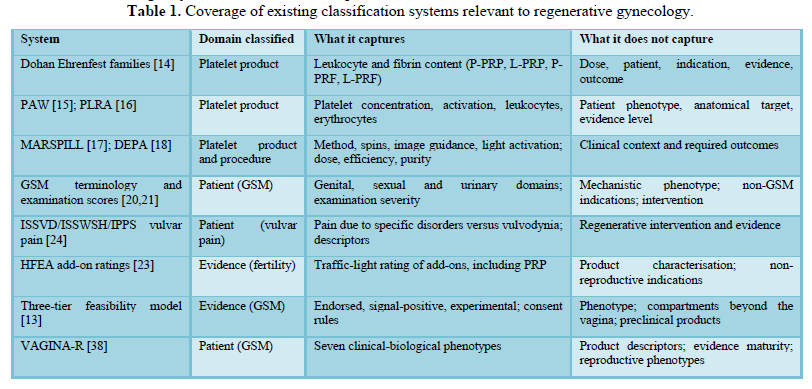
These three strands point to a common deficit. The field lacks not publications but a shared coding language. Platelet-product classifications exist — Dohan Ehrenfest's four families [14], PAW [15], PLRA [16], MARSPILL [17] and DEPA [18] — yet a 2025 scoping review found that such frameworks were rarely applied in gynecologic PRP studies [19]. GSM has an accepted definition [20] and examination scores [21], but no definitive diagnostic criteria [22]. Regulatory rating schemes such as the HFEA traffic-light system grade selected fertility add-ons [23] but do not describe the patient, the product or the required outcome. No existing system answers, in one code, the five questions a clinician, trialist, reviewer or regulator needs answered: where, in whom, with what, with what level of evidence, and measured how.
This position paper proposes GRACE — Gynecologic Regenerative Axis Classification of Evidence — to fill that gap. Its purpose is not to endorse any intervention but to make the evidential status of each regenerative claim explicit, comparable and auditable.
DEVELOPMENT OF THE FRAMEWORK
Sources
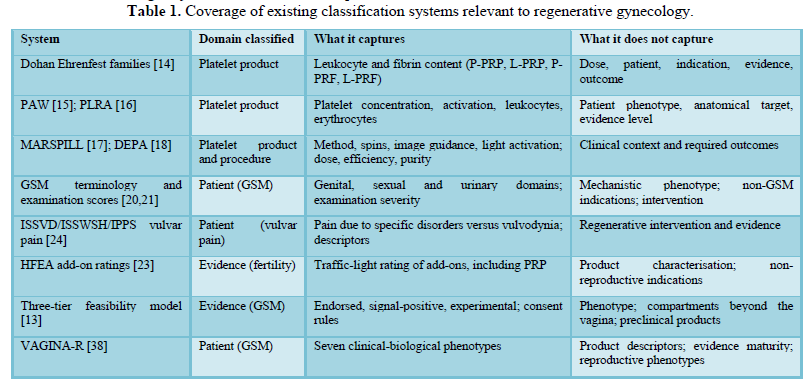
GRACE was constructed by the authors through structured integration of four sources: (i) the evidential pathologies and research agenda of the umbrella review [6]; (ii) the three-tier feasibility model, its tier-entry criteria and its consent requirements [13]; (iii) the VAGINA-R phenotype model [38]; and (iv) established external frameworks for GSM terminology [20], persistent vulvar pain [24], vaginal microbial community state types [25], platelet-product characterisation [14–18], core outcome set development [26] and Delphi methodology [27]. Table 1 summarises the coverage of the main existing systems and the gap that GRACE is designed to close.
Design principles
Five principles, derived from the preceding syntheses, govern every axis.
- Function before aesthetics. The target is a measurable clinical entity — dyspareunia, dryness, tissue integrity, continence, sexual function, live birth — never an undefined notion of 'rejuvenation', 'revitalisation' or 'regeneration'.
- Phenotype before technology. Patient classification precedes the selection of PRP, laser, radiofrequency, photobiomodulation or any adjunct; two women with 'vaginal dryness' may carry different phenotypes and require different strategies.
- Characterised intervention. An intervention that cannot be described with its product or dose descriptors cannot be classified and therefore cannot be pooled.
- Evidence maturity attached to the triplet. Maturity is a property of a specific compartment–phenotype–intervention combination, not of a technology: PRP is not 'experimental' in the abstract but experimental for a defined use.
- Anchor outcome and durability. Each phenotype has an obligatory outcome anchor that prevents surrogate endpoints from standing in for patient-important benefit, and every claim requires at least 12-month follow-up.
THE GRACE CLASSIFICATION
Code syntax
A GRACE code has five fields, written in a fixed order:
C-P[r] / I[descriptor] / M / O
C is the anatomical compartment; P is the primary phenotype, optionally followed by a secondary phenotype after '>' and by the hormonal-risk modifier 'r'; I is the intervention class with its mandatory descriptor in brackets, combinations being joined by '+'; M is the evidence-maturity level; and O lists the anchor outcome domains, followed by the minimum follow-up. For example, 'VG-ATR>NMS r / B1[P3-L(−)-A(−); 3 × 5 mL; 4-week interval] / M3 / T+S-12m' denotes a vaginal application in an atrophic phenotype with a secondary neuromuscular-sexual component in a woman with hormonal contraindication, treated with a leukocyte-poor, non-activated PRP within research (M3), with tissue and patient-centred anchors measured to 12 months.
Axis C — anatomical compartment
Six compartments are defined because the same product behaves differently, and is assessed differently, in each: VU, vulva and vestibule; VG, vagina; UB, urethra and bladder neck; PF, pelvic floor musculature and connective tissue; EN, endometrium and uterine cavity; and OV, ovary. Multi-compartment protocols list each compartment separately (for example, VG+VU), so that outcomes can be attributed.
Axis P — clinical-biological phenotype
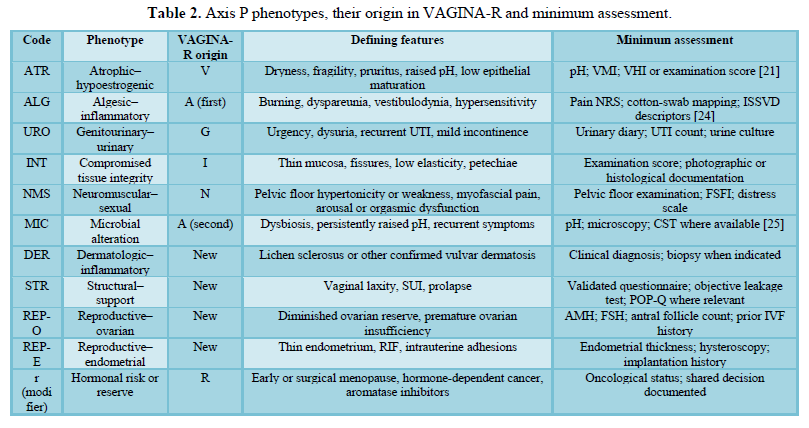
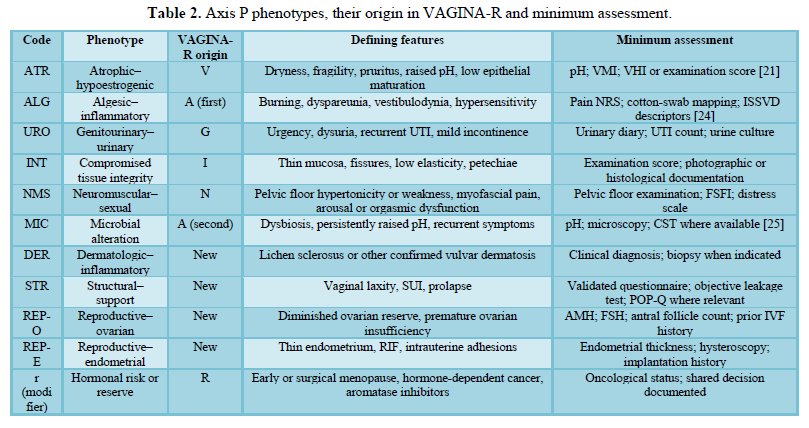
Axis P maps the seven VAGINA-R phenotypes [38] and extends them to non-menopausal and reproductive indications (Table 2). In VAGINA-R, the final letter R denoted 'risk and hormonal reserve' (early menopause, hormone-dependent cancer, aromatase-inhibitor therapy). Because this characteristic modifies the choice of therapy rather than describing a tissue mechanism, GRACE converts it into a modifier, 'r', that can accompany any phenotype. Three phenotypes are added: DER, for histologically or clinically confirmed vulvar dermatoses such as lichen sclerosus; STR, for structural and support disorders, including vaginal laxity, stress urinary incontinence and prolapse; and REP, subdivided into REP-O (ovarian reserve) and REP-E (endometrial thickness, receptivity or adhesions). Pain phenotypes should be described with the 2015 ISSVD/ISSWSH/IPPS terminology [24], and microbial phenotypes, where sequencing is available, with community state types [25].
Phenotypes are not mutually exclusive. The primary phenotype is the one judged to drive the most bothersome symptom; up to two secondary phenotypes may be recorded. This hierarchy allows trials to stratify randomisation and meta-analyses to restrict pooling to phenotypically comparable populations.
Axis I — intervention class and mandatory descriptors
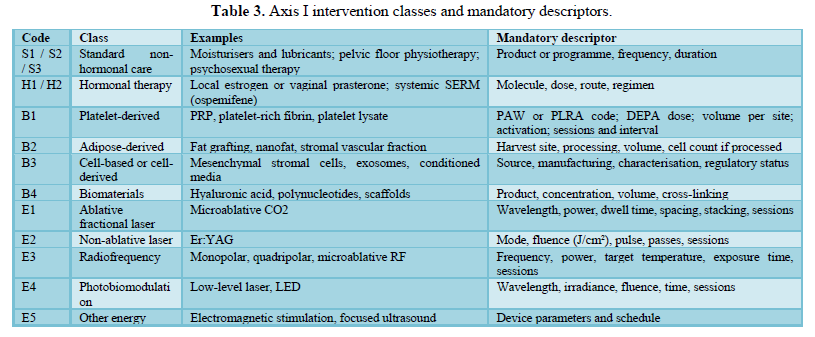
Axis I groups interventions into four families and requires a descriptor for each (Table 3). Standard non-hormonal care (S) and hormonal therapy (H) are included deliberately: they are the reference comparators against which regenerative claims must be judged, and local hormonal therapy remains the benchmark for objective change in atrophic GSM [28,29]. For platelet products, GRACE does not create a new nomenclature; it requires that an existing one be applied, preferably PAW or PLRA for composition and DEPA for dose and purity [15,16,18]. For energy-based devices, the descriptor must make doses comparable rather than merely similar; trials of CO2 laser for GSM have used different power settings, dwell times, dot spacing, stacking and session schedules [8].
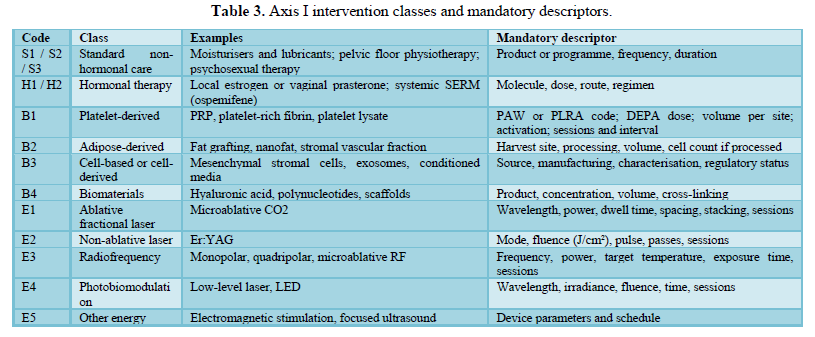
Combinations are written explicitly (for example, B1+B4 or E1+B1). A study that does not report the descriptor is coded with '[NR]' (not reported), which in GRACE automatically caps evidence maturity at M3, because an uncharacterised intervention cannot be reproduced.
Axis M — evidence maturity
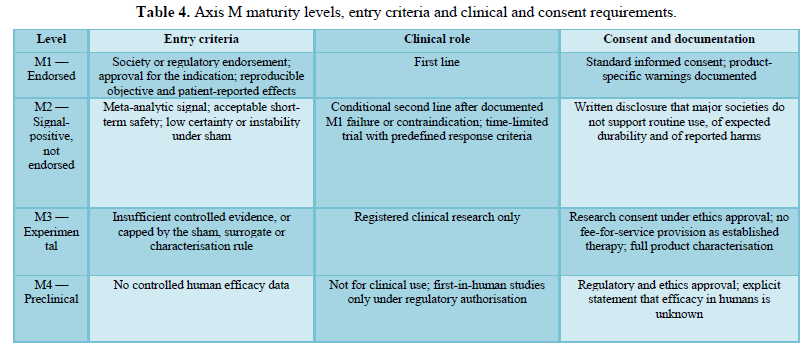
Axis M inherits the three tiers of the feasibility model [13] and adds a fourth level for products with no controlled human efficacy data (Table 4). Entry criteria for M1 to M3 are retained from that model: M1 requires a positive recommendation from at least one major society or regulator, regulatory approval for the indication and reproducible effects on objective and patient-reported outcomes; M2 requires a meta-analytic signal on at least one clinically relevant outcome with acceptable short-term safety, but with absent or negative guideline endorsement, low or very low certainty, or instability under sham control; M3 denotes insufficient controlled evidence to estimate effect with confidence. GRACE adds four rules that convert the evidential pathologies into explicit ceilings.
- Sham rule. A triplet whose benefit is not confirmed in double-blind sham-controlled trials cannot exceed M2, regardless of the magnitude of uncontrolled effects.
- Surrogate rule. A reproductive triplet (REP-O or REP-E) supported only by biomarker or clinical-pregnancy gains, without live-birth benefit, cannot exceed M3.
- Characterisation rule. A triplet whose supporting studies predominantly lack the Axis I descriptor cannot exceed M3.
Redundancy rule. Agreement among overlapping reviews does not count as independent confirmation; maturity is judged on the underlying primary trials, with overlap quantified.
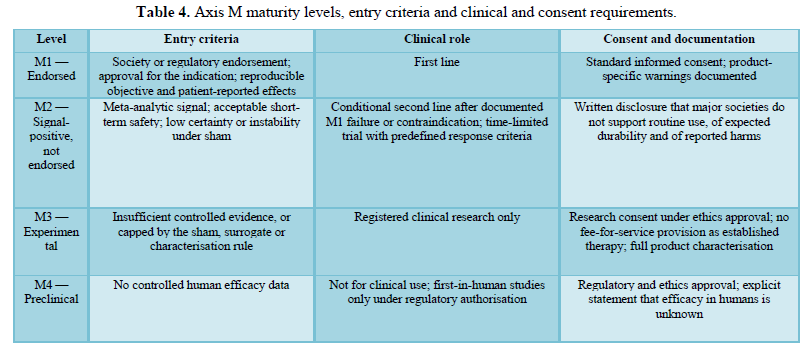
Within M2, a lower position (M2b) may be recorded when controlled evidence is almost absent, as the feasibility model did for radiofrequency relative to laser [13]. Upgrading requires positive evidence on the anchor outcome: from M3 to M2, at least one adequately powered, sham- or placebo-controlled randomised trial with a fully characterised intervention; from M2 to M1, guideline endorsement and reproducible benefit on anchor outcomes with durability of at least 12 months.
Axis O — anchor outcomes
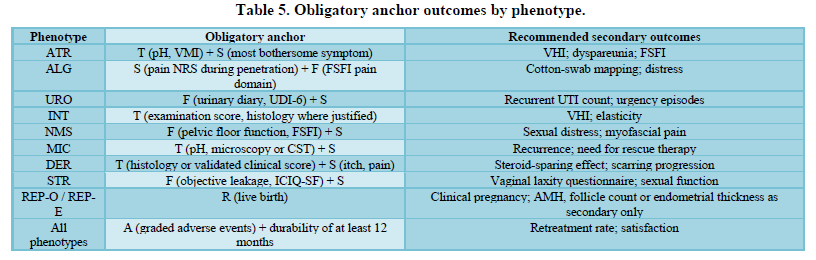
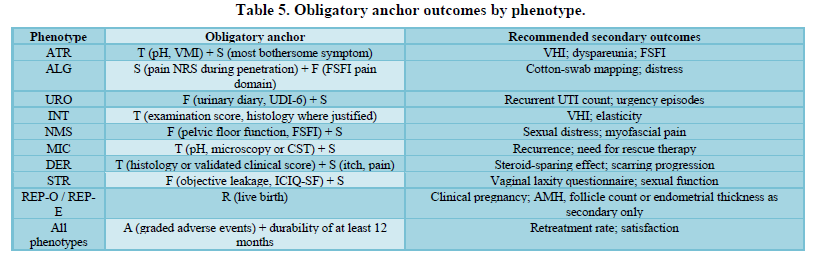
Axis O defines five outcome domains: T, objective tissue measures (VMI, pH, VHI, histology); F, function (FSFI, ICIQ-SF, UDI-6, urodynamic or pad-test data, pelvic floor function); S, patient-centred outcomes (most bothersome symptom, PGI-I, responder rate defined by a prespecified MCID); R, reproductive outcomes, with live birth as the primary endpoint; and A, adverse events graded by severity. Each phenotype carries an obligatory anchor (Table 5). Adverse events and a minimum 12-month follow-up are required for all phenotypes, because absence of harm in short, small trials is not evidence of long-term safety. The set is offered as a starting point for a formal core outcome set developed according to the COMET Handbook [26]; the International Consultation on Sexual Medicine recommendations on GSM provide a complementary reference for sexual-health outcomes [30].
APPLICATION TO CURRENT EVIDENCE
Table 6 applies GRACE to representative uses, drawing on the evidence assembled in our two syntheses. The assignments illustrate the framework; they are provisional and should be revisited by the consensus process described in section 6.
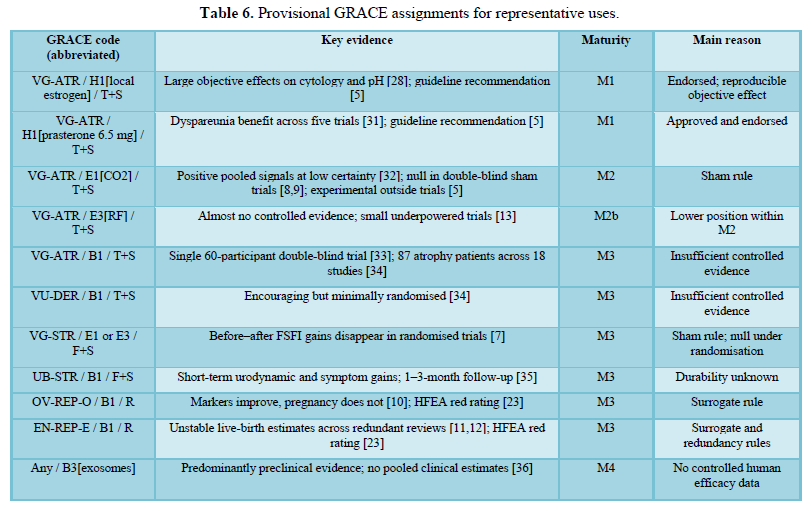
Two observations follow. First, no regenerative biologic currently reaches M2 for any gynecologic phenotype; the only interventions above M3 are hormonal therapy and, conditionally, laser. Second, the comparison of CO2 laser with vaginal estrogen in small randomised trials, which found similar improvement [37], does not by itself raise laser's maturity, because convergence of two unblinded active arms cannot distinguish shared efficacy from shared placebo response and regression to the mean.
INTENDED USES
Clinical decision-making
In practice, GRACE replaces menu-based selection with a sequence. The clinician first codes compartment and phenotype, including the modifier r, and then selects the highest-maturity intervention appropriate to that phenotype. Four rules from the feasibility model are retained [13]: offer M1 therapy to every symptomatic patient without contraindication; define failure before escalating, meaning at least 12 weeks of documented adherence with objective reassessment; use M2 interventions as time-limited trials with predefined response criteria and discontinue them in the absence of MCID-level improvement; and confine M3 interventions to registered research. The phenotype axis adds a fifth rule: treat the mechanism that drives the most bothersome symptom. A woman with an NMS-dominant dyspareunia, for example, is first referred for pelvic floor assessment rather than for an energy-based procedure.
Trial design and reporting
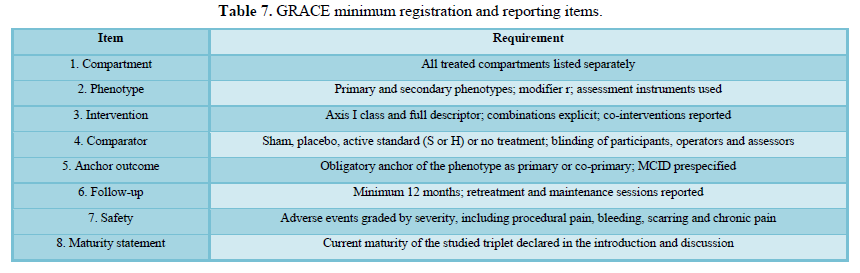
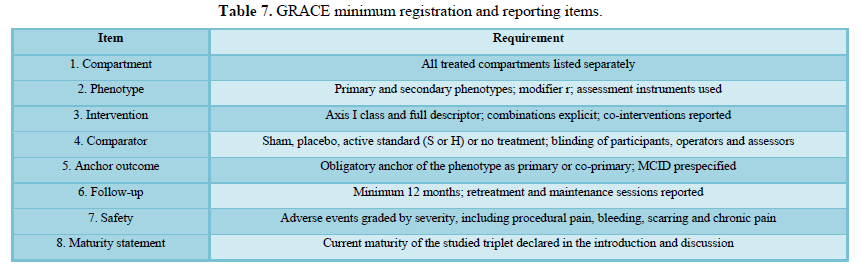
For investigators, GRACE functions as a registration and reporting checklist (Table 7). Table 7 lists the minimum items only; an item-by-item coding manual, an extended checklist and pooling rules for reviewers are provided in a companion methodological article [39]. Declaring the full code at registration forces three decisions that the current literature often leaves implicit: which phenotype is eligible, how the product or dose is characterised, and which anchor outcome is primary.
 Evidence synthesis
For reviewers, GRACE defines the unit of pooling. Studies may be pooled only when compartment, primary phenotype and intervention class coincide and when descriptors fall within a prespecified range. Studies coded [NR] are analysed separately; decision rules for ambiguous cases are detailed in the companion coding manual [39]. Applied retrospectively, the coding also quantifies the reporting deficit itself — the proportion of studies that cannot be fully coded — which is a more useful measure of a field's maturity than the number of reviews it has produced.
Communication and ethics
Because every GRACE code names a clinical entity and a maturity level, it offers a disciplined vocabulary for patient information, professional education and public communication. A statement such as 'PRP for atrophic GSM is M3: experimental and offered only within research' is both accurate and understandable, whereas 'vaginal rejuvenation with growth factors' is neither. GRACE therefore supports the position, shared by regulators and societies, that terminology itself can be an evidential hazard [1,2].
VALIDATION PROGRAMME
GRACE is proposed as a version 1.0 framework. Before it is recommended for routine use, we propose four validation phases.
- Phase 1 — Consensus. A modified Delphi process reported according to CREDES [27], with a multidisciplinary panel of gynecologists, urogynecologists, reproductive specialists, pelvic floor physiotherapists, sexual-medicine specialists, pathologists, microbiome researchers, methodologists and patient representatives. Each axis, category and rule would be rated over two to three rounds, with consensus predefined as at least 75% agreement.
- Phase 2 — Reliability. Two or more independent raters would code a sample of published studies and clinical cases; agreement would be estimated per axis with kappa statistics, with a target of at least 0.70 before release.
- Phase 3 — Retrospective recoding. The primary studies included in our two syntheses [6,13] would be recoded to measure codability, axis-specific missingness and the effect of restricting pooling to code-concordant studies on effect estimates and heterogeneity.
- Phase 4 — Prospective validation. Within the planned REGEN-VAG study, whose design is reported with VAGINA-R [38], women with moderate or severe GSM would be allocated to standardised management or to phenotype-guided management. The primary outcome would be an MCID-defined response at 6 months, with follow-up to 12 months and a biomarker sub-study (microbiome, local cytokines and matrix-remodelling markers) to test whether baseline phenotype predicts response.
Governance should include versioning, public documentation of changes and periodic re-assignment of maturity levels as new controlled evidence appears, so that GRACE functions as a living classification rather than a static opinion.
LIMITATIONS
GRACE is an author-derived proposal and has not yet undergone consensus or reliability testing. The maturity assignments in Table 6 involve judgement, particularly at the boundary between M2 and M3 and in the placement of radiofrequency. Phenotypes overlap, and the hierarchy of primary and secondary phenotypes may be difficult to apply in mixed presentations. Some descriptors, such as platelet counts in the final product or microbial community typing, require laboratory resources that are not universally available; GRACE accommodates this through the [NR] code, at the cost of capping maturity. The framework draws heavily on evidence in GSM and may require adaptation for postpartum, oncological and adolescent populations. Finally, patients were not involved in the initial design; their participation in Phase 1 is essential, particularly for the patient-centred anchor outcomes.
CONCLUSION
Regenerative gynecology rests on defensible biological reasoning but lacks the shared language of a therapeutic specialty. GRACE proposes that language in five axes: where the intervention is applied, in which phenotype, with what characterised product or dose, at what level of evidential maturity and measured by which anchor outcome. By incorporating the VAGINA-R phenotypes and the three-tier feasibility model, and by converting the sham gradient, the surrogate–outcome gap and estimate instability into explicit maturity rules, GRACE makes the status of every regenerative claim visible and auditable. Its central proposition is simple: in regenerative gynecology, the phenotype should be defined before the technology, the product should be characterised before it is pooled, and the outcome that matters to the woman should be measured before regeneration is claimed.
DECLARATIONS
Ethics approval and consent to participate
Not applicable. This article proposes a classification framework based on previously published aggregate data and does not involve human participants, human material or human data collected by the authors.
Consent for publication
Not applicable.
Availability of data and materials
No new data were generated. All evidence discussed is contained in the publications and regulatory documents listed in the references.
Competing interests
This research has no relationship with manufacturers of vaginal energy-based devices, platelet-rich plasma systems, cell-based or exosome products, or menopausal hormone therapy products.
Funding
This research received no specific grant from any funding agency.
Authors' contributions
MAP: conceptualisation, framework design and drafting. MAP and MHK: critical revision of the framework and the manuscript. All authors approved the final version.
Acknowledgements
None.
Use of artificial intelligence
An AI-based writing assistant was used to support literature organisation, drafting and language editing. The authors verified all extracted values and references against the primary sources and accept full responsibility for the content.
- International Urogynecological Association. FDA warns against use of energy-based devices to perform vaginal rejuvenation or vaginal cosmetic procedures (FDA safety communication, 30 July 2018). IUGA news; 2018. Available from: https://www.iuga.org/news/news/fda-warns-against-use-of-energy-based-devices-to-perform-vaginal-rejuvenation-or-vaginal-cosmetic-procedures-fda-safety-communication
- American College of Obstetricians and Gynecologists. Elective female genital cosmetic surgery. Committee guidance; 2020. Available from: https://www.acog.org/clinical/clinical-guidance/committee-opinion/articles/2020/01/elective-female-genital-cosmetic-surgery
- Alshiek J, Garcia B, Minassian V, Iglesia CB, Clark A, Sokol ER, et al. Vaginal energy-based devices: a clinical consensus statement from the American Urogynecologic Society. Urogynecology (Phila). 2022;28(10):633-48. doi:10.1097/SPV.0000000000001241. Available from: https://pubmed.ncbi.nlm.nih.gov/36256959/
- Campaner AB, Valadares ALR, Vale FBC, Oliveira LM, Schreiner L, Lara LAS, et al. Energies and new technologies in pelvic and pelvic floor dysfunctions. FEBRASGO position statement. Rev Bras Ginecol Obstet. 2025;47:e-FPS6. doi:10.61622/rbgo/2025FPS6. Available from: https://www.scielo.br/j/rbgo/a/hKZbXdgQ7SG8HgPPgsbnqtC/?format=pdf&lang=en
- American Urological Association, Society of Urodynamics Female Pelvic Medicine and Urogenital Reconstruction, American Urogynecologic Society. Genitourinary syndrome of menopause: AUA/SUFU/AUGS guideline (unabridged). Linthicum, MD: AUA; 2025. Available from: https://www.auanet.org/documents/Guidelines/PDF/2025%20Guidelines/GSM%20Unabridged%202025.pdf
- Probst MA, Kume MH, Peracchi E, Ribas CAPM. Regenerative and energy-based interventions in gynecology: an umbrella review of systematic reviews on platelet-rich plasma, vaginal laser, radiofrequency, and reproductive tissue regeneration. J Stem Cell Res. 2027;8(1). Available from: https://www.genesispub.org/jscr
- Pereira GMV, Cartwright R, Juliato CRT, Domoney C, Iglesia CB, Brito LGO. Treatment of women with vaginal laxity: systematic review with meta-analysis. J Sex Med. 2024;21(5):430-42. Available from: https://pubmed.ncbi.nlm.nih.gov/38508858/
- Prodromidou A, Zacharakis D, Athanasiou S, et al. CO2 laser versus sham control for the management of genitourinary syndrome of menopause: a systematic review and meta-analysis of randomized controlled trials. J Pers Med. 2023;13(12):1694. doi:10.3390/jpm13121694. Available from: https://www.mdpi.com/2075-4426/13/12/1694
- Li FG, et al. Laser for genitourinary syndrome of menopause. Climacteric. 2025. doi:10.1080/13697137.2025.2455186. Available from: https://www.tandfonline.com/doi/full/10.1080/13697137.2025.2455186
- Fang Y, Liu C, He Z, Zheng Y, Zhu L, Ye Z. Efficacy of intraovarian autologous platelet-rich plasma in women with poor ovarian reserve or ovarian insufficiency: a meta-analysis of randomized controlled trials. Front Endocrinol. 2026;17:1827041. Available from: https://www.frontiersin.org/journals/endocrinology/articles/10.3389/fendo.2026.1827041/full
- Almohammadi A, Choucair F, Khan KS, Bueno-Cavanillas A, Cano-Ibáñez N. Interventions for recurrent embryo implantation failure: an umbrella review. Int J Gynecol Obstet. 2025;169(2):539-56. Available from: https://pubmed.ncbi.nlm.nih.gov/39636199/
- Masiello F, Pati I, Piccinini V, Pupella S, De Angelis V, Cruciani M. Platelet rich plasma for assisted reproduction: an overview of systematic reviews. Blood Transfus. 2025;23(4):322-37. Available from: https://pmc.ncbi.nlm.nih.gov/articles/PMC12274202/
- Probst MA, Kume MH, Peracchi E, Ribas CAPM. Conventional hormonal therapy versus emerging regenerative interventions for genitourinary syndrome of menopause: a technical comparative matrix and evidence-tiered feasibility analysis of 2024–2026 systematic reviews and meta-analyses. J Clin Pract Med Case Rep. 2026;3(1):1-21. doi:10.52793/JCPMCR.2026.3(1)-38. Available from: https://www.genesispub.org/jcpmcr/conventional-hormonal-therapy-versus-emerging-regenerative-interventions-for-genitourinary-syndrome-of-menopause-a-technical-comparative-matrix-and-evidence-tiered-feasibility-analysis-of-2024-2026-systematic-reviews-and-meta-analyses
- Dohan Ehrenfest DM, Rasmusson L, Albrektsson T. Classification of platelet concentrates: from pure platelet-rich plasma (P-PRP) to leucocyte- and platelet-rich fibrin (L-PRF). Trends Biotechnol. 2009;27(3):158-67. doi:10.1016/j.tibtech.2008.11.009. Available from: https://pubmed.ncbi.nlm.nih.gov/19187989/
- DeLong JM, Russell RP, Mazzocca AD. Platelet-rich plasma: the PAW classification system. Arthroscopy. 2012;28(7):998-1009. doi:10.1016/j.arthro.2012.04.148. Available from: https://pubmed.ncbi.nlm.nih.gov/22738751/
- Mautner K, Malanga GA, Smith J, et al. A call for a standard classification system for future biologic research: the rationale for new PRP nomenclature. PM R. 2015;7(4 Suppl):S53-9. doi:10.1016/j.pmrj.2015.02.005. Available from: https://doi.org/10.1016/j.pmrj.2015.02.005
- Lana JFSD, Purita J, Paulus C, Huber SC, Rodrigues BL, Rodrigues AA, et al. Contributions for classification of platelet rich plasma - proposal of a new classification: MARSPILL. Regen Med. 2017;12(5):565-74. doi:10.2217/rme-2017-0042. Available from: https://pubmed.ncbi.nlm.nih.gov/28758836/
- Magalon J, Chateau AL, Bertrand B, et al. DEPA classification: a proposal for standardising PRP use and a retrospective application of available devices. BMJ Open Sport Exerc Med. 2016;2(1):e000060. doi:10.1136/bmjsem-2015-000060. Available from: https://pmc.ncbi.nlm.nih.gov/articles/PMC5117023/
- Willison N, Behnia-Willison F, Aryan P, et al. Application of platelet-rich plasma in gynaecologic disorders: a scoping review. J Clin Med. 2025;14(16):5832. Available from: https://pmc.ncbi.nlm.nih.gov/articles/PMC12387537/
- Portman DJ, Gass MLS; Vulvovaginal Atrophy Terminology Consensus Conference Panel. Genitourinary syndrome of menopause: new terminology for vulvovaginal atrophy from the International Society for the Study of Women's Sexual Health and the North American Menopause Society. Maturitas. 2014;79(3):349-54. doi:10.1016/j.maturitas.2014.07.013. Available from: https://pubmed.ncbi.nlm.nih.gov/25179577/
- Surgical menopause and genitourinary syndrome of menopause severity assessed with a standardized eight-component examination score [accepted manuscript MENO-D-26-00038]. Menopause. 2026. Available from: https://www.menopause.org/wp-content/uploads/press-release/MENO-D-26-00038.pdf
- Update on genitourinary syndrome of menopause [review]. PubMed Central; 2024. Available from: https://pmc.ncbi.nlm.nih.gov/articles/PMC11595908/
- Human Fertilisation and Embryology Authority. Treatment add-ons: platelet-rich plasma (PRP). London: HFEA; accessed October 2026. Available from: https://www.hfea.gov.uk/treatments/treatment-add-ons/platelet-rich-plasma-prp/
- Bornstein J, Goldstein AT, Stockdale CK, Bergeron S, Pukall C, Zolnoun D, Coady D. 2015 ISSVD, ISSWSH and IPPS consensus terminology and classification of persistent vulvar pain and vulvodynia. Obstet Gynecol. 2016;127(4):745-51. doi:10.1097/AOG.0000000000001359. Available from: https://www.isswsh.org/resources/publications
- Ravel J, Gajer P, Abdo Z, Schneider GM, Koenig SSK, McCulle SL, et al. Vaginal microbiome of reproductive-age women. Proc Natl Acad Sci U S A. 2011;108 Suppl 1:4680-7. doi:10.1073/pnas.1002611107. Available from: https://pubmed.ncbi.nlm.nih.gov/20534435/
- Williamson PR, Altman DG, Bagley H, Barnes KL, Blazeby JM, Brookes ST, et al. The COMET Handbook: version 1.0. Trials. 2017;18(Suppl 3):280. doi:10.1186/s13063-017-1978-4. Available from: https://www.cometinitiative.org/Studies/Details/1618
- Jünger S, Payne SA, Brine J, Radbruch L, Brearley SG. Guidance on Conducting and REporting DElphi Studies (CREDES) in palliative care: recommendations based on a methodological systematic review. Palliat Med. 2017;31(8):684-706. doi:10.1177/0269216317690685. Available from: https://pubmed.ncbi.nlm.nih.gov/28190381/
- Ali A, et al. Efficacy and safety of vaginal estrogen therapy in postmenopausal women with genitourinary syndrome of menopause: a systematic review and meta-analysis. J Menopausal Med. 2024;30(2):88-103. doi:10.6118/jmm.23037. Available from: https://pmc.ncbi.nlm.nih.gov/articles/PMC11439571/
- Danan ER, Sowerby C, Ullman KE, Ensrud K, Forte ML, Zerzan N, et al. Hormonal treatments and vaginal moisturizers for genitourinary syndrome of menopause: a systematic review. Ann Intern Med. 2024;177(10):1400-14. doi:10.7326/ANNALS-24-00610. Available from: https://pmc.ncbi.nlm.nih.gov/articles/PMC12333043/
- Simon JA, Nappi RE, Chedraui P, et al. International Consultation on Sexual Medicine recommendations on genitourinary syndrome of menopause. Sex Med Rev. 2026;14(1):qeaf055. doi:10.1093/sxmrev/qeaf055. Available from: https://academic.oup.com/smr/article/14/1/qeaf055/8261468
- Lemos MJ, et al. Vaginal dehydroepiandrosterone for genitourinary syndrome of menopause: a systematic review and meta-analysis. Menopause. 2026;33(7):852-8. doi:10.1097/GME.0000000000002736. Available from: https://pubmed.ncbi.nlm.nih.gov/41589851/
- Pessoa LLMN, Souza ATB, Sarmento ACA, et al. Laser therapy for genitourinary syndrome of menopause: systematic review and meta-analysis of randomized controlled trials. Rev Bras Ginecol Obstet. 2024;46:e-rbgo38. Available from: https://pubmed.ncbi.nlm.nih.gov/39381344/
- Abdel Hamid AS, et al. Efficacy of intravaginal platelet-rich plasma injection versus saline placebo for genitourinary syndrome of menopause: a double-blind randomized controlled trial. BMC Womens Health. 2025;25(1):576. doi:10.1186/s12905-025-04076-5. Available from: https://pubmed.ncbi.nlm.nih.gov/41291715/
- De Ponte A, Cabrera S, Bermúdez Sparice SS, Baulies S, Rodríguez I. Platelet-rich plasma in the management of vulvovaginal disorders: a systematic review. J Sex Med. 2026;23(1):qdaf307. Available from: https://pubmed.ncbi.nlm.nih.gov/41168677/
- Utama BI, Al Birru AB, Cuandra KN, et al. Therapeutic efficacy and safety of injectable platelet-rich plasma in women with stress urinary incontinence: a systematic review and meta-analysis. Front Med (Lausanne). 2026;13:1728478. Available from: https://pubmed.ncbi.nlm.nih.gov/41930120/
- Applications of exosomes in female medicine: a systematic review. PubMed Central; 2026. Available from: https://pmc.ncbi.nlm.nih.gov/articles/PMC12786979/
- Jang YC, Leung CY, Huang HL. Comparison of severity of genitourinary syndrome of menopause symptoms after carbon dioxide laser vs vaginal estrogen therapy: a systematic review and meta-analysis. JAMA Netw Open. 2022;5(9):e2232563. doi:10.1001/jamanetworkopen.2022.32563. Available from: https://pubmed.ncbi.nlm.nih.gov/36129710/
- Kume MH, Probst MA, Ribas CAPM. VAGINA-R: a phenotype classification for the genitourinary syndrome of menopause and the REGEN-VAG validation protocol. Manuscript in preparation; 2026.
- Kume MH, Probst MA, Ribas CAPM. Coding before pooling: a coding manual and reporting checklist for trials, registries and systematic reviews in regenerative and energy-based gynecology. Manuscript in preparation; 2026.
-
 Table 1
-
Table 2
-
Table 3
-
Table 4
-
Table 5
-
Table 6
-
Table 7
QUICK LINKS
- SUBMIT MANUSCRIPT
- RECOMMEND THE JOURNAL
-
SUBSCRIBE FOR ALERTS
RELATED JOURNALS
- Dermatology Clinics and Research (ISSN:2380-5609)
- Ophthalmology Clinics and Research (ISSN:2638-115X)
- Oncology Clinics and Research (ISSN: 2643-055X)
- International Journal of Clinical Case Studies and Reports (ISSN:2641-5771)
- Journal of Alcoholism Clinical Research
- Journal of Cardiology and Diagnostics Research (ISSN:2639-4634)
- Journal of Immunology Research and Therapy (ISSN:2472-727X)