

2
Views & Citations10
Likes & Shares
As global consumer demand for fresh, high-quality horticultural produce continues to expand, optimizing the growth, photosynthetic efficiency, and marketable yield of Cucurbita pepo has become a primary focus of modern agronomic research [5]. Environmental factors and physiological stressors heavily influence the crop's development, making the exploration of innovative growth-promoting strategies essential for maximizing agricultural productivity [6]. Achieving optimal crop establishment, robust vegetative growth, and high marketable fruit yield requires innovative management strategies that enhance physiological efficiency and photosynthetic pigment accumulation [1]. While conventional agronomic inputs have historically supported crop production, sustainable agriculture increasingly demands non-chemical, non-invasive biophysical interventions to improve plant (green zucchini) vigor without environmental degradation [7]. In this context, subtle energy modalities such as Spiritual Blessings / Biofield Energy Treatment (SBET) often referred to as the Trivedi Effect® have emerged as a novel paradigm for modulating plant growth and metabolic pathways [8]. Despite these promising findings, the specific physiological responses and yield dynamics of golden summer squash (yellow zucchini) under targeted SBET applications warrant deeper exploration to establish standardized protocols for sustainable cultivation. Therefore, the present study was designed to evaluate the growth and yield parameters of golden summer squash / yellow zucchini (Cucurbita pepo L.) as influenced by the application of Spiritual Blessings (Biofield) Energy Treatment (SBET), bridging quantum-based agricultural innovations with practical horticultural management.
MATERIALS AND METHODS
Study site
Located 26 meters above the sea level, the research site in Bhandarwadi (Sindhudurg, Maharashtra, India) sits between 15°37’ and 16°40’ N, and 73°19’ and 74°13’ E. The area's weather patterns were defined by harsh summers peaking at 40 °C in April and May and cooler winters dropping to between 8 °C and 25 °C from December through February. A significant environmental challenge at this location was the unpredictable rainfall, which frequently induces soil moisture stress while crops are actively growing.
Seed source and experimental design
This study utilized high-purity (95%) hybrid yellow zucchini (Cucurbita pepo L.) seeds (Lot No. 19471359, Label: A4-2706) procured from Syngenta India Pvt. Ltd. The experiment was structured using a Randomized Complete Block Design (RCBD) with three replicates, comparing an untreated control group (CONYZUG) against a cohort subjected to biofield energy treatment (BTYZUG). To ensure any observed differences were strictly due to the energy treatment, both cohorts were maintained under identical agronomic conditions, sharing standardized watering, fertilization, and pest management protocols.
Study plot design
Prior to sowing, the 60.0 m² experimental site was cleared and prepared. The field was partitioned into three blocks to accommodate the randomized experimental design. The layout consisted of six individual plots, each measuring 4.0 m × 2.0 m (8.0 m²). Plant spacing was maintained at 1.0 m × 1.0 m. To prevent treatment interference, a 1.0 m buffer was established between replications, alongside a 50 cm gap between adjacent plots.
Spiritual blessing (biofield/prayer) energy treatment (SBET) strategy
For this study, the test matrix BTYZUG (Cucurbita pepo seeds and soil) underwent a one-time, 4-minute spiritual blessing energy treatment (SBET). The treatment was administered by Mr. Mahendra Kumar Trivedi (>17 years’ experience) using a non-contact, in-person approach from a distance of 0.5 meters to prevent physical confounding factors. A parallel control group (CONYZUG) received no intervention. Both groups were kept under tightly controlled environmental parameters (28 ± 2°C and 65 ± 5% relative humidity) to ensure the reliability of the experimental outcomes.
Soil characterization and sample preparation
The soil at the trial site was a highly permeable, brownish-red loam deficient in baseline nutrients. To determine initial soil properties, random samples were drawn from the top 30 cm of the profile. These samples were combined into a single composite, dried in ambient air, and processed through a 2-mm mesh. Standard methodologies were applied to determine particle size distribution [9], and pH levels were recorded using a benchtop meter in a 1:2 (w/v) mixture of soil and deionized water.
Agronomic management and plant protection
Seeds were sown directly into the experimental plots, which received manual irrigation for the first nine days. Subsequently, water was supplied via a surface drip irrigation system equipped with pressure-compensating emitters (0.5 m spacing, 3 L h⁻¹ discharge). A standard fertilizer rate of 50:100:50 kg ha⁻¹ (N:P:K) was administered uniformly across all control and treatment plots. The basal application comprised the total required amounts of phosphorus (as single superphosphate) and potassium (as muriate of potash), along with half of the nitrogen (as urea). The remaining 50% of the nitrogen was side-dressed 21 days after sowing (DAS). To manage pests consistently, a foliar spray of a commercial insecticide (Hamla 550, Gharda Chemicals Ltd., Mumbai, India) was applied to all plots at a concentration of 2 mL L⁻¹.
Growth and morphological parameters
To assess vegetative and reproductive growth dynamics, five plants were randomly selected from each plot at 50 days after sowing (DAS). Observations were recorded for the following parameters:
- Qualitative traits: Leaf characteristics (size, shape, blade margin, color, and number of lobes), flower color, fruit attributes (shape, skin color, and flesh color), and seed properties (size, shape, and color).
- Quantitative traits: Plant height (cm), leaf spread (cm), number of primary branches, number of nodes, total leaf count, leaf blade length and width (cm), days to 50% flowering, fruit weight (g), fruit length and diameter (cm), number of fruits per plant, fruit yield (t/ha), and seed length and width (cm).
Yield parameters
For yield evaluation, a random sample of five plants per experimental plot was designated. Upon reaching physiological maturity, yellow zucchini (Cucurbita pepo) fruits were harvested. Morphological dimensions specifically length and diameter (cm) were recorded alongside fruit mass (kg), which was determined via a calibrated digital balance. The aggregate fruit biomass per plot was subsequently converted into tonnes per hectare (t/ha) using standard area-based extrapolations.
Statistical analysis
Quantitative data are presented as the mean ± standard error of the mean (SEM). Two independent cohorts were compared using a two-tailed Student’s t-test. All statistical analyses were conducted in SigmaPlot software (version 14.0), with significance established a priori at p < 0.05.
RESULTS
Soil properties
Before treatment, the site consisted of a strongly acidic sandy loam (pH 5.01) that struggled to hold and deliver nutrients. Applying the SBET amendment after harvest successfully buffered this acidity, bringing the pH up to a healthier 5.86. It also enriched the soil with essential nutrients specifically calcium, magnesium, sodium, and potassium in the treated group (BTYZUG) compared to the untreated control (CONYZUG). Ultimately, SBET improves how the soil interacts with and releases minerals, proving to be an excellent tool for rehabilitating acidic, nutrient-poor soils.
Phenological progression and morphology of Cucurbita pepo
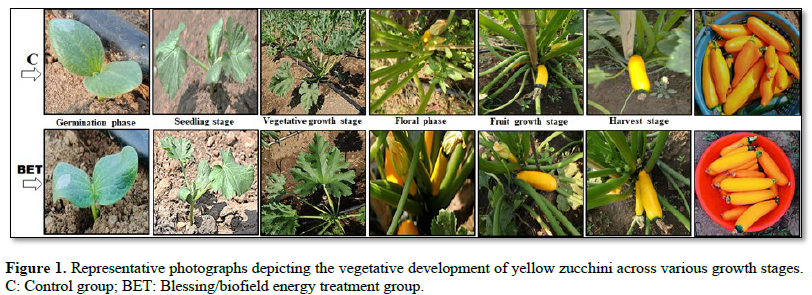
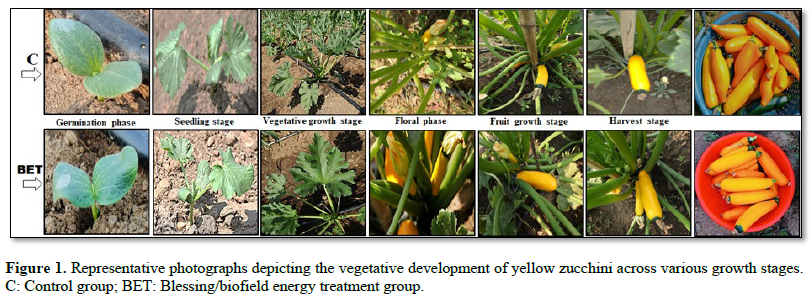
Growth and yield metrics for yellow zucchini were documented at regular intervals throughout its cultivation. Figure 1 illustrates the plant's complete developmental cycle, encompassing the germination, seedling, vegetative, flowering, fruiting, and harvest stages.
Morphological characteristics
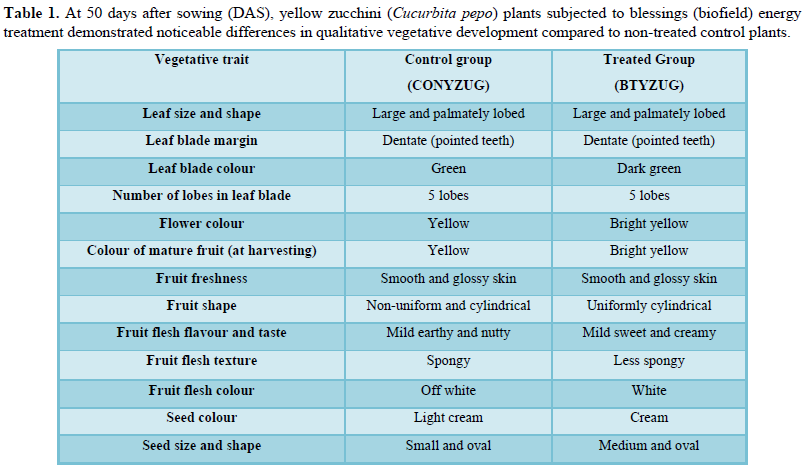
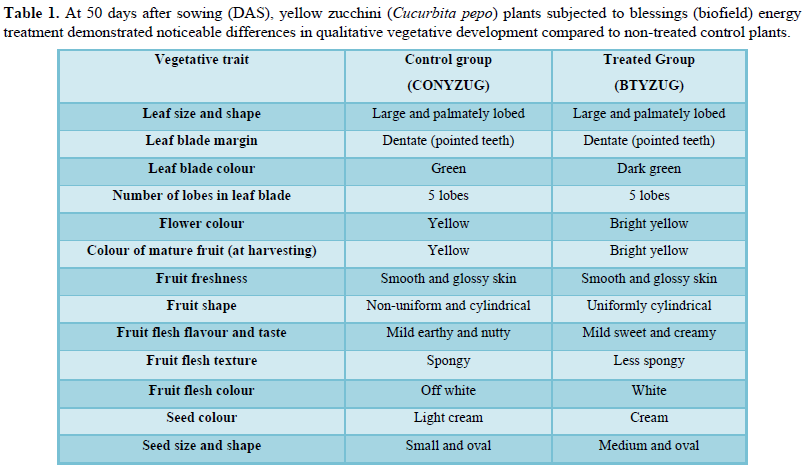
As outlined in Table 1, the application of blessing (biofield) energy treatment resulted in notable phenotypic differences in the vegetative and reproductive morphology of yellow zucchini (BTYZUG) compared to the untreated control (CONYZUG). Green leaf blade colour was observed for CONYZUG, whereas dark green colour was found in BTYZUG. The flower colour of CONYZUG and BTYZUG was yellow and bright yellow, respectively. The colour of matured fruit at harvesting was bright yellow in the BTYZUG group, and the CONYZUG group had yellow fruits. The fruit shape was non-uniform and cylindrical in the CONYZUG, while uniformly cylindrical in the BTYZUG. The fruit flesh flavour and taste were mild earthy and nutty in the CONYZUG while it was mild sweet and creamy in the BTYZUG. The fruit flesh texture and colour were spongy and off-white in the CONYZUG, while it was observed as less spongy and white in the BTYZUG. The CONYZUG group had light cream seed colour and the BTYZUG had cream colour seed. The small and oval-shaped seeds were found in CONYZUG, while medium and oval-shaped was observed in the BTYZUG (Table 1). Plant leaf size and shape, leaf blade margin, number of lobes in leaf blade, and fruit freshness were unaltered in the treatment group compared to the control.
Phenology and yield traits
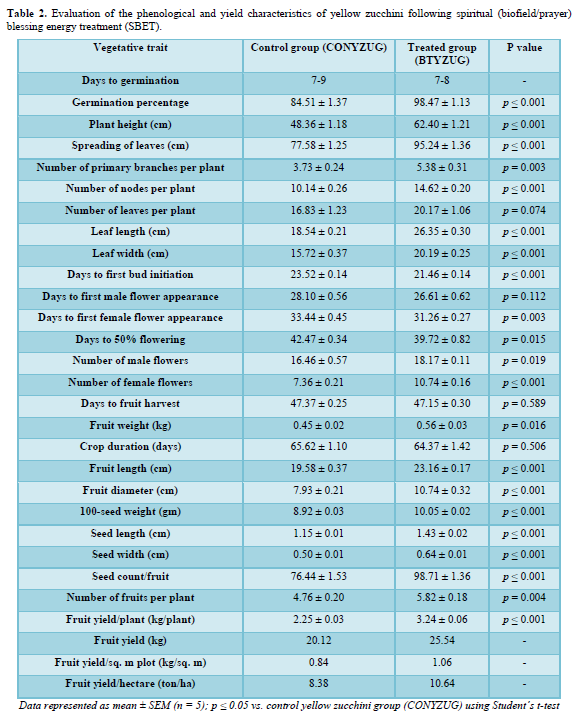
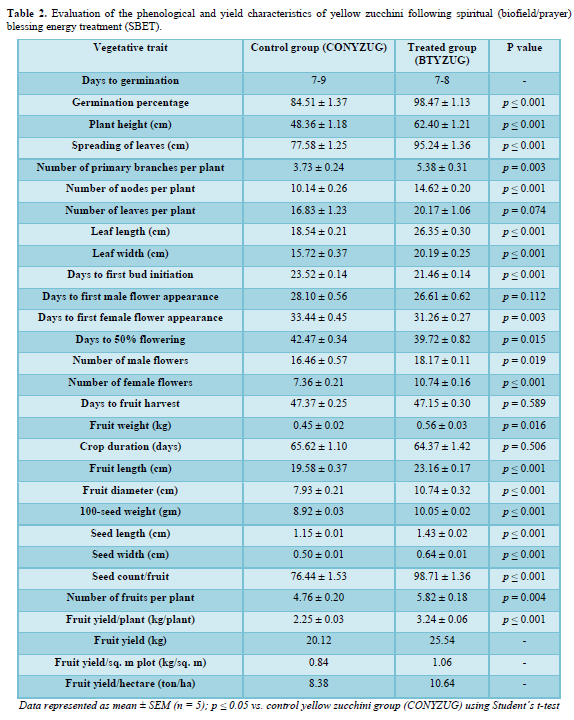
Compared with CONYZUG, application of SBET in BTYZUG significantly enhanced plant performance across all evaluated physiological, phenological, and yield traits (Table 2). Seed germination rate increased by 16.52% (p ≤ 0.001) in the BTYZUG compared to CONYZUG. BTYZUG promoted robust vegetative growth, marked by substantial increases in plant height (29.03%, p ≤ 0.001), leaf spread (22.76%, p ≤ 0.001), primary branch count (44.24%, p = 0.003), and node count (44.18%, p ≤ 0.001) compared to the CONYZUG. Leaf dimensions also improved significantly, with length and width expanding by 42.13% (p ≤ 0.001) and 28.44% (p ≤ 0.001), respectively. Phenologically, BTYZUG accelerated plant development, reducing the days to initial bud initiation (8.76%, p ≤ 0.001), first female flower emergence (6.52%, p = 0.003), and 50% flowering (6.48%, p = 0.015). Reproductive output favored higher productivity, showing increases in male (10.39%, p = 0.019) and female flower counts (45.92%, p ≤ 0.001). Consequently, fruit physical characteristics improved, including fruit weight (24.44%, p = 0.016), fruit length (18.28%, p ≤ 0.001), fruit diameter (35.44%, p ≤ 0.001), and fruit count per plant (22.27%, p = 0.004). Seed traits followed a parallel upward trajectory, exhibiting significant (p ≤ 0.001) increases in seed count per fruit (29.13%), seed length (24.35%), seed width (28.00%), and 100-seed weight (12.67%). Together, these combined enhancements culminated in a 26.97% overall increase in total fruit yield per hectare (Table 2).
DISCUSSION
The present study demonstrated a profound enhancement in the agricultural performance of yellow zucchini (Cucurbita pepo) following spiritual blessing/biofield energy treatment (The Trivedi Effect®). The physiological improvements began with a highly significant increase in the seed germination rate for the biofield-treated yellow zucchini group (BTYZUG) compared to the control (CONYZUG). Rapid and uniform seed germination was a fundamental prerequisite for establishing a robust crop stand, which directly dictates the ultimate yield potential and resilience in Cucurbita pepo cultivars [10]. The underlying mechanism for such systemic physiological enhancements across both seeds and mature plants was attributed to the biofield energy treatment, an intervention that has been shown to optimize physiological, cellular, and nutrient-uptake processes in terrestrial agriculture [11].
Following this initial developmental stage, BTYZUG promoted exceptionally robust vegetative growth. The treatment led to substantial increases in plant height, primary branch count, and node count compared to the CONYZUG. Expanding the structural framework of the yellow zucchini plant enables superior light interception and carbohydrate synthesis. Leaf dimensions also improved significantly, with expansion of leaf length and width, resulting in a wider leaf spread. Extensive canopy and leaf area development in yellow squash was directly correlated with higher photosynthetic capacity, supplying the necessary metabolic energy surplus required to support a heavier vegetative and fruit load [12]. Phenologically, the biofield energy-treatment accelerated plant development, which was a highly desirable trait for maximizing seasonal crop cycles. BTYZUG significantly reduced the days to initial bud initiation, first female flower emergence, and 50% flowering. Furthermore, reproductive output favored higher productivity through a massive surge in female flowers and increase in male flowers. As because of yellow zucchini is a monoecious crop, manipulating the floral sex ratio to increase the absolute proportion of female flowers is the primary biological driver for maximizing the total fruit count per plant [10, 12].
The synergistic downstream effect of these vegetative and floral enhancements culminated in vastly superior physical fruit characteristics. The BTYZUG demonstrated prominent increases in fruit weight, fruit length, and fruit diameter. The assimilation and partitioning of photosynthates into the fruit sink were evidently optimized, serving as a critical determinant for producing marketable, high-yield Cucurbita pepo crops [10]. Consequently, the fruit count per plant rose, which interacted with the elevated individual fruit weight to generate a massive increase in total fruit yield per hectare. Parallel to the flesh enhancements, the reproductive fitness of the seeds exhibited an identical upward trajectory. BTYZUG plants produced fruits with highly significant (p ≤ 0.001) increases in seed count per fruit, seed length, seed width, and 100-seed weight. The overall improvement in these seed dimensional traits signify enhanced embryo growth and superior nutrient storage, which were essential markers of genetic transfer and vigor for the next generation of yellow zucchini cultivation [12]. Together, these combined enhancements across the plant's life cycle validate the treatment as a highly effective approach to augment overall productivity.
CONCLUSION
Based on the findings of this study, the application of Spiritual Blessings/Biofield Energy Treatment (SBET) exerted a statistically significant, positive influence on both the vegetative development and reproductive performance of Golden Summer Squash / Yellow Zucchini (Cucurbita pepo L.). Specifically, the treated plants (BTYZUG) demonstrated superior agronomic metrics across all measured parameters compared to the control group (CONYZUG). The substantial and statistically robust enhancements, particularly in female flower counts, primary branching, and leaf length, indicated that SBET effectively stimulated physiological and morphological pathways conducive to higher crop productivity. Ultimately, these synchronized vegetative and reproductive advancements culminated an increase in total fruit yield per hectare, suggesting that blessing (biofield) energy treatments represent a viable, non-invasive avenue for optimizing agricultural output and crop resilience in cucurbit cultivation.
ABBREVIATIONS
SBET: spiritual blessing energy treatment; CONYZUG: control yellow zucchini group; BTYZUG: biofield energy-treated yellow zucchini group
ACKNOWLEDGEMENT
The authors are grateful to Divine Connection Foundation for the assistance and support during the work.
CONFLICT OF INTERESTS
Author MKT was employed by Trivedi Global, Inc. VDK, NRP, and TBG were employed by Shree Angarsiddha Shikshan Prasarak Mandal’s College of Agriculture, Sangulwadi, Mohitewadi, Maharashtra, India. Authors SM and SJ were employed by Trivedi Science Research Laboratory Pvt. Ltd.
FUNDING
The authors declare that no funds, grants, or other support were received during the preparation of this manuscript.
- Abd-Elkader DY, Mohamed AA, Feleafel MN, Al-Huqail AA, Salem MZM, Ali HM, Hassan HS. Photosynthetic pigments and biochemical response of zucchini (Cucurbita pepo L.) to plant-derived extracts, microbial, and potassium silicate as biostimulants under greenhouse conditions. Frontiers in Plant Science, 2022;13:879545. https://doi.org/10.3389/fpls.2022.879545
- Richardson KVA. Preliminary evaluation of a yellow zucchini squash (Cucurbita pepo L.) variety for the fresh market and for use as a frozen vegetable. Gladstone road agricultural centre crop research report, No. 11, 2012.
- Hassan AA, Abdel-Ati KEA, Mohamed MIA. Squash germplasm evaluation for some vegetative growth, flowering and yield characters. Middle East Journal of Agriculture Research, 2016;05(01):109-116.
- Soniya T, Arivazhagan E. Evaluation of summer squash genotypes (Cucurbita pepo L.) under tropical conditions. Ecology, Environment and Conservation, 2024; 30:S121-S123. https://doi.org/10.53550/EEC.2024.v30i04s.021
- Savvas D, Magkana P, Yfantopoulos D, Kalozoumis P, Ntatsi G. Growth and nutritional responses of zucchini squash to a novel consortium of six Bacillus sp. strains used as a biostimulant. Agronomy, 2024;14(2):362. https://doi.org/10.3390/agronomy14020362
- Wyrwicka A, Urbaniak M. The different physiological and antioxidative responses of zucchini and cucumber to sewage sludge application. PLoS One, 2016;11(6):e0157782. https://doi.org/10.1371/journal.pone.0157782
- Trivedi D, Kadam VD, Phutankar NR, Gaikwad TB, Mondal S, Jana S. Modulation of summer squash growth and productivity via spiritual blessings (biofield) energy treatment (SBET). Journal of Farming, 2026;1(3):12–20. https://doi.org/10.14302/issn.3070-2232.jf-26-6197
- Trivedi MK, Trivedi D, Branton A, Kadam VD, Phutankar NR, Gaikwad TB, Mondal S, Jana S. Morphological attributes and yield of Momordica charantia (bitter gourd) under the application of spiritual blessing/biofield energy treatment (BET). Journal of Farming, 2026;1(3):1-11. https://doi.org/10.14302/issn.3070-2232.jf-26-6051
- Richer-de-Forges AC, Arrouays D, Chen S, Dobarco MR, Libohova Z, Roudier P, Minasny B, Bourennane H. Hand-feel soil texture and particle-size distribution in central France. Relationships and Implications, CATENA, 2022;213:106155. https://doi.org/10.1016/j.catena.2022.106155
- Kaur B, Garcha KS, Sandhu JS, Sharma M, Dhatt AS. Interspecific hybridization for transfer of hull-less seed trait from Cucurbita pepo to C. moschata. Scientific Reports, 2023;13(1):4627. https://doi.org/10.1038/s41598-023-29935-9
- Trivedi MK, Branton A, Trivedi D, Nayak G, Mondal SC, Jana S. Impact of biofield energy treatment on soil fertility. Earth Sciences, 2015;4(6):275-279. https://doi.org/10.11648/j.earth.20150406.19
- Uddain J, Tripti SI, Jahan MS, Sultana N, Rahman MJ, Subramaniam S. Changes of morphological and biochemical properties in organically grown zucchini squash (Cucurbita pepo L.). HortScience, 2019;54(9):1485–1491. https://doi.org/10.21273/HORTSCI14168-19
-
 Table 1
 -
Table 2
QUICK LINKS
- SUBMIT MANUSCRIPT
- RECOMMEND THE JOURNAL
-
SUBSCRIBE FOR ALERTS
RELATED JOURNALS
- Journal of Microbiology and Microbial Infections (ISSN: 2689-7660)
- Proteomics and Bioinformatics (ISSN:2641-7561)
- Journal of Genetics and Cell Biology (ISSN:2639-3360)
- Journal of Veterinary and Marine Sciences (ISSN: 2689-7830)
- Journal of Womens Health and Safety Research (ISSN:2577-1388)
- Journal of Genomic Medicine and Pharmacogenomics (ISSN:2474-4670)
- Journal of Biochemistry and Molecular Medicine (ISSN:2641-6948)