

47
Views & Citations10
Likes & Shares
In recent years, alternative physical biostimulation modalities, such as biofield energy treatment and spiritual blessing interventions, have gained attention in agricultural science [5]. Biofield energy treatment (SBET) has been reported to modulate soil fertility, microbial dynamics, and vegetative growth parameters across agricultural crops [6]. However, a comprehensive evaluation of Spiritual Blessing/Biofield Energy Treatment (SBET) on the specific morphological progression, phenological milestones, and yield characterization of Citrullus lanatus remains systematically under-explored. Therefore, this study was designed to characterize the morphological development, phenological performance, and yield efficiency of watermelon subjected to Spiritual Blessing/Biofield Energy Treatment under field conditions.
MATERIALS AND METHODS
Study site
Field evaluation took place in Bhandarwadi, Sindhudurg, Maharashtra, India (15°37′–16°40′ N, 73°19′–74°13′ E, 26 m above the mean sea level). Climatic conditions feature peak temperatures of 39 °C during late spring (April–May) contrasting with cooler winters (8–25 °C, December–February). Unpredictable rainfall distribution regularly triggers transient soil moisture stress during active crop growth.
Seed source and experimental design
Hybrid watermelon seeds (Citrullus lanatus L., 95% purity, Lot No. 19558699, Syngenta India Pvt. Ltd.) were evaluated using a randomized complete block design (RCBD) with three biological replicates. The study evaluated two treatment groups: an untreated/control watermelon group (CONWAMG) and a biofield energy-treated watermelon cohort (BTWAMG). All experimental units were maintained under standardized agronomic conditions including uniform irrigation, fertilizers application, and crop protection protocols to minimize environmental variance.
Plot design
Treatments were arranged in a RCBD (three replicates). Experimental plots (22.0 m²; 5.5 m × 4.0 m) were separated by 0.5-m buffers, with plant spacing strictly maintained at 0.5 m × 0.5 m. Pre-sowing basal fertilization (50 kg N ha⁻¹, 100 kg P ha⁻¹, and 50 kg K ha⁻¹) was directly incorporated into the upper soil horizon.
Spiritual blessing (biofield/prayer) energy treatment (SBET) strategy
The experimental group (watermelon seeds and designated crop land soil) received a single 4-minute session of distant biofield energy treatment from a spiritual practitioner with over 14 years of experience (Ms. Alice Branton, Florida, USA) via a real-time web-conferencing platform under controlled ambient conditions (28 ± 2 °C and 65 ± 5% relative humidity). The control group (identical seeds and soil) received no treatment and was maintained under equivalent environmental conditions.
Soil characterization and sample preparation
The experimental site was characterized by a well-drained, brownish-red loam with low baseline fertility. Prior to trial establishment, composite topsoil samples (30 cm depth) were air-dried and sieved through a 2-mm mesh for baseline characterization. Soil particle size distribution was determined according to Richer-de-Forges et al. [7], and soil pH was measured potentiometrically in a 1:2 (w/v) soil-to-deionized water suspension using a calibrated pH meter.
Agronomic management and plant protection
To facilitate crop establishment, direct-seeded plots were hand-watered for the first 8 days post-sowing before transitioning to a surface drip irrigation system (pressure-compensating emitters at 0.5 m spacing; 3.0 L h⁻¹ flow rate). Before sowing during soil preparation, basal fertilizers were applied uniformly across all the plots at the proportion of 50–100–50 kg ha⁻¹ (N–P–K), providing full requirements of P (single superphosphate) and K (muriate of potash) along with 50% of N (urea). The remaining N fraction was top-dressed at 21 days after sowing (DAS). Insect pest management was standardized across all treatments via a foliar spray of Hamla 550 (Gharda Chemicals Ltd., India) was applied at 2.0 mL L⁻¹.
Growth and morphological parameters
To evaluate morpho-agronomic and yield dynamics, five plants per plot were randomly sampled. At 90 DAS, vegetative parameters comprising vine length (m), primary branch count, internode length (cm), stem diameter (cm), leaf count, and leaf dimensions (cm) were recorded alongside qualitative leaf morphology (blade shape, coloration, margin type, and pubescence). At harvest, fruit morphological and quality traits were evaluated, including qualitative attributes (fruit shape, skin, and flesh color) and quantitative attributes: fruit dimensions (length and diameter, cm), flesh thickness (cm), rind thickness (mm), individual fruit mass (kg), and fruit yield per plant and total yield (t ha⁻¹). Seed morphometry was subsequently characterized by measuring seed dimensions (length, width, and thickness, cm), seed count per fruit, and 100-seed mass (g).
Yield parameters
Yield evaluation was conducted on five randomly selected representative plants per plot. Watermelon (C. lanatus) fruits were harvested upon reaching physiological maturity. Morphometric dimensions including polar length and equatorial diameter (cm) were measured and individual fruit mass (kg) was determined using a calibrated digital balance. Cumulative fruit yield per plot was subsequently converted to yield per hectare (t ha-1).
Statistical analysis
Continuous variables were expressed as mean ± standard error of the mean (SEM). Comparisons between two independent cohorts were performed using a two-tailed, unpaired Student's t-test. Statistical significance was defined as p < 0.05. All analyses were conducted using SigmaPlot (version 14.0).
RESULTS
Soil properties
Blessing/Biofield energy-treated watermelon (BTWAMG) significantly improved both the physical and chemical properties of the sandy loam soil matrix compared to CONWAMG, as evidenced by enhanced water-holding capacity and elevated levels of exchangeable cations such as Ca2+, Mg2+, and Na+ (data not shown).
Phenological progression and morphology of watermelon
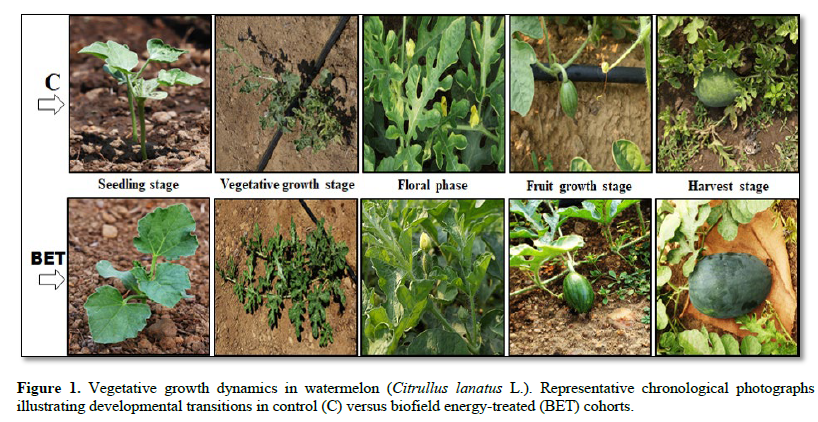
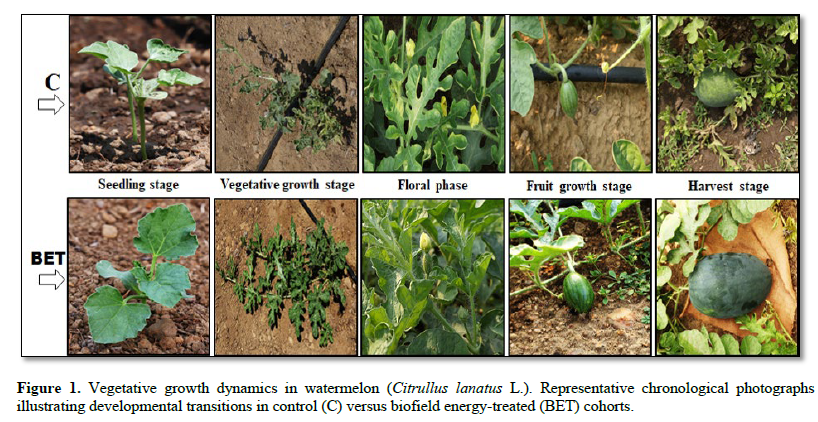
Morpho-physiological and yield-related parameters of Citrullus lanatus were tracked sequentially at five benchmark phenological stages: seedling, vegetative growth, floral phase, fruit growth, and harvest (Figure 1).
Morphological characteristics
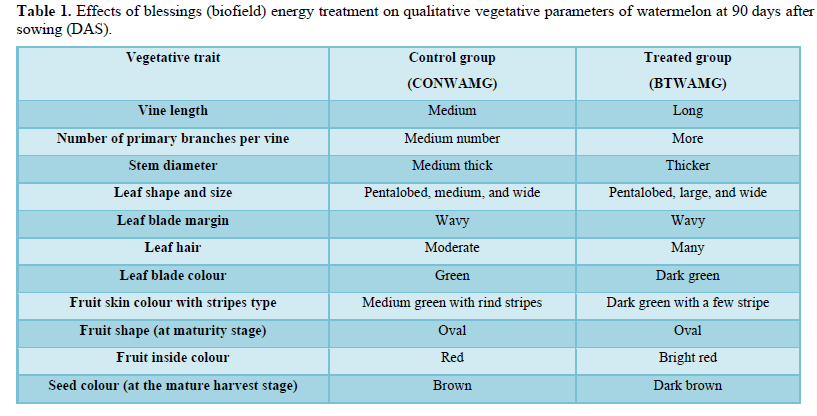
Distinct phenotypic variations were observed between the control (CONWAMG) and blessing/biofield energy-treated (BTWAMG) groups across several key vegetative and reproductive descriptors (Table 1). Compared to the control, BTWAMG plants exhibited enhanced vegetative vigor, characterized by increased vine length, greater primary branch frequency, thicker stem diameter, larger leaves, denser foliar pubescence, and darker green blade pigmentation. Fruit and seed morphology were similarly altered: BTWAMG fruits developed dark green epicarps with sparse rind striping, bright red flesh, and dark brown seeds, whereas CONWAMG fruits displayed medium green epicarps with standard striping, red flesh, and brown seeds. Both groups consistently produced wavy leaf blade margins and oval fruit morphology at maturity (Table 1). Overall, these observations demonstrate a pronounced qualitative enhancement in both vegetative canopy architecture and reproductive traits following biofield energy treatment.
Phenology and yield traits
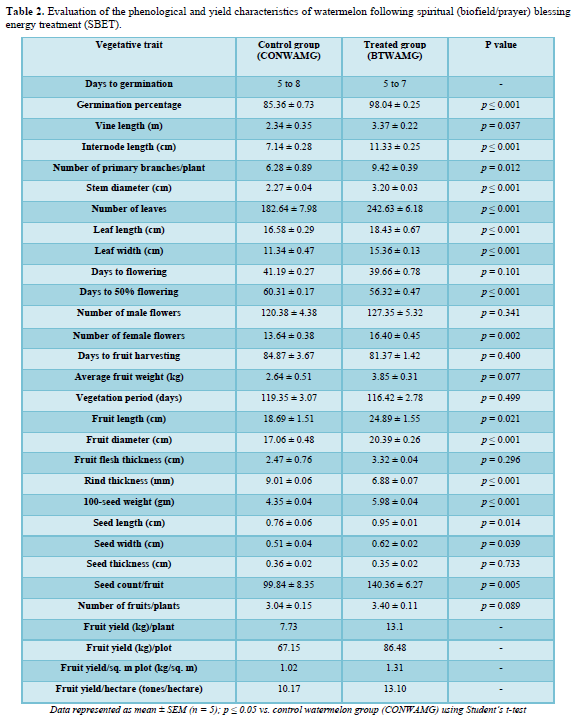
Relative to CONWAMG, BTWAMG significantly increased germination rate by 14.85% (p ≤ 0.001) and enhanced vegetative growth, improving vine length (44.02%, p = 0.037), internode length (58.68%, p ≤ 0.001), primary branch count (50%, p = 0.012), and stem diameter (40.97%, p ≤ 0.001). Leaf morphology also showed marked improvement in leaf count (32.85%, p ≤ 0.001), leaf length (11.16%, p ≤ 0.001), and leaf width (35.45%, p ≤ 0.001). Phenologically, BTWAMG took less time to 50% flowering by 6.62% (p ≤ 0.001); while boosting of female flower counts (20.23%, p = 0.002) compared to the CONWAMG. Yield parameters responded positively, with increases in fruit length (33.17%, p = 0.021) and fruit diameter (19.52%, p ≤ 0.001) accompanied by 23.64% (p ≤ 0.001) reduction in rind thickness. Furthermore, seed metrics followed a similar upward trend, with significant increases in seed count per fruit (40.58%, p = 0.005), seed length (25%, p = 0.014), and 100-seed weight (37.47%, p ≤ 0.001) in the BTWAMG compared to the CONWAMG. Together, these improvements drove a 28.81% expansion in total fruit yield per hectare in the BTWAMG compared to the CONWAMG (Table 2).
DISCUSSION
The phenotypic variations observed between BTWAMG and control (CONWAMG) plants highlight a clear physiological and morphological shift across both vegetative and reproductive tissues. The substantial enhancement of vegetative vigor observed in BTWAMG plants characterized by increased vine length, higher primary branch frequency, thicker stem diameter, and larger leaf surface area, demonstrates optimized vegetative growth and resource partitioning due to the effects of SBET (Table 1). Similar growth enhancements in watermelon have been documented by Luo et al. 2026 [8]. This pronounced enhancement in overall plant architecture aligns with the core principles established by Selim et al. 2026 and demonstrated that beneficial microbial interactions and biological treatments stimulate systemic growth pathways, promote cell division in apical meristems, and facilitate macro- and micronutrient uptake across crop species [9]. In this study, BTWAMG plants improved denser foliar pubescence and darker green blade pigmentation. Also increased trichome density which served as an adaptive structural mechanism in cucurbits to modulate microclimate, reduce transpiration loss, and confer protection against biotic stress. Besides, darker green pigmentation correlates with elevated chlorophyll densities and enhanced photosynthetic efficiency [10].
Here, the transition from medium green epicarps (fruit skin colour) with standard rind striping in CONWAMG to dark green epicarps with sparse rind striping in BTWAMG indicates substantial modulation of epidermal pigment synthesis and rind pattern development. The genetic regulation and phenotypic expression of background skin color and stripe intensity in watermelon were reported by Gusmini et al. 2006 [11]. Furthermore, the shift from standard red flesh in CONWAMG to bright red flesh in BTWAMG points toward heightened secondary metabolite synthesis, particularly carotenoid accumulation. Bright red flesh coloration in mature watermelon fruit was governed by lycopene accumulation and chromoplast differentiation, a metabolic process systematically evaluated by Yu et al. 2022 [12]. Moreover, the darker brown seed coat was observed in BTWAMG seeds compared to the brown seeds of CONWAMG, suggests an accelerated physiological maturity and increased phytomelanin or polyphenol deposition in the seed testa. These seed coat pigmentation mechanisms in watermelon were detailed by Mavi, 2010 [13]. The significant acceleration in germination rate was observed in the BTWAMG highlights enhanced seed metabolic reactivation and seedling vigor, establishing a robust foundation for early crop establishment. This early developmental momentum translated directly into augmented vegetative architecture, evidenced by substantial improvements in vine length, internode length, primary branch count, and stem diameter. These structural enhancements were supported by foundational findings on watermelon seed metabolism and vigor dynamics [14].
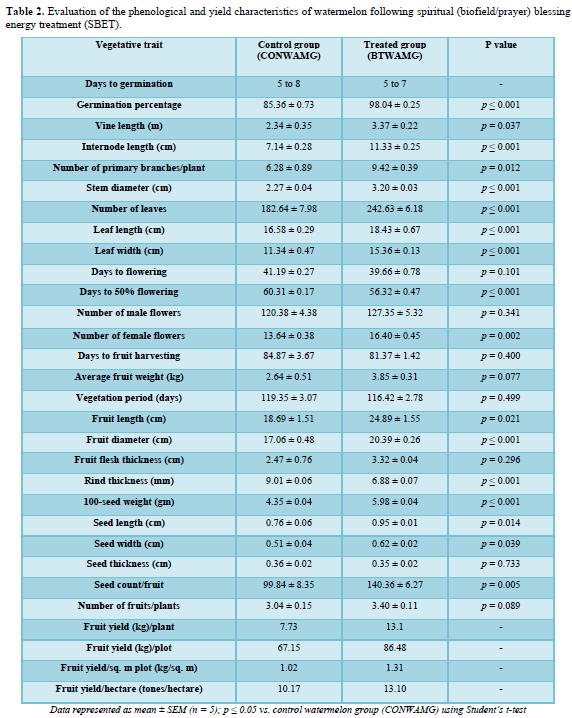
In addition to primary stem elongation, leaf canopy architecture exhibited marked structural expansion, characterized by notable increases in leaf count, leaf length, and leaf width. Enlargement of the total leaf surface area directly enhances photon interception and light-use efficiency, providing greater carbon assimilate capacity necessary to support demanding sinks during subsequent reproductive phases in watermelon crops [15]. The enhanced assimilate supply and superior floral establishment ultimately driven by BTWAMG resulted in major improvements to fruit physical characteristics, including increases in fruit length and fruit diameter. Remarkably, these dimensional expansions were accompanied by a reduction in rind thickness. A thinner rind coupled with enlarged fruit dimensions significantly enhances edible flesh yield and consumer preference metrics, corroborating physiological models of cell division and expansion during watermelon pericarp tissue development [16]. Consistent with fruit dimensional growth and seed morphometry displayed significant positive gains in the BTWAMG, including increases in seed count per fruit, seed length, and 100-seed weight. Enhanced seed mass and seed loading serve as crucial physiological indicators of strong endosperm sink capacity and efficient nutrient translocation during maturation, which collectively underpinned the overall expansion in total commercial fruit yield per hectare observed in BTWAMG compared to CONWAMG [10].
CONCLUSION
Based on the experimental results, the spiritual blessing energy treatment (The Trivedi Effect®) significantly enhances both the vegetative architecture and reproductive yield parameters of watermelon plants compared to untreated control. The treatment acts as a potent growth-promoting agronomic intervention. By simultaneously optimizing vegetative establishment, canopy expansion, and reproductive efficiency, the treatment achieved a significant expansion in fruit yield per hectare. Consequently, this treatment demonstrates strong commercially viable potential for maximizing overall crop productivity and agricultural efficiency in watermelon cultivation.
ABBREVIATIONS
SBET: spiritual blessing energy treatment; CONWAMG: control watermelon group; BTWAMG: biofield energy-treated watermelon group; SSP: single super phosphate; MOP: muriate of potash
ACKNOWLEDGEMENT
The authors are grateful to Divine Connection Foundation for the assistance and support during the work.
CONFLICT OF INTERESTS
Author AB was employed by Trivedi Global, Inc. NRP, VDK, and TBG, were employed by Shree Angarsiddha Shikshan Prasarak Mandal’s College of Agriculture, Sangulwadi, Mohitewadi, Maharashtra, India. Authors SM and SJ were employed by Trivedi Science Research Laboratory Pvt. Ltd.
FUNDING
The authors declare that no funds, grants, or other support were received during the preparation of this manuscript.
- Coşkun ÖF, Gülşen O. Molecular, morphological and phytochemical characterization of some watermelon (Citrullus lanatus) genotypes. Horticultural Science, 2024;51(3): 189–201. https://doi.org/10.17221/5/2023-hortsci
- Mandizvo T, Odindo AO, Mashilo J. Citron watermelon potential to improve crop diversification and reduce negative impacts of climate change. Sustainability, 2021; 13(4):2269. https://doi.org/10.3390/su13042269
- Haq MT, Ahmed MS. Evaluation of growth and yield performance of year round watermelon (Citrullus lanatus): Growth and yield of year round watermelon. South Asian Journal of Agriculture, 2023;9(1-2):80-85. https://doi.org/10.3329/saja.v9i1-2.70096
- Yismaw G, Fantaw S, Ayalew A. Data on effect of mulches on growth and fruit yield of watermelon (Citrullus lanatus) varieties in west Dembia district, central Gondar zone, Ethiopia. Data in Brief, 2024;53:110071. https://doi.org/10.1016/j.dib.2024.110071
- Matos LC, Machado JP, Monteiro FJ, Greten HJ. Perspectives, measurability and effects of non-contact biofield-based practices: A narrative review of quantitative research. International Journal of Environmental Research and Public Health, 2021;18(12):6397. https://doi.org/10.3390/ijerph18126397
- Trivedi MK, Branton A, Trivedi D, Nayak G, Mondal SC, Jana S. Impact of biofield energy treatment on soil fertility. Earth Sciences, 2015;4(6):275-279. https://doi.org/10.11648/j.earth.20150406.19
- Richer-de-Forges AC, Arrouays D, Chen S, Dobarco MR, Libohova Z, Roudier P, Minasny B, Bourennane H. Hand-feel soil texture and particle-size distribution in central France. Relationships and implications, CATENA, 2022;213:106155. https://doi.org/10.1016/j.catena.2022.106155
- Luo Z, Wang A, Quan W, Li C, Wang B. Application of biochar for the prevention and control of soil continuous cropping obstacles in solanaceous vegetables: A review. Biochar X 2026;2:e013. https://doi.org/10.48130/bchax-0026-0012
- Selim KA, Bolla J, Förderer A, Maurino VG, Fernie AR. Plant structural biology: State of the art and future prospects. The Plant Journal, 2026;127(3):e71012. https://doi.org/10.1111/tpj.71012
- Guo S, Zhang J, Sun H, Salse J, Lucas WJ, Zhang H, Zheng Y, Mao L, Ren Y, Wang Z, Min J, Guo X, Murat F, Ham BK, Zhang Z, Gao S, Huang M, Xu Y, Zhong S, Bombarely A, Mueller LA, Zhao H, He H, Zhang Y, Zhang Z, Huang S, Tan T, Pang E, Lin K, Hu Q, Kuang H, Ni P, Wang B, Liu J, Kou Q, Hou W, Zou X, Jiang J, Gong G, Klee K, Schoof H, Huang Y, Hu X, Dong S, Liang D, Wang J, Wu K, Xia Y, Zhao X, Zheng Z, Xing M, Liang X, Huang B, Lv T, Wang J, Yin Y, Yi H, Li R, Wu M, Levi A, Zhang X, Giovannoni JJ, Wang J, Li Y, Fei Z, Xu Y. The draft genome of watermelon (Citrullus lanatus) and resequencing of 20 diverse accessions. Nature Genetics,2013;45(1):51-8. https://doi.org/10.1038/ng.2470
- Gusmini G, Wehner TC. Qualitative inheritance of rind pattern and flesh color in watermelon. Journal of Heredity, 2006;97(2):177-85. https://doi.org/10.1093/jhered/esj023
- Yu Y, Guo S, Ren Y, Zhang J, Li M, Tian S, Wang J, Sun H, Zuo Y, Chen Y, Gong G, Zhang H, Xu Y. Quantitative transcriptomic and proteomic analysis of fruit development and ripening in watermelon (Citrullus lanatus). Frontiers in plant science, 2022;13:818392. https://doi.org/10.3389/fpls.2022.818392
- Mavi K. The relationship between seed coat color and seed quality in watermelon crimson sweet. Horticultural Science, 2010;37(2): 62–69. https://doi.org/10.17221/53/2009-HORTSCI
- Nerson H. Effects of seed maturity, extraction practices and storage duration on germinability in watermelon. Scientia Horticulturae, 2002;93(3-4):245-256. https://doi.org/10.1016/S0304-4238(01)00332-6
- Zaaroor-Presman M, Alkalai-Tuvia S, Chalupowicz D, Beniches M, Gamliel A, Fallik E. Watermelon rootstock/scion relationships and the effects of fruit-thinning and stem-pruning on yield and postharvest fruit quality. Agriculture, 2020;10(9):366. https://doi.org/10.3390/agriculture10090366
- Zhu Q, Gao P, Liu S, Zhu Z, Amanullah S, Davis AR, Luan F. Comparative transcriptome analysis of two contrasting watermelon genotypes during fruit development and ripening. BMC Genomics, 2017;18(1):3. https://doi.org/10.1186/s12864-016-3442-3
-
 Table 1
 -
Table 2
QUICK LINKS
- SUBMIT MANUSCRIPT
- RECOMMEND THE JOURNAL
-
SUBSCRIBE FOR ALERTS
RELATED JOURNALS
- Journal of Genetics and Cell Biology (ISSN:2639-3360)
- Journal of Astronomy and Space Research
- Journal of Genomic Medicine and Pharmacogenomics (ISSN:2474-4670)
- Advances in Nanomedicine and Nanotechnology Research (ISSN: 2688-5476)
- Proteomics and Bioinformatics (ISSN:2641-7561)
- Journal of Womens Health and Safety Research (ISSN:2577-1388)
- Journal of Agriculture and Forest Meteorology Research (ISSN:2642-0449)