

22
Views & Citations10
Likes & Shares
Maximizing the agronomic productivity of Luffa cylindrica requires the exploration of specialized cultivation methods and advanced intercropping systems. Modifying the vegetative and reproductive microclimate through multi-species plant patterns has shown substantial promise in upgrading per-plant fruit biomass, protecting environmental biomes, and boosting overall land-use efficiency ratios in challenging or contaminated cultivation media [3].
Despite its broad ecological distribution, traditional sponge gourd farming continues to confront significant vulnerabilities during critical growth stages. The overarching phenological timeline, early seedling establishment, and final fruit morphology are heavily governed by complex molecular pathways and transcriptional regulatory networks that remain highly sensitive to extreme abiotic stressors like low-temperature variations and low sunlight exposure, which can spark catastrophic yield reductions [4].
To safely mitigate these physiological stress barriers and optimize the developmental cycles of this vegetable crop without altering genetic structures or relying on hazardous chemicals, alternative biophysical interventions such as the Trivedi Effect® (blessing/biofield energy treatment) were actively being investigated [5]. Based on the reported data, the authors explored to see the effects of the spiritual blessing energy treatment (SBET) on the vegetative growth parameters, phenotypic presentation, seed germination integrity, and overall economic yield metrics of Luffa cylindrica.
MATERIALS AND METHODS
Study site
This study was conducted in Bhandarwadi, Sindhudurg, Maharashtra, India (15°37’–16°40’ N, 73°19’–74°13’ E; 26 m above mean sea level.), situated within the tropical Konkan agro-climatic zone. The region features a hyper-thermic temperature regime, with mean maximum pre-monsoon temperatures reaching 38 - 41°C. Pronounced interannual rainfall variability induces severe seasonal soil moisture deficits, which increases crop vulnerability to drought stress and potentially compromises physiological mechanisms during critical phenological stages.
Seed source and experimental design
Genetically pure (98%) sponge gourd (Luffa cylindrica cultivar 'Desi'; Lot No. NUSP0099, Label: 00218) seeds were procured from Namdeo Umaji Agritech (India) Pvt. Ltd. The field experiment was structured as a randomized complete block design (RCBD) featuring two treatment groups with three replicates each: an untreated control (CONSPGG) and a biofield energy treatment (BTSPGG). To minimize confounding variables, both cohorts were cultivated under identical agronomic and environmental regimes, utilizing standardized irrigation, fertilization, and pest management protocols.
Field layout
The experimental site occupied a total area of 80.0 m², arranged in a RCBD consisting of six individual plots (4.5 m × 2.5 m each; plot area = 11.25 m²) separated by 0.5-m buffer zones between adjacent plots and replications. Within each plot, crops were established using a grid spacing of 0.5 m × 0.5 m. Prior to sowing, the site was cleared of vegetation debris, and basal fertilizer was uniformly incorporated into the topsoil of each plot at rates of 50 kg ha⁻¹ N, 100 kg ha⁻¹ P, and 50 kg ha⁻¹ K.
Spiritual blessing (biofield/prayer) energy treatment (SBET) strategy
The experimental group, designated as BTSPGG (comprising Luffa cylindrica seeds and corresponding soil), received a single, 4-minute exposure to a biofield energy treatment (BET). The treatment was administered via a non-contact, physical-presence modality by an experienced (more than 14 years) practitioner Mrs. Dahryn Trivedi stationed at a static distance of 0.5 m from the matrices to eliminate tactile confounding variables. Concurrently, the control group (CONSPGG; untreated seeds and soil) was maintained under identical environmental conditions without intervention. To ensure reproducibility, ambient parameters during the exposure period were regulated at a temperature of 28 ± 2°C and a relative humidity of 65 ± 5%.
Soil characterization and sample preparation
To establish baseline physicochemical properties, composite topsoil samples (30 cm depth) were collected from each plot using a systematic five-point sampling design. Samples were air-dried at ambient temperature, sieved to <2 mm, and stored at 4°C prior to analysis. Soil particle size distribution was determined according to established protocols [6]. Soil pH was measured potentiometrically in a 1:2 (w/v) soil-to-deionized water suspension.
Agronomic management and plant protection
Following direct sowing, we maintained the experimental plots via manual irrigation for a 7-day crop establishment window before transitioning to a surface drip irrigation system. The irrigation architecture featured pressure-compensating emitters spaced at 0.5 m intervals with a nominal discharge rate of 3 L h-1. Fertilizer was applied at a baseline rate of 50:100:50 kg ha-1 of N, P, and K, respectively. The entire allocation of P (supplied as single superphosphate) and K (supplied as muriate of potash), along with a 50% fraction of the total N (supplied as urea), was incorporated basally at sowing. The remaining 50% N split-application was side-dressed at 21 days after sowing (DAS). To prevent pest-induced confounding effects and maintain uniform biotic pressure, insect populations were controlled using a foliar application of a commercial insecticide blend (50% chlorpyrifos + 5% cypermethrin; Hamla 550, Gharda Chemicals Ltd., Mumbai, India) at 2 mL L-1.
Growth and morphological parameters
Vegetative and reproductive parameters were assessed 70 days after sowing (DAS) using five randomly selected plants per plot. Morphological traits were categorized into qualitative attributes, including growth habit, stem shape, stem pubescence, leaf blade lobing depth, leaf blade color, fruit skin color, fruit shape, seed color, and seediness. The quantitative measurements comprised primary vine length (m), primary branch number, nodes per vine, internode length (cm), stem diameter (cm), days to 50% flowering, fruit weight (g), cumulative fruit yield (t ha⁻¹), and the dimensions (length and width) of leaves, fruits, and seeds, alongside seed count per fruit.
Yield parameters
To evaluate yield components, five plants were randomly sampled from each net plot. Sponge gourd (Luffa cylindrica) fruits were harvested at physiological maturity; fruit length and diameter were measured using digital caliper, and individual fruit mass was determined on a calibrated electronic balance. Total fruit yield per plot (kg) was subsequently scaled to tonnes per hectare (t ha⁻¹).
Statistical analysis
Quantitative variables are expressed as the mean ± standard error of the mean (SEM). Inter-group differences between the two independent cohorts were evaluated using a two-tailed Student’s t-test. All statistical analyses were performed using SigmaPlot (version 14.0), and statistical significance was defined a priori at p < 0.05.
RESULTS
Soil properties
Initial characterization identified a strongly acidic (pH 5.01) sandy loam prone to low effective cation exchange capacity (ECEC) and concomitant nutrient leaching. Post-harvest, SBET application mitigated this acidity, shifting the soil pH upward to 5.90.
Phenological progression and morphology of Luffa cylindrica
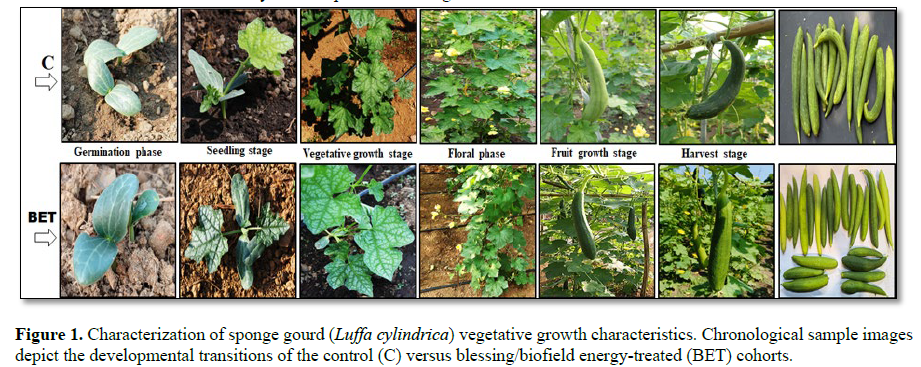
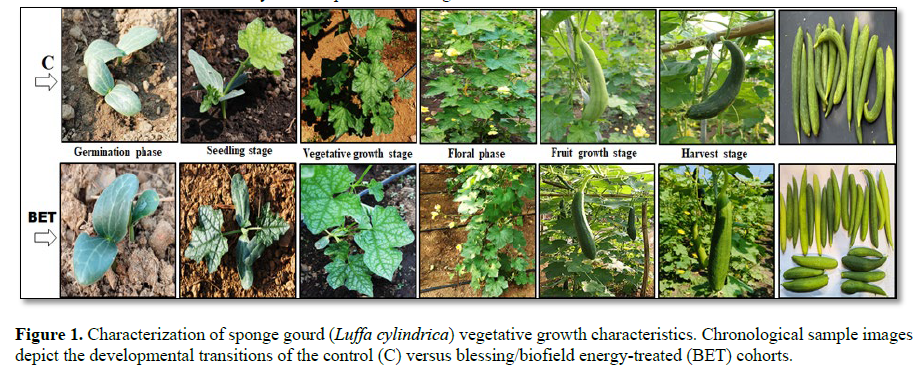
To map the ontogenesis of Luffa cylindrica (L.) Roxb., we systematically tracked its morphology across distinct growth stages. This study provides a quantified phenological timeline that captures critical developmental milestones from germination and seedling establishment through vegetative expansion, anthesis, and fruit maturation (Figure 1).
Morphological characteristics
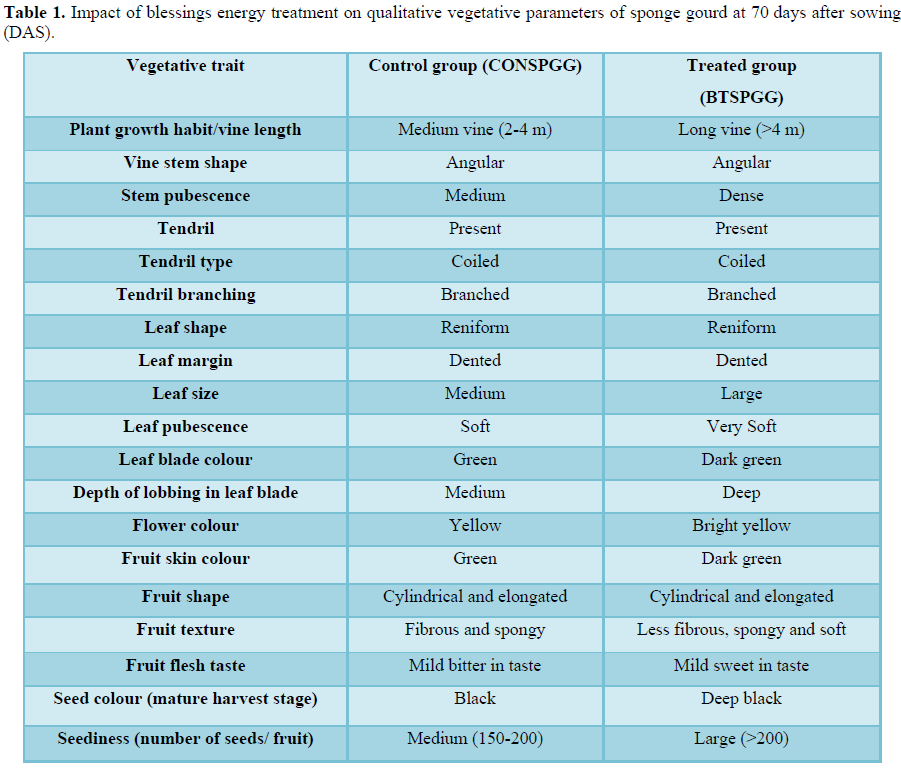
The qualitative vegetative and reproductive descriptors of sponge gourd are summarized in Table 1. Notable phenotypic variations between the control (CONSPGG) and biofield energy-treated (BTSPGG) groups were observed across vine, leaf, fruit, and seed characteristics. The BTSPGG cohort exhibited enhanced vegetative vigor, characterized by longer vine lengths, dense stem pubescence, and large leaf sizes with deep lobing, compared to the medium vine lengths, medium stem pubescence, medium leaf sizes, and medium lobing observed in the CONSPGG group. Additionally, leaf pubescence in the BTSPGG group was distinctly softer than CONSPGG. Foliar and floral pigmentation also intensified following treatment; BTSPGG displayed dark green leaf blades and bright yellow flowers, whereas CONSPGG exhibited green leaf blades and standard yellow flowers. Distinct treatment-induced variations were also evident in fruit and seed morphology. CONSPGG fruits were characterized by green skins, a highly fibrous and spongy internal texture, and a mildly bitter flesh taste. Conversely, BTSPGG fruits developed dark green skins, a softer texture with reduced fibrousness and sponginess, and a slightly sweet flavor profile. Seed traits varied significantly: CONSPGG presented light black seeds with medium seediness (150–200 seeds per fruit), while BTSPGG produced dark black seeds with high seediness (greater than 200 seeds per fruit). Despite these divergences, both groups maintained identical phenotypic patterns for vine stem shape, tendril morphology (including type and branching), leaf shape, leaf margin, and fruit shape (Table 1). Many qualitative morphological traits in BTSPGG were better than those in CONSPGG, indicating the superior quality of the treated sponge gourd fruits.
Phenology and yield traits
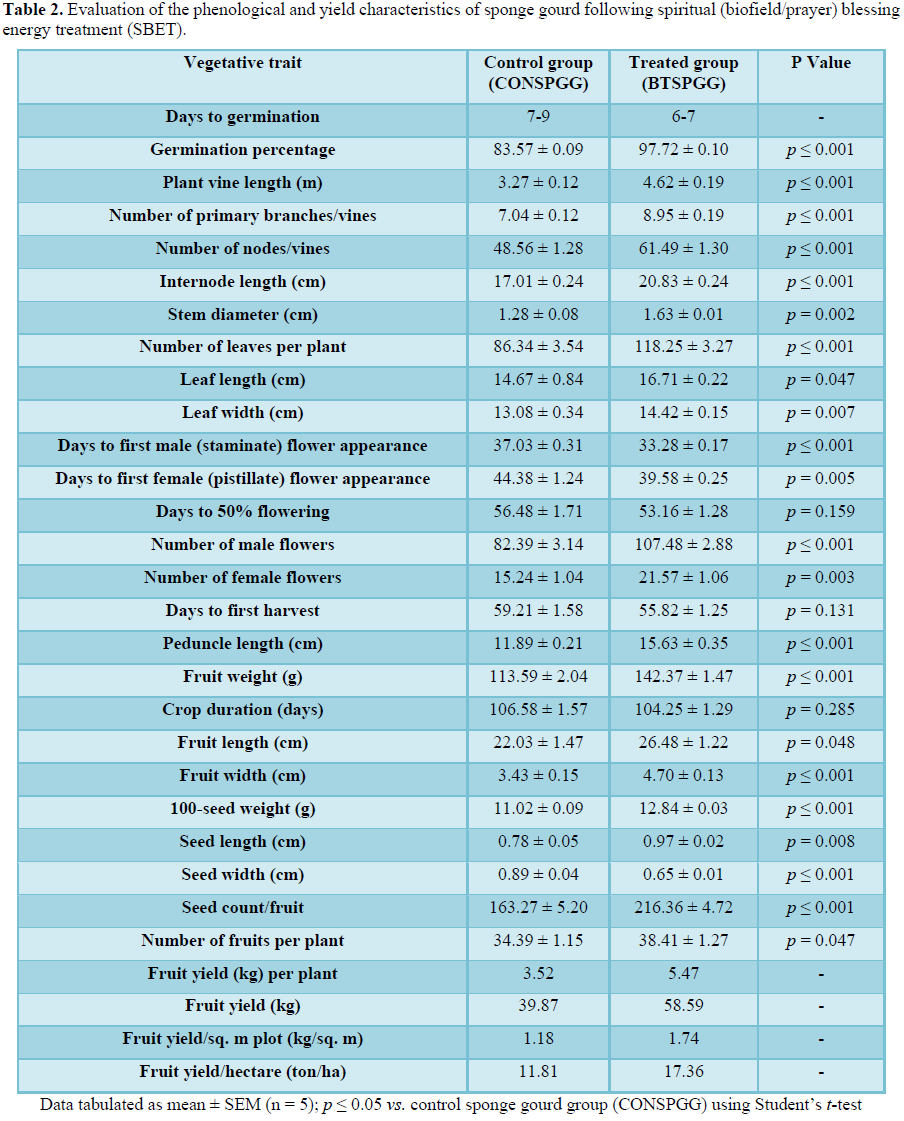
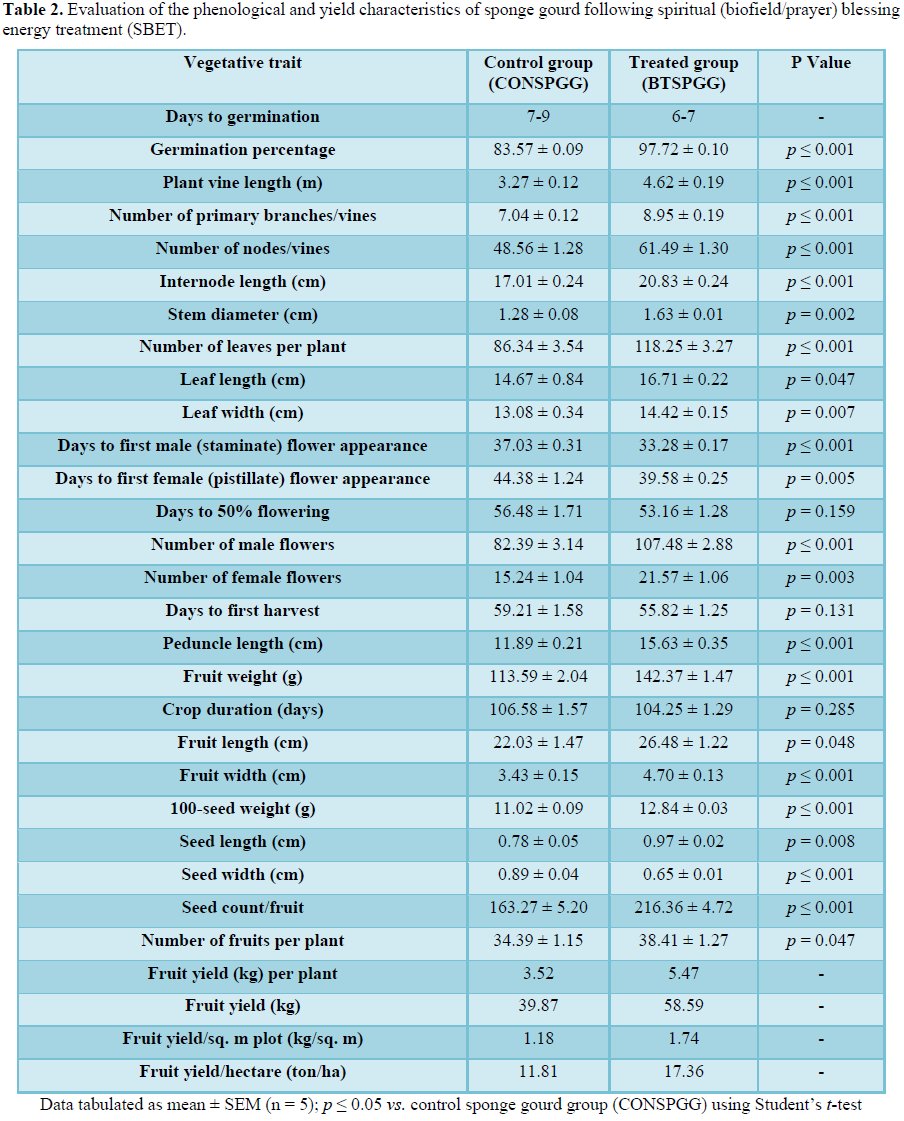
Compared to the control (CONSPGG), the BTSPGG treatment elicited significant enhancements across all evaluated growth, physiological, and yield parameters. The germination rate increased by 16.93% (p ≤ 0.001). Vegetative growth was substantially promoted in the BTSPGG, with significant increases observed in vine length (41.28%, p ≤ 0.001), number of primary branches (27.13%, p ≤ 0.001), number of nodes (26.63%, p ≤ 0.001), internode length (22.46%, p ≤ 0.001), and stem diameter (27.34%, p = 0.002) compared to the CONSPGG. Leaf morphological characteristics also improved significantly under BTSPGG treatment, including leaf number per plant (36.96%, p ≤ 0.001), leaf length (13.91%, p = 0.047), and leaf width (10.24%, p = 0.007) than CONSPGG. Reproductive phenology and yield components were altered favorably. The number of male and female flowers increased by
30.45% (p ≤ 0.001) and 41.54% (p = 0.003), respectively, while the days to first male and female anthesis were significantly reduced by 10.13% (p ≤ 0.001) and 10.82% (p = 0.005). Furthermore, yield-attributing traits such as peduncle length (31.46%, p ≤ 0.001), fruit weight (25.34%, p ≤ 0.001), fruit length (20.20%, p = 0.048), fruit width (37.03%, p ≤ 0.001), and the number of fruits per plant (11.69%, p = 0.047) were all significantly enhanced. This culminated in a 46.99% expansion in overall fruit yield per hectare was observed in the BTSPGG compared to the CONSPGG. Seed metrics followed a similar upward trend, with significant increases in seed count per fruit (32.12%, p ≤ 0.001), seed length (24.36%, p = 0.008), seed width (26.97%, p ≤ 0.001), and 100-seed weight (16.52%, p ≤ 0.001) (Table 2).
DISCUSSION
The BTSPGG demonstrated a remarkable capacity to enhance initial seed viability and structural architecture in sponge gourd, as evidenced of boost in germination rate and extensive vegetative promotion compared to the control (CONSPGG). The significant elevations in vine length, primary branches, nodes, internode length, and stem diameter demonstrate that the treatment effectively shifts cellular dynamics toward rapid elongation and robust mechanical tissue expansion. These outcomes indicate an optimized vegetative framework capable of managing increased physiological demands, a trend that mirrors morphological improvements observed during elite line selections within Luffa species as characterized by Bindal et al. 2023 [7]. Concurrently, leaf morphological properties experienced distinct upgrades under the BTSPGG regimen, showcasing an increased leaf count per plant along with significant expansions in both leaf length and width. This structural configuration significantly increases the total photo-assimilatory canopy surface area, allowing for maximized light interception and elevated net photosynthetic rates. Such physical enhancements in the foliar architecture were vital for building a heavy carbohydrate pool, aligning with agricultural practices designed to maximize biomass accumulation and land use efficiency in climbing cucurbit models as documented by Chen et al. 2022 [8].
The transition from vegetative growth to reproductive phases was significantly accelerated and amplified in the BTSPGG group, marked by advanced maturity and higher flower counts. The time required for first male and female anthesis was significantly shortened, while the absolute counts of male and female blossoms were expanded. The simultaneous drop-in days to anthesis and the pronounced development of pistillate (female) nodes represent a favourable shift in sex expression, which directly minimizes abortive sites and maximizes harvest potential. These field dynamics correspond tightly with previous non-traditional biostimulant trials executed on related monoecious cucurbit architectures, which revealed accelerated blooming and highly optimized floral phenotypes as established author’s previous publication [9].
The physical optimization across vegetative and reproductive stages culminated in a substantial expansion in overall fruit yield per hectare for the BTSPGG group over the CONSPGG control. This major yield increment was structurally supported by improvements in specific yield-attributing components, such as peduncle length, individual fruit weight, fruit length, fruit width, and the total number of fruits per plant (Table 2). The balanced scaling of fruit length and width prevents structural deformities, confirming that the treatment successfully coordinates uniform sink-source relationships during rapid fruit filling phases, a critical baseline noted during structural hybridization studies in the Luffa genus by Sidhu et al. 2021 [10].
Finally, seed development metrics tracked a matching upward trajectory in the BTSPGG, including significant increases in seed count per fruit, seed length, seed width, and 100-seed weight (Table 2). Enhanced seed dimensions and mass reflect a substantial accumulation of maternal carbohydrates, proteins, and lipids within the cotyledons, which provides a physiological explanation for the improved germination recorded at the beginning of the crop cycle. This positive relationship between seed morphological dimensions, weight allocation, and overall maternal partitioning was typical of superior economic cultivars within the Luffa family as demonstrated by Prakash et al. 2014 [11].
CONCLUSION
These findings demonstrate that blessing energy treatment (Trivedi Effect®) can effectively modulate the phenotypical plasticity and reproductive efficiency of L. cylindrica. By accelerating maturity and substantially boosting yield without the inputs of synthetic chemicals, this approach presents a promising, sustainable alternative for modern crop management strategies designed to enhance agricultural productivity.
ABBREVIATIONS
SBET: spiritual blessing energy treatment; CONSPGG: control sponge gourd group; BTSPGG: biofield energy-treated sponge gourd group; SSP: single super phosphate; MOP: muriate of potash
ACKNOWLEDGEMENT
The authors are grateful to Divine Connection Foundation for the assistance and support during the work.
CONFLICT OF INTERESTS
Author DT was employed by Trivedi Global, Inc. NRP, VDK, and TBG were employed by Shree Angarsiddha Shikshan Prasarak Mandal’s College of Agriculture, Sangulwadi, Mohitewadi, Maharashtra, India. Authors SM and SJ were employed by Trivedi Science Research Laboratory Pvt. Ltd.
FUNDING
The authors declare that no funds, grants, or other support were received during the preparation of this manuscript.
- Fernández-Lambert G, Lavoignet-Ruiz M, García-Santamaría LE, Fernández-Echeverría E, Ruvalcaba-Sánchez L, Brenis-Dzul A, Borroto-Pentón Y, Romero-Romero Y, Carrión-Delgado JM. Evaluation of the adaptation and feasibility of direct-sown sponge gourd (Luffa cylindrica) cultivation in a subtropical climate in Mexico. Agriculture, 2025;15(3):287–304. https://doi.org/10.3390/agriculture15030287
- Tyagi R, Bhardwaj R, Suneja P, Sureja AK, Munshi AD, Arya L, Riar A, Verma M. Harnessing sponge gourd: An alternative source of oil and protein for nutritional security. Frontiers in Nutrition, 2023;10:1158424. https://doi.org/10.3389/fnut.2023.1158424
- Chen W, Yang Y, Meng D, Ying J, Huang H, Li H. Luffa cylindrica intercropping with semen cassiae—A production practice of improving land use in soil contaminated with arsenic. Plants, 2022;11(23):3398. https://doi.org/10.3390/plants11233398
- Liu J, Zhong H, Cao C, Wang Y, Zhang Q, Wen Q, Zhu H, Li Z. Identification of AP2/ERF transcription factors and characterization of AP2/ERF genes related to low-temperature stress response and fruit development in Luffa. Agronomy, 2024;14(11):2509. https://doi.org/10.3390/agronomy14112509
- Trivedi MK, Branton A, Trivedi D, Nayak G, Gangwar M, Jana S. Morphological and molecular analysis using RAPD in biofield treated sponge and bitter gourd. American Journal of Agriculture and Forestry, 2015;3(6):264-270. https://doi.org/10.11648/j.ajaf.20150306.14
- Richer-de-Forges AC, Arrouays D, Chen S, Dobarco MR, Libohova Z, Roudier P, Minasny B, Bourennane H. Hand-feel soil texture and particle-size distribution in central France. Relationships and implications, CATENA, 2022;213:106155. https://doi.org/10.1016/j.catena.2022.106155
- Bindal S, Sheu ZM, Kenyon L, Taher D, Rakha M. Novel sources of resistance to fusarium wilt in Luffa species. Frontiers in Plant Science, 2023;14:1116006. https://doi.org/10.3389/fpls.2023.1116006
- Araujo IM, Borges JA de O, Cabral KB, dos Santos Sá L, Pereira-de-Morais L, Brito Milfont CG, et al. Aqueous extract of Luffa cylindrica: modulation of antibiotic action and antioxidant and cytoprotective evaluation. Scientific Electronic Archives, 2026;19(4):1–7. https://doi.org/10.36560/19420262223
- Trivedi D, Kadam VD, Gaikwad TB, Phutankar NR, Mondal S, Jana S. Spiritual blessing energy treatment as an approach for boosting growth and yield of bottle gourd (Lagenaria siceraria). Journal of Plant Genetics and Crop Research, 2026; 1(2):30-37. https://doi.org/10.14302/issn.2641-9467.jgrc-26-6123
- Sidhu MK, Kaur J. Interspecific hybridization between sponge gourd (Luffa cylindrica) and 'Satputia' (Luffa hermaphrodita Singh & Bhandari) for preintrogression of cluster bearing, high yield and gynoecism. Journal of Genetics, 2021;100:73. PMID: 34706997.
- Prakash K, Radhamani J, Pandey A, Yadav S. A preliminary investigation of cultivated and wild species of Luffa for oil and protein contents. Plant Genetic Resources, 2014;12(1):103-111. https://doi.org/10.1017/S147926211300035X
-
 Table 1
 -
Table 2
QUICK LINKS
- SUBMIT MANUSCRIPT
- RECOMMEND THE JOURNAL
-
SUBSCRIBE FOR ALERTS
RELATED JOURNALS
- Advances in Nanomedicine and Nanotechnology Research (ISSN: 2688-5476)
- Proteomics and Bioinformatics (ISSN:2641-7561)
- Journal of Womens Health and Safety Research (ISSN:2577-1388)
- Journal of Genetics and Cell Biology (ISSN:2639-3360)
- Journal of Agriculture and Forest Meteorology Research (ISSN:2642-0449)
- Journal of Veterinary and Marine Sciences (ISSN: 2689-7830)
- Journal of Microbiology and Microbial Infections (ISSN: 2689-7660)