

51
Views & Citations10
Likes & Shares
Farmers traditionally depend on various targeted physical, chemical, or biological inputs to get a fruitful production, such as microbial and chemical biostimulants [1], precision irrigation management [5], and targeted environmental modulations [6, 7].
While these traditional physical and agrochemical strategies remain the bedrock of precision cultivation, modern agricultural science has actively searching for non-invasive, eco-friendly, and residue-free paradigms capable of supplementing crop resilience. Among these emerging frontiers, subtle energetic and biofield modifications, frequently applied through standardized intentional energetic protocols or focused blessings, generating preliminary curiosity within advanced biophysical and holistic plant research. Authors hypothesize that these non-contact, energy-based interventions may influence fundamental cellular dynamics, though their quantifiable, empirical validity remains a topic of scientific investigation. Because, C. melo possesses an incredibly sensitive physiological architecture that is highly responsive to external micro-environmental fluctuations, it serves as an excellent model candidate for evaluating the limits of alternative agronomic inputs. This study was designed to evaluate these concepts under controlled conditions. Specifically, we assessed the empirical efficacy of structured energetic interventions (spiritual blessings energy treatment) on the chronological phenological benchmarks, vegetative growth, and yield profiles of muskmelon (Cucumis melo).
MATERIALS AND METHODS
Study field site details
The study was located in Bhandarwadi, Sindhudurg (15°37’–16°40’ N, 73°19’–74°13’ E), within the tropical Konkan agro-climatic zone. The site experiences extreme pre-monsoon temperatures (39°C to 41°C) and erratic precipitation patterns. Such conditions frequently impose significant edaphic moisture stress, potentially detrimental to plant physiological integrity during sensitive growth phases.
Seed details and trial regimen
Seeds of Cucumis melo cv. ‘Sweet Moon’ (Namdeo Umaji Agritech, India; 90% purity, Lot NUU-5022305) were utilized to evaluate the effects of Spiritual Blessing Energy (Biofield) Treatment (SBET). The experimental design compared a control group (CONMUMG) against a treatment group (BTMUMG) subjected to a SBET. Systematic controls were implemented to eliminate confounding variables; specifically, irrigation, fertilization, and pest control regimes were maintained with strict uniformity across both groups to isolate the SBET as the sole independent variable.
Segregation of study area
The experiment followed a randomized complete block design (RCBD) consisting of two primary treatments and three replications. Individual experimental units (plots) measured 5.0 m × 4.0 m (20.0 m²), with 0.5 m buffer zones maintained between plots and blocks to minimize edge effects. Sowing was conducted at a spacing of 0.5 m × 0.5 m. During land preparation, basal NPK fertilizer (50, 100, and 50 kg ha⁻¹, respectively) was mechanically incorporated into the soil profile prior to sowing.
Spiritual blessing (biofield/prayer) energy treatment (SBET) strategy
The muskmelon seeds and experimental plots were divided into two groups: control/untreated muskmelon group (CONMUMG) and a biofield energy-treated muskmelon group (BTMUMG). The BTMUMG cohort was subjected to a remote/distant Biofield Energy Treatment (the Trivedi Effect®) one day prior to planting. The intervention was administered for approximately four minutes by an experienced practitioner (Ms. Alice Branton) via a remote web-conferencing platform from Florida, USA. During the treatment, the practitioner focused on intentionally transmitting biofield energy to the seeds and soil. The procedure was conducted under standard environmental conditions, with a temperature of 28 ± 2°C and a relative humidity of 65 ± 5%. The control group remained untreated and was maintained under identical environmental parameters to ensure consistency.
Soil characteristics
Baseline soil characteristics were assessed using composite samples obtained from a 30 cm depth via a systematic five-point sampling strategy. Samples were air-dried, sieved (
Plantation of seeds and its management
Post-sowing, experimental plots received daily manual irrigation for an initial 7-day period to facilitate uniform seedling emergence. Subsequently, irrigation was transitioned to a surface drip system equipped with pressure-compensating emitters (0.5 m spacing; 3 L h⁻¹ discharge rate). Mineral fertilization was applied at a total rate of 50:100:50 kg ha⁻¹ of nitrogen (N), phosphorus (P), and potassium (K), respectively. The sources of phosphorus from single superphosphate (SSP), potassium from muriate of potash (MOP), and nitrogen from urea. Total SSP, MOP, and 50% urea were mixed with the soil during soil preparation before seed before sowing. The remaining 50% urea was side-dressed at 21 days after sowing (DAS). To ensure standardized phytosanitary conditions, insect pests were controlled using a foliar application of a chlorpyrifos (50%) and cypermethrin (5%) premix (Hamla 550, Gharda Chemicals Ltd., Mumbai, India) at a concentration of 2 mL L⁻¹.
Plant growth parameters
Eighty days after sowing (DAS), five plants were randomly sampled per plot for comprehensive agromorphological characterization using standard phenotypic descriptors. Qualitative vegetative traits, including cotyledon and leaf blade dimensions, morphology (shape, margin), and foliage color were recorded alongside reproductive and carpological attributes, specifically fruit shape, rind, and flesh coloration, and seed characteristics. Quantitative growth dynamics were assessed by measuring vine length, primary branch and node counts, internode length, stem diameter, and total leaf area. Phenological and yield-related parameters included days to 50% flowering, fruit weight, fruit dimensions (longitudinal and transverse diameters), prolificacy (fruits per plant), mesocarp thickness, and total yield (t/ha). Additionally, seed morphometrics (length and width) were quantified.
Yield parameters
Fruits were harvested at physiological maturity, and morphometric characteristics (length and diameter) were quantified using digital calipers. Individual fruit mass was measured via a precision electronic balance. Total yield, assessed from five randomly sampled plants per net plot, was recorded and converted to tonnes per hectare (t/ha) for standardized comparison. Fruits were harvested at physiological maturity to determine morphometric parameters, including its length and diameter, using digital calipers. Individual fruit mass was recorded with a precision electronic balance. Total yield was calculated based on five plants per plot, randomly selected from the net area, and normalized to tonnes per hectare (t/ha) for comparative analysis.
DATA ANALYSIS
Continuous variables were reported as mean ± SEM. After confirming normality and equal variance, differences between two independent groups were analyzed using an unpaired, two-tailed Student’s t-test. Data processing and statistical evaluations were conducted in SigmaPlot (v14.0), and a p-value of less than 0.05 was considered statistically significant.
RESULTS
Soil properties analysis
The BTMUMG treatment group outperformed than CONMUMG in key physicochemical parameters, demonstrating superior water-holding capacity and enriched levels of exchangeable cations (Ca2+, Mg2+, and Na+). These findings indicate a substantive modification of the sandy loamy soil matrix (data not shown).
Morphology of muskmelon plants
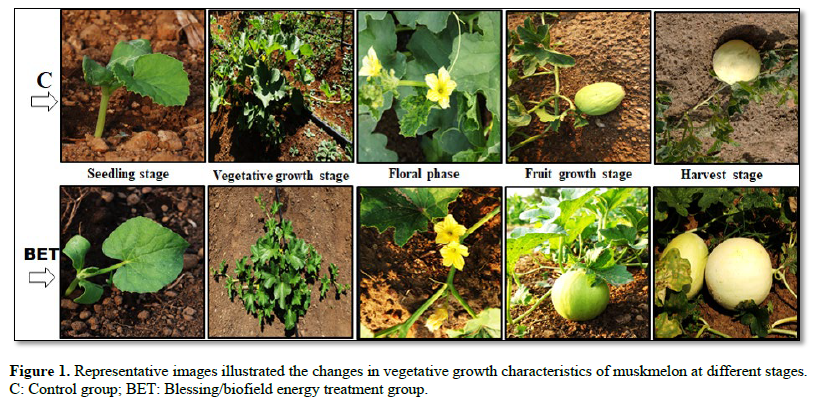
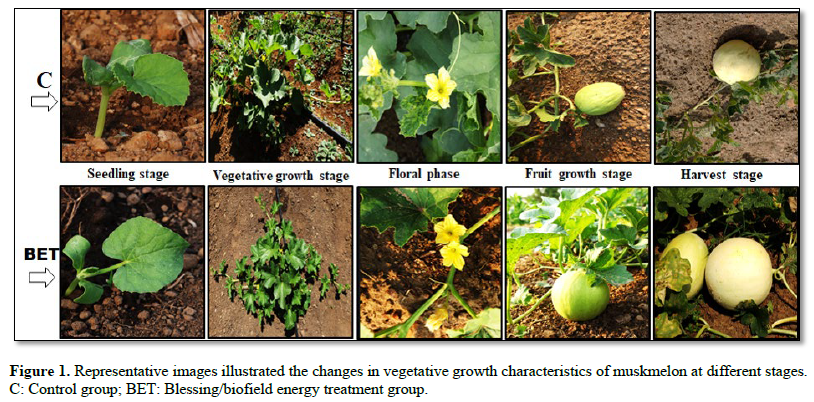
Morphological characterization of the muskmelon germplasm was performed through periodic assessments of key phenological stages. Systematic data collection tracked the transition from radical emergence and seedling establishment to the vegetative growth, reproductive (floral), and fructification stages, ending at the harvest-ready phase (Figure 1).
Morphological attributes
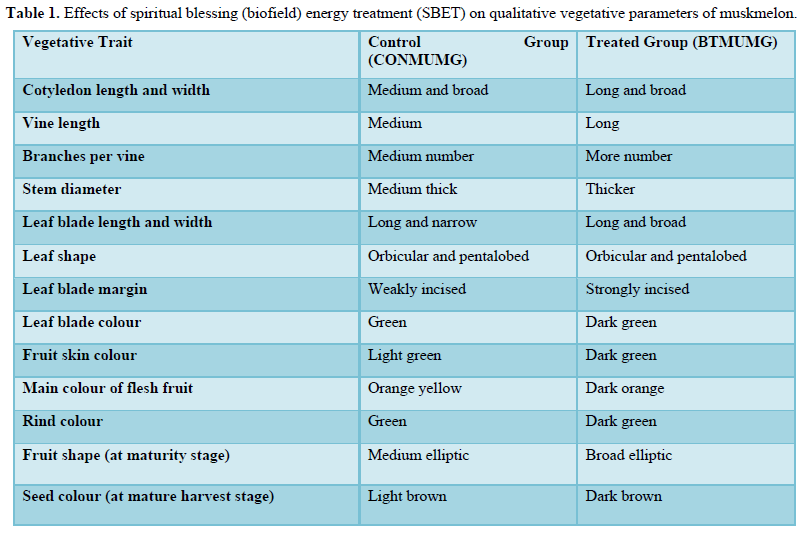
The morphological attributes like cotyledon length and width in the BTMUMG was longer than CONMUMG, which was medium. Plant vine length was longer for the BTMUMG and medium for the control group (CONMUMG). More numbers of branches per vine was observed in the BTMUMG, while medium in the CONMUMG. Thicker stem diameter was observed in the BTMUMG and the CONMUMG was medium. Long and narrow leaf blade length and width were found in CONMUMG, and long and broad leaf blade observed for BTMUMG. Leaf blade margin was strongly incised in the BTMUMG and weekly incised in the CONMUMG. Green leaf blade colour was observed for CONMUMG, whereas dark green colour was found in BTMUMG. The colour of the muskmelon skin fruit was dark green in the BTMUMG group, and CONMUMG had light green fruits. The flesh fruit colour was dark orange in the BTMUMG and it was orange yellow in CONMUMG. Rind colour was dark green in the BTMUMG and green in colour in the CONMUMG. The fruits shape was medium elliptic in the CONMUMG, while broad elliptic in the BTMUMG. The CONMUMG group had light brown seed colour, and the BTMUMG had dark brown seed colour (Table 1).
Phenology and yield traits
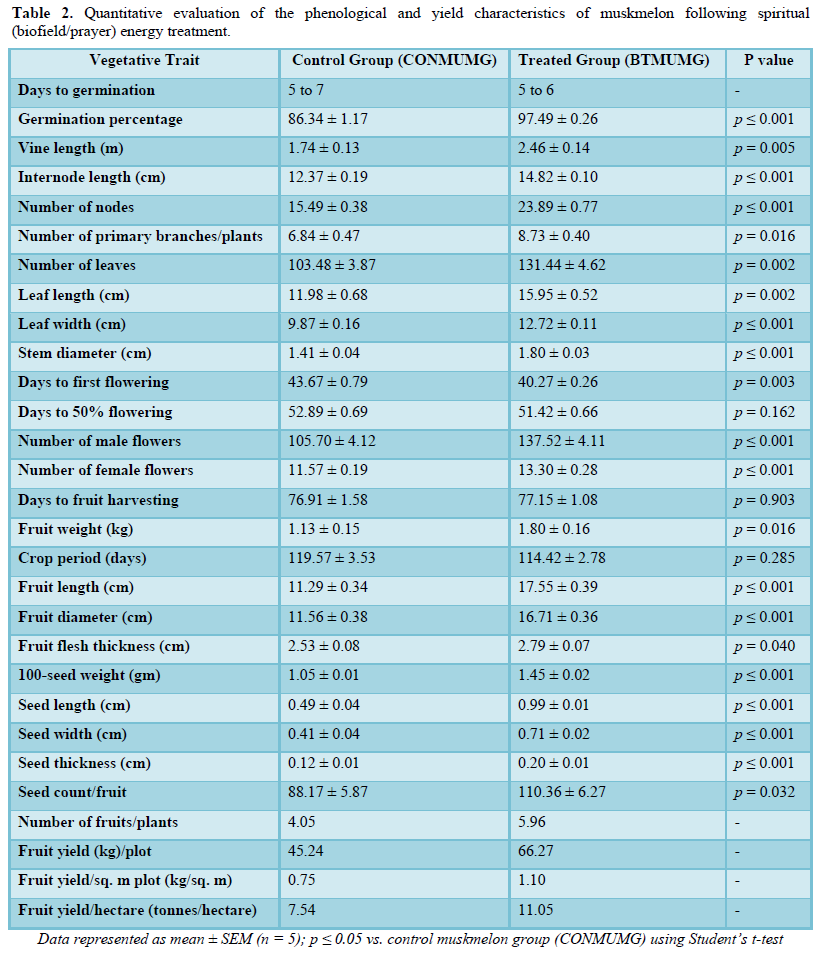
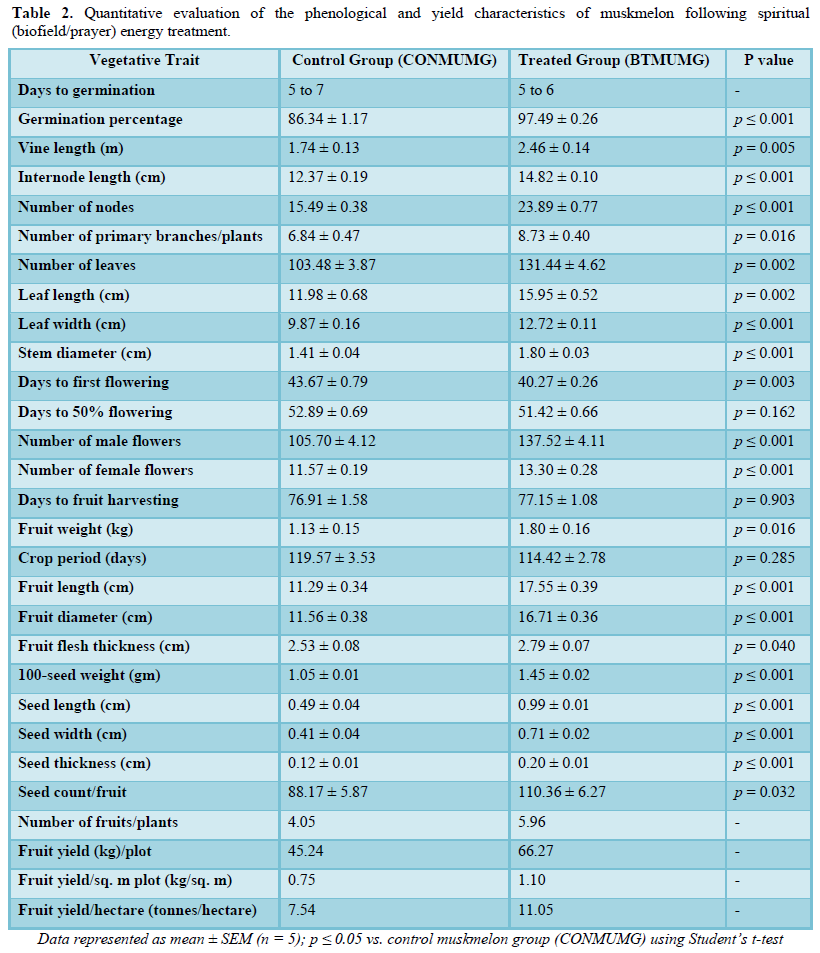
Compared to the control (CONMUMG), the BTMUMG group exhibited significant enhancements across all growth and yield-related parameters. All comparison was performed with respect to the control group (CONMUMG). Germination rates and plant vine length were significantly increased by 12.91% (p ≤ 0.001) and 41.38% (p = 0.005), respectively. Structural architecture was similarly improved significantly such as the number of primary branches, number of nodes, and internode length rose by 27.63% (p = 0.016), 54.23% (p ≤ 0.001), and 19.81% (p ≤ 0.001), respectively. Photosynthetic capacity also showed marked improvement: the number of leaves, leaf length, and leaf width increased significantly by 27.02% (p = 0.002), 33.14% (p = 0.002), and 28.88% (p ≤ 0.001), respectively. Furthermore, stem diameter saw a 27.66% (p ≤ 0.001) increase in the treatment group. Reproductive development was accelerated in BTMUMG, which reached first day flowering approximately three days earlier than the control. Male and female flower counts per plant were significantly rose by 30.10% (p ≤ 0.001) and 14.95% (p ≤ 0.001), respectively, in the BTMUMG compared to the CONMUMG. Substantial gains were observed in fruit metrics of BTMUMG, with fruit weight increased by 59.29% (p = 0.016), fruit length by 55.45% (p ≤ 0.001), fruit diameter by 44.55% (p ≤ 0.001), and fruit flesh thickness by 10.28% (p = 0.040), respectively, compared to the CONMUMG. Seed dimensions showed the most dramatic changes. Seed length, seed width, and seed thickness were significantly increased by 102.04% (p ≤ 0.001), 73.17% (p ≤ 0.001), and 66.67% (p ≤ 0.001), respectively in the BTMUMG compared to the CONMUMG. Moreover, number of seeds per fruit and weight of 100 seeds were significantly increased by 25.17% (p = 0.032) and 38.09% (p ≤ 0.001), respectively in the BTMUMG compared to the CONMUMG. Finally, the fruit yield (t/ha) was improved by 46.55% in the BTMUMG compared to the CONMUMG (Table 2).
DISCUSSION
The significant enhancement in the vegetative and reproductive performance of muskmelon (Cucumis melo L.) in the BTMUMG group compared to the control. The observed data indicated an increase in germination rate, which aligns with findings that specific soil amendments, particularly low-dose biochar, can optimize the seedbed environment to facilitate early seedling emergence [9, 10]. The substantial increase in vine length and the number of nodes suggest accelerated cell division and elongation, likely driven by improved nutrient availability and hormone-like signaling in the rhizosphere. Similar growth responses in muskmelon have been attributed to the synergistic effects of biostimulants and optimized media, which enhance the plant's structural architecture and nutrient uptake efficiency [11].
Furthermore, an increase in stem diameter in the BTMUMG indicates a more robust vascular system, which was critical for supporting the weight of developing fruits and facilitating the long-distance transport of water and photoassimilates [12, 13]. The marked improvements in leaf number, leaf length, and leaf width suggest a significantly higher total leaf area, which was a primary determinant of photosynthetic potential in cucurbits. Increased leaf area directly correlates with enhanced light interception and net photosynthetic rates, which was vital for the accumulation of soluble sugars in muskmelon fruits [14, 15]. The expansion of the photosynthetic source observed in the BTMUMG likely provides the necessary carbon skeleton for the enhanced yield traits recorded in this study. The acceleration of reproductive development, evidenced by BTMUMG reaching first-day flowering three days earlier than the control, suggests that the treatment influenced the plant's internal hormonal balance and thermal unit accumulation efficiency. Early flowering was a desirable trait in muskmelon as it can lead to an earlier harvest and potentially higher market value [16, 17]. This shift in phenology might be related to the regulation of phytohormones like auxin and gibberellins, which were known to orchestrate the transition from vegetative to reproductive phases in muskmelon.
The experimental results demonstrate that the BTMUMG group significantly outpaced the CONMUMG group across all key reproductive, carpological, and seed-related metrics of muskmelon (Cucumis melo L.). The dramatic rise in flower proliferation, where male and female flower counts per plant rose, underpins the enhanced reproductive vigor of the plant. This structural expansion in floral architecture directly impacts the total fruit-bearing capacity of the crop, as established phenotypic variations in total female flowers correlate strongly with cumulative yield metrics in muskmelon breeding programs [18]. This enhancement in flowering behavior translates seamlessly into robust developments in individual fruit dimensions. The BTMUMG group displayed major structural modifications, including increase in fruit weight, expansion in fruit length, enlargement in fruit diameter, and increase in fruit flesh thickness relative to the CONMUMG.
These morphometric surges point toward a highly efficient source-to-sink translocation mechanism, allowing more substantial assimilates to move into the fruit pulp during the post-reproductive and ripening phases [18]. Furthermore, final yield relies directly on positive genotypic and phenotypic correlations with fruit diameter, overall fruit weight, and edible flesh thickness [19]. Concurrently, the most drastic morphological shifts were observed within the seed compartment. In the BTMUMG group, seed length, seed width, and seed thickness grew significantly. This inner structural shift was backed by increase in the number of seeds per fruit and increase in the weight of 100 seeds. Such deep shifts in seed size and density underscore an alteration in fertilization efficiency and subsequent embryonic resource allocation [18].
Ultimately, these cumulative improvements in flowering, fruit dimensions, and seed mass culminated in a boost in total fruit yield (t/ha) for the BTMUMG group compared to the control. This robust yield progression matches broader agricultural paradigms in muskmelon production. Collectively, the findings highlight that the structural adjustments observed in the BTMUMG group work synergistically to maximize the biological and economic yield potential of muskmelon.
CONCLUSION
In conclusion, the comparative assessment between the BTMUMG and CONMUMG groups demonstrates that the spiritual blessing energy treatment (Trivedi Effect®) triggers a profound, holistic upgrade across the morphometric and yield of muskmelon (Cucumis melo L.). The marked escalation in both male and female floral architecture established a robust reproductive base, which effectively converted into substantial gains in fruit yield and dimensions. Ultimately, these multi-level structural enhancements worked synergistically to culminate in a substantial surge in total fruit yield (t/ha). These findings establish that the BTMUMG methodology holds significant agronomic potential to maximize both the physical quality traits and economic yield of commercial muskmelon cultivation.
ABBREVIATIONS
SBET: spiritual blessing energy treatment; CONMUMG: control muskmelon group; BTMUMG: biofield energy-treated muskmelon group; SSP: single super phosphate; MOP: muriate of potash
ACKNOWLEDGEMENT
The authors are grateful to Divine Connection Foundation for the assistance and support during the work.
CONFLICT OF INTERESTS
Author AB was employed by Trivedi Global, Inc. NRP, TBG, and VDK were employed by Shree Angarsiddha Shikshan Prasarak Mandal’s College of Agriculture, Sangulwadi, Mohitewadi, Maharashtra, India. Authors SM and SJ were employed by Trivedi Science Research Laboratory Pvt. Ltd.
FUNDING
The authors declare that no funds, grants, or other support were received during the preparation of this manuscript.
- Balusamy G, Prabhakaran J, Veerasamy R, Kandasamy V, Duraisamy S, Loganathan A. Muskmelon morpho-physiology and yield: The combined effect of biostimulants and phosphorus. Notulae Botanicae Horti Agrobotanici Cluj-Napoca. 2025;53(4):14816.
- Bae J, Kwak J, Park J. Exogenous ethanol application enhances drought tolerance and fruit quality in melon (Cucumis melo L.) across seasons. Journal of Bio-Environment Control. 2025;34(4):564-573. https://doi.org/10.12791/KSBEC.2025.34.4.564
- Adel MA, Emran SE, Esari MB. Study of growth rate and yield performance of five cultivars of Gorgak melons (Cucumis melo L.) using morphological traits in Sar-e-Pol province, Afghanistan. Nangarhar University International Journal of Biosciences. 2023;2(4):70-79. https://doi.org/10.70436/nuijb.v2i04.120
- Begaliev K, Tokhetova L, Urazbaev I, Masharipov NK. Ecological testing of foreign melon varieties (Cucumis melo L.) in the climatic conditions of the Kazakhstan’s Aral Sea region. Jordan Journal of Biological Sciences. 2026;19(1):1–11. https://doi.org/10.54319/jjbs/190101
- Chang L, Yin Y, Xiang J, Liu Q, Li D, Huang D. A phenotype-based approach for the substrate water status forecast of greenhouse netted muskmelon. Sensors. 2019;19(12):2673. https://doi.org/10.3390/s19122673
- Alenazi M. Response of muskmelon cultivars to plastic mulch and irrigation regimes under greenhouse conditions. Journal of Animal and Plant Sciences. 2015;25(5):105–112.
- Wu W, Chen L, Liang R, Huang S, Li X, Huang B, Luo H, Zhang M, Wang X, Zhu H. The role of light in regulating plant growth, development and sugar metabolism: a review. Frontiers in Plant Science, 2025;15:1507628. https://doi.org/10.3389/fpls.2024.1507628
- Richer-de-Forges AC, Arrouays D, Chen S, Dobarco MR, Libohova Z, Roudier P. et al. Hand-feel soil texture and particle-size distribution in central France. Relationships and implications. CATENA 2022;213:106155. https://doi.org/10.1016/j.catena.2022.106155
- Fedeli R, Fiaschi T, de Simone L, Angiolini C, Maccherini S, Loppi S, Fanfarillo E. Low concentrations of biochar improve germination and seedling development in the threatened Arable Weed Centaurea cyanus. Environments. 2024;11(9):189. https://doi.org/10.3390/environments11090189
- Chen L, Ao J, Gao Z, Xu Z, Yu H, Zhang H, Yu C, Wei L, Li S. Dose-dependent effects of biochar amendment on early rice seedling growth and nursery substrate properties in Southern China. Frontiers in Agronomy. 2025;7:1679276. https://doi.org/10.3389/fagro.2025.1679276
- Rouphael Y, Colla G. Synergistic biostimulatory action: Designing the next generation of plant biostimulants for sustainable agriculture. Frontiers in Plant Science. 2018;9:1655. https://doi.org/10.3389/fpls.2018.01655
- Chang W, Chen H, Jiao G, Dou Y, Liu L, Qu C, Li J, Lu K. Biomolecular strategies for vascular bundle development to improve crop yield. Biomolecules. 2022;12(12):1772. https://doi.org/10.3390/biom12121772
- Olson ME, Rosell JA. Vessel diameter-stem diameter scaling across woody angiosperms and the ecological causes of xylem vessel diameter variation. New Phytologist. 2013;197(4):1204-1213. https://doi.org/10.1111/nph.12097
- Weraduwage SM, Chen J, Anozie FC, Morales A, Weise SE, Sharkey TD. The relationship between leaf area growth and biomass accumulation in Arabidopsis thaliana. Frontiers in Plant Science. 2015;6:167. https://doi.org/10.3389/fpls.2015.00167
- Liu YF, Qi HY, Bai CM, Qi MF, Xu CQ, Hao JH, Li Y, Li TL. Grafting helps improve photosynthesis and carbohydrate metabolism in leaves of muskmelon. International Journal of Biological Sciences. 2011;7(8):1161-70. https://doi.org/10.7150/ijbs.7.1161
- Kalaiselvan S, Lenin AR. Assessment of growth and early maturation traits in various genotypes of muskmelon (Cucumis melo L.). Crop Research. 2023;58(5 & 6):243-247. https://doi.org/10.31830/2454-1761.2023.CR-936
- Anusha KR, Kulbir S, Dilpreet T, Neena C, Virender S. Enhancing yield and quality of muskmelon (Cucumis melo L.) through strategic planting dates and mulching techniques in low tunnel conditions. Plant Science Today. 2025;12(sp1):1-10. https://doi.org/10.14719/pst.9227
- Harsh K, Pal AK, Choudhury M. Genetic divergence analysis in muskmelon (Cucumis melo L.) genotypes using morphological and biochemical traits. The Journal of Applied Horticulture. 2022;24(1):105-109. https://doi.org/10.37855/jah.2022.v24i01.20
- Indraja G, Sadarunissa S, Madhumathi C, Priya BT, Sekhar MR. Genetic diversity and correlation coefficient studies in muskmelon (Cucumis melo L.). Agricultural Science Digest. 2025;45(5):772-776. https://doi.org/10.18805/ag.d-5409
-
 Table 1
 -
Table 2
QUICK LINKS
- SUBMIT MANUSCRIPT
- RECOMMEND THE JOURNAL
-
SUBSCRIBE FOR ALERTS
RELATED JOURNALS
- Proteomics and Bioinformatics (ISSN:2641-7561)
- Advances in Nanomedicine and Nanotechnology Research (ISSN: 2688-5476)
- Journal of Genetics and Cell Biology (ISSN:2639-3360)
- Journal of Microbiology and Microbial Infections (ISSN: 2689-7660)
- Journal of Genomic Medicine and Pharmacogenomics (ISSN:2474-4670)
- Journal of Veterinary and Marine Sciences (ISSN: 2689-7830)
- Food and Nutrition-Current Research (ISSN:2638-1095)