

110
Views & Citations10
Likes & Shares
Spiritual Blessing Energy Treatment (SBET) is a form of biofield energy therapy that involves the transmission of "vital energy" or "universal life force" to biological systems. Recent pilot studies have begun to subject these phenomena to scientific scrutiny. For instance, biofield energy treatments have been reported to significantly enhance the nutritional quality and morphological parameters of livestock and poultry, improving egg weight and albumen height in laying hens [7]. Despite the preliminary evidence suggesting that biofield energy can influence biological systems, there is a distinct lack of high-impact research specifically assessing the impact of SBET on the morphological and phenological progression of Zea mays L. Given that maize's nutrient balance is frequently diverted toward survival mechanisms during stress, evaluating whether SBET can act as a "catalyst" for growth and developmental stability is of paramount importance [3]. If SBET can successfully mitigate developmental delays or enhance vegetative vigor, it could offer a low-cost, eco-friendly adjunct to modern agricultural practices.
This study aims to fill this knowledge gap by rigorously evaluating the morphological (e.g., plant height, leaf width, and biomass) and phenological (e.g., days to tasselling and maturity) attributes of maize under the influence of SBET. By bridging the gap between traditional energetic wisdom and contemporary agricultural science, this research seeks to provide a comprehensive roadmap for the potential integration of SBET into sustainable maize production systems.
MATERIALS AND METHODS
Study site details
The study took place on agricultural territory within the Konkan region at Bhandarwadi, Sindhudurg, Maharashtra, India, between February and May 2025. This site lies between latitudes 15° 37’ and 16° 40’ N and longitudes 73° 19’ to 74° 13’ E, featuring an elevation of 26 meters. The local climate is defined by intense summers and mild winters. Peak temperatures hit 40°C during April and May, while dropping to 8°C–25°C throughout the December to February period. Rainfall patterns remain highly inconsistent, often causing significant dry spells and diminished soil moisture levels during the critical stages of crop development.
Seed details
Maize (Zea mays L.) seeds (label: 13562, lot: NRSM-270624, purity: 95%) of the Rise 202 hybrid/SHINE™ variety were sourced from Rise Agro Infra Pvt. Ltd., India. The samples were divided into two cohorts: an untreated control group and a treated group subjected to Spiritual (Biofield) Energy Treatment (SBET/prayers). Following preparation, both sets were sown in designated field plots to evaluate comparative growth, morphology, and productivity. Standardized agricultural practices, encompassing irrigation, fertilization, and pest management, were applied uniformly across both experimental groups to ensure that any observed variations resulted solely from the treatment.
Plot design
A Randomized Complete Block Design (RCBD) was utilized, featuring two primary groups: an untreated control corn group (CONCORG) and a spiritual blessing (Biofield) Energy Treatment (SBET) group (BTCORG). While the CONCORG group received no intervention for seeds or soil, the BTCORG group utilized SBET-treated seeds and land. The experimental area was partitioned into three blocks, allowing for the random assignment of treatments within each block. Six plots were established, each measuring 3.0 m × 3.0 m, with 0.5 × 0.5 m spacing. A 0.5-meter buffer was maintained between replications and 50 cm between plots, across a 70.0 m2 total site area with individual 9.0 m2 plots. The site was cleared, and standard fertilizer levels (50, 100, and 50 kg NPK ha-1) were directly incorporated into the soil before the sowing process began.
Spiritual energy treatment (blessing/prayer) strategy
The baseline set of maize kernels and fields, labeled CONCORG, served as the untreated sample. The experimental assembly, designated BTCORG, was administered a spiritual biofield energy treatment (SBET), commonly termed blessing and prayer, by Mr. Mahendra Kumar Trivedi. This procedure was conducted on-site for approximately 4 minutes by a veteran biofield energy practitioner possessing over 15 years of expertise. The specialist consecrated the seeds and soil without physical contact. The intervention utilized the laying on of hands and invocations from a distance of roughly 1.5 feet, under conditions of 28 ± 2°C and relative humidity of 65 ± 5%. Throughout this session, the practitioner sought to transmit celestial energy from the Cosmos into the designated kernels and agricultural terrain.
Soil properties
Prior to applying treatments, composite topsoil was gathered from 30 cm depths across every plot via a five-point sampling pattern. These specimens were air-dried, filtered (using a 2 mm sieve), and kept at 4 °C before examination. Soil textural classes were identified through the hand-feel technique [8], while soil pH was assessed in a 1:2 (w/v) soil–water mixture utilizing a calibrated electronic pH meter.
Seed plantation and management
The seeds were planted directly into the soil, with manual watering ensuring consistent moisture levels for the first 9 days after sowing (DAS). Following this period, irrigation transitioned to a drip system featuring self-compensating emitters positioned every 0.5 m, each providing a flow rate of 3 L h⁻¹. A basal nutrient load of 50:100:50 kg ha⁻¹ N:P:K was administered using urea, single superphosphate (SSP), and muriate of potash (MOP). The full amounts of SSP and MOP, along with half of the urea, were mixed into the ground pre-sowing; the rest of the urea was applied at 21 DAS. To manage pests, Hamla 550 procured from Gharda Chemicals Ltd., India was sprayed at 2 mL L⁻¹ on 21 and 49 DAS for every treatment. Finally, five plants from each plot were randomly collected at 80 DAS to evaluate growth and yield metrics.
Plant growth parameters
A diverse array of qualitative and quantitative morphological characteristics was analyzed. The qualitative parameters of the crop included growth habit, stem shape, leaf pubescence, leaf color, orientation, texture, and blade width, alongside tassel texture, anther glume pigmentation, silking color, ear shape, husk coverage, kernel color, and grain texture and size. Concurrently, several quantitative metrics were documented, including plant height (cm), stem diameter (cm), leaf count, blade dimensions (cm), days to 50% tasselling and silking, ear length and width (cm), kernels per row, kernel rows per ear, total kernels, grain and straw biomass per plant, and overall grain and straw productivity (t/ha).
Yield parameters
Upon reaching physiological maturity, the corn ears were collected for detailed analysis. Each cob underwent measurement to evaluate dimensions specifically length and diameter as well as total mass. Dimensions were quantified in centimeters, while weight was documented using a precision balance. To assess productivity, data were gathered from five plants chosen at random within every plot. Finally, the corn yield per net plot was calculated in kilograms and extrapolated into tonnes per hectare through a conversion factor.
Data analysis
Data are expressed as mean ± standard error of the mean (SEM). Differences between two independent groups were assessed using Student’s t-test in SigmaPlot (v14.0). Statistical significance was set at p < 0.05.
RESULTS
Analysis of soil properties
Prior to planting, the experimental soil for both control and treatment plots were classified as sandy loam soils with strong acidic pH (5.01). This acidic soil condition associated with reduced cation exchange capacity (CEC) and nutrient availability. Following the application of spiritual blessing (biofield) energy treatment (SBET) on lands of treatment group, the soil pH increased to 5.86 measured after harvesting, corresponding to a moderately acidic status. In addition, total potassium and exchangeable cations (Ca, Mg, and Na) were increased in the BTCORG treatment group compared to CONCORG (data not shown).
Morphology of corn plants
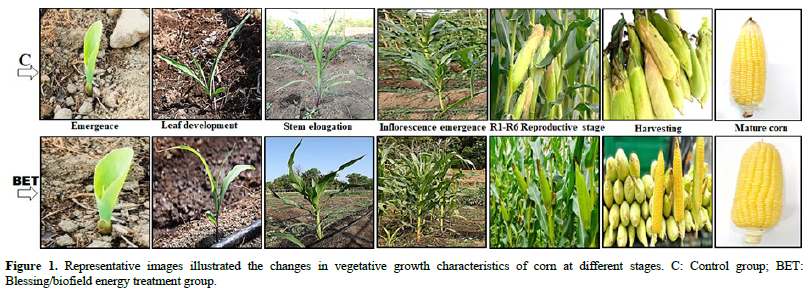
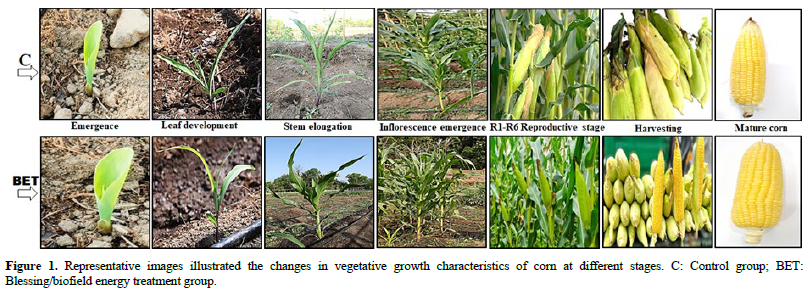
The morphological development of the corn was documented through systematic observations at set intervals. This study tracked from the initial germination, seedling phase through vegetative expansion, anthesis (flowering), fruit set, and final harvest maturity (Figure 1).
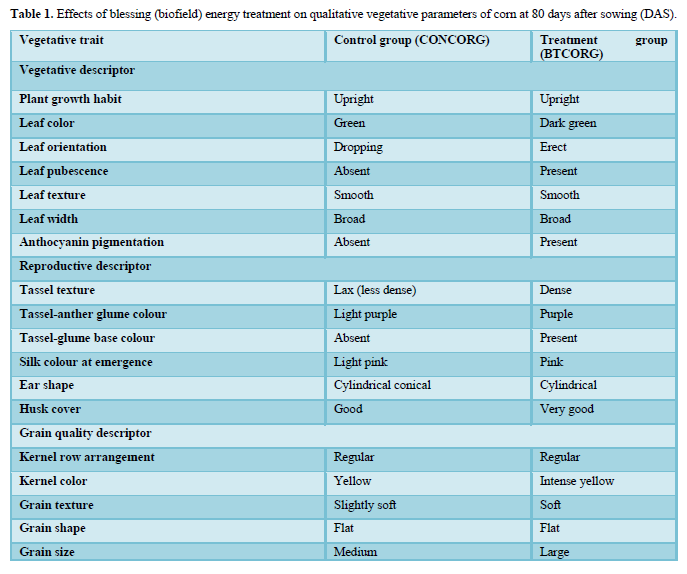
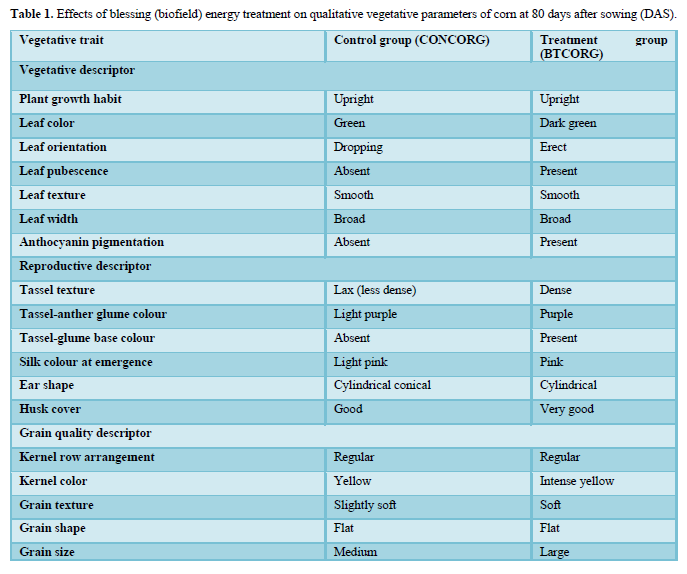
The phenotypic characterization of maize revealed significant divergence across several botanical parameters, ranging from vegetative architecture to reproductive morphology. BTCORG consistently exhibited more robust and pigmented traits compared to CONCORG. From a vegetative standpoint, BTCORG was characterized by a dark green leaf canopy with an erect orientation, and prominent pubescence, whereas CONCORG displayed a standard green hue with a dropping leaf habit and an absence of pubescence. Furthermore, anthocyanin pigmentation was distinctly present in the vegetative tissues of BTCORG but entirely absent in CONCORG, suggesting a higher concentration of flavonoids in the blessing treatment group (Table 1). The reproductive structures further delineated the two groups. The tassel of BTCORG was characterized by a dense texture, purple anther glumes, and a pigmented glume base. In contrast, CONCORG presented a lax tassel texture with light purple anther glumes and no basal pigmentation. Similar variations were noted in the silk at the time of emergence, with BTCORG displaying a vibrant pink coloration compared to the light pink observed in CONCORG. Regarding ear development, BTCORG produced cylindrical cobs with "very good" husk protection, while CONCORG yielded cylindrical-conical ears with "good" husk coverage. Final analysis of the harvested grain indicated that BTCORG produced larger, soft-textured kernels of a intense yellow hue. Conversely, the CONCORG genotype was distinguished by medium-sized, slightly soft kernels with a standard yellow pigmentation.
Phenology and yield traits
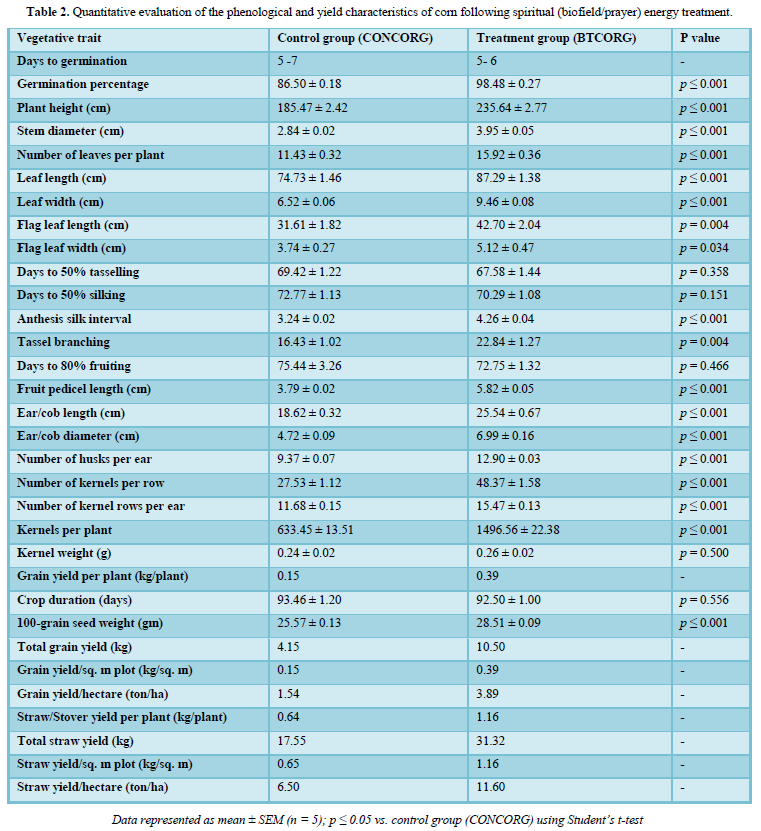
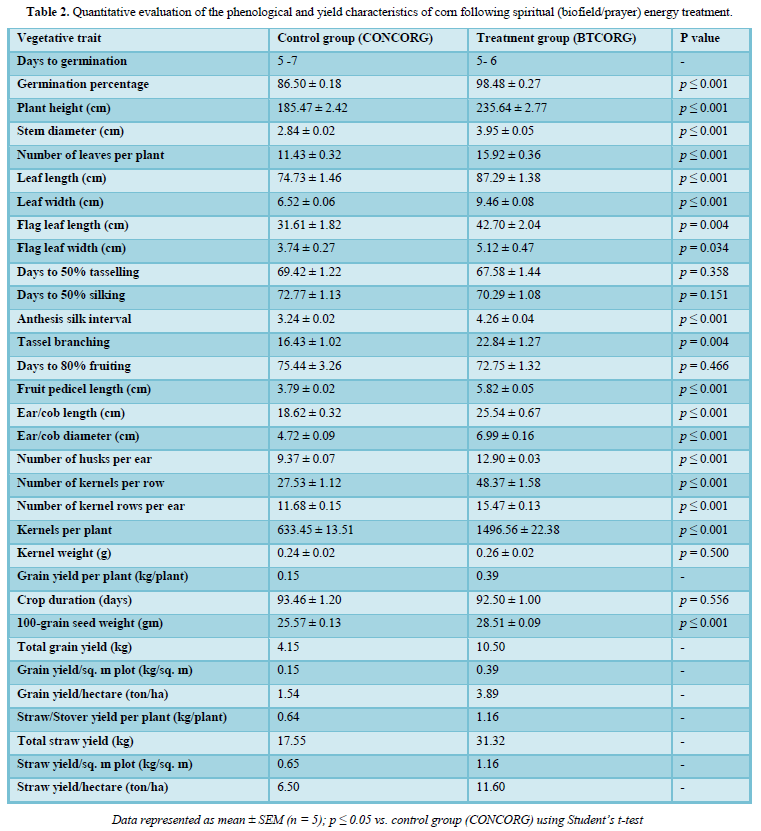
The study data showed a detail the comparative performance of the treatment group (BTCORG) against the control group (CONCORG). The data reveals that the treatment significantly enhanced nearly all vegetative and yield-contributing traits, with particularly robust gains in grain productivity. The BTCORG group exhibited superior early-stage development and structural vigor. The germination percentage increased significantly by 13.80% (p ≤ 0.001), in BTCORG compared to the control, CONCORG. Plant architecture like plant height and stem diameter increased by 27.05% and 39.08%, respectively (p ≤ 0.001) in the BTCORG than CONCORG. Parameters related to photosynthetic capacity such as the number of leaves per plant rose by 39.28%, supported by a 16.81% increase in leaf length, and a 45.09% increase in leaf width (p ≤ 0.001) in the BTCORG than CONCORG. Reproductive priming descriptors such as flag leaf dimensions, critical for grain filling, showed substantial gains, with length increased by 35.08% (p = 0.004) and width increased by 36.90% (p = 0.034) in BTCORG compared to the CONCORG. Notably, phenological traits like days to 50% tasselling and days to 50% silking showed no statistically significant difference, suggesting the treatment promotes vigor without altering the natural life cycle duration. The treatment significantly altered the reproductive architecture of the crop. While the anthesis-silk interval (ASI) widened by 31.48% (p ≤ 0.001), this did not negatively impact kernel set. In fact, ear development was markedly superior in the BTCORG group. Ear dimensions like ear/cob length and diameter increased by 37.16% and 48.09%, respectively (p ≤ 0.001) in the BTCORG compared to the CONCORG. The number of kernels per row saw a massive increase of 75.70% (p ≤ 0.001), and the number of kernel rows per ear increased by 32.4% (p ≤ 0.001) in the BTCORG compared to the CONCORG. The most striking impact of the treatment was observed in final yield metrics. The BTCORG group achieved a 136.20% (p ≤ 0.001) increase in total kernels per plant compared to the CONCORG. The harvest index was profoundly shifted; grain yield per hectare rose (152.60%) from 1.54 ton/ha in the control to 3.89 ton/ha in the treatment group. This was accompanied by a 78.5% increase in straw/stover yield per hectare (11.60 ton/ha vs. 6.50 ton/ha), indicating that the treatment boosts both reproductive output and vegetative biomass simultaneously.
DISCUSSION
The "erect" leaf orientation observed in BTCORG, compared to the "dropping" habit of CONCORG, is a critical agronomic trait. Modern maize breeding prioritizes erect leaves to increase leaf area index (LAI) and improve light penetration to the lower canopy, ultimately enhancing photosynthetic efficiency under high-density planting [9]. Furthermore, the prominent pubescence and dark green hue in BTCORG suggest a robust defence mechanism. Leaf hairs (trichomes) serve as a physical barrier against herbivory and excessive transpiration, while higher chlorophyll density indicated by the darker hue, often correlates with superior nitrogen use efficiency. A defining characteristic of the BTCORG group is the pervasive presence of anthocyanin pigmentation in vegetative tissues, tassel glumes, and silk. Anthocyanins are powerful antioxidants that protect plant tissues from photo-oxidative stress and UV radiation. The vibrant pink silk and purple anther glumes in BTCORG indicate a high concentration of these flavonoids, which are often linked to enhanced reproductive resilience under fluctuating environmental conditions [10]. The transition from the "cylindrical-conical" ears of CONCORG to the "cylindrical" cobs of BTCORG, paired with "very good" husk protection, suggests an improvement in yield stability and grain protection. Enhanced husk coverage is a vital trait for preventing ear rot and protecting against avian pests. At the grain level, the shift toward larger, intensely yellow, soft-textured kernels in BTCORG indicates an accumulation of carotenoids. Carotenoids are not only essential for grain nutritional quality but also serve as precursors for abscisic acid (ABA), a key hormone in drought tolerance [11].
The substantial enhancement in vegetative vigor and reproductive efficiency observed in the BTCORG suggests a profound optimization of physiological processes. The 13.80% increase in germination percentage aligns with findings that specific biological or chemical treatments can mitigate early-stage oxidative stress and improve seedling establishment. According to Farooq et al. 2009 improved initial stand establishment is a critical precursor to maximizing grain yield in cereal crops [12]. The remarkable 27.0% increase in plant height and 39.3% increase in leaf number (p ≤ 0.001) indicates a more photosynthetic capacity. This structural reinforcement is further supported by the 45.10% increase in leaf width, which likely facilitated higher light interception and carbon assimilation. This phenomenon is supported by Zhu et al. 2010, who state that optimizing canopy architecture and leaf area index is essential for breaking the current yield plateaus in modern agriculture [13]. The transition from vegetative growth to reproductive development in the BTCORG group was characterized by a significant increase in ear/cob length (37.12%) and diameter (48.09%). The massive 136.2% increase in total kernels per plant (p ≤ 0.001) indicates that the treatment group maintained a superior "sink" capacity during the grain-filling period. As noted by Boyer et al. 2004, the ability of a plant to maintain kernel number is the primary determinant of yield stability under varying environmental conditions [14]. The most critical finding was the 152.6% increase in grain yield per hectare in the BTCORG, which was achieved without a significant change in crop duration compared to the CONCORG. This suggests that the treatment enhanced the harvest index by accelerating the translocation of photosynthates to the grain. This is consistent with the metabolic theories proposed by Slewinski, 2012, where increased sink strength drives higher nutrient transport efficiency [15].
Furthermore, the simultaneous 78.5% increase in total straw yield (11.60 ton/ha) in the BTCORG group demonstrates that the treatment did not result in a trade-off between vegetative biomass and grain production. This synergistic growth pattern is a hallmark of high-efficiency agricultural inputs, as discussed by Cassman et al. 2003, highlighting the importance of integrated nutrient and resource management in achieving global food security [16].
CONCLUSION
The application of the spiritual blessing energy treatment (Trivedi Effect®) in the BTCORG group resulted in a highly significant improvement across the majority of agronomic parameters. The doubling of grain yield (ton/ha) suggests that the treatment optimizes the plant's source-sink relationship, primarily by increasing ear capacity and kernel density rather than merely extending the crop duration. In conclusion, these outstanding findings would be cost-effective and beneficial to the farmers near future.
ABBREVIATIONS
NPK: nitrogen phosphorus potassium; SBET: spiritual blessing energy treatment; CONCORG: control corn group; BTCORG: biofield energy-treated corn group; SSP: single super phosphate; MOP: muriate of potash; DAS: days after sowing
ACKNOWLEDGEMENT
The authors are grateful to Divine Connection Foundation for the assistance and support during the work.
CONFLICT OF INTERESTS
Author MKT was employed by Trivedi Global, Inc. VDK, NRP, and TBG were employed by Shree Angarsiddha Shikshan Prasarak Mandal’s College of Agriculture, Sangulwadi, Mohitewadi, Maharashtra, India. Authors SM and SJ were employed by Trivedi Science Research Laboratory Pvt. Ltd. The authors do not have any commercial interests on the objectivity of the research.
FUNDING
The authors declare that no funds, grants, or other support were received during the preparation of this manuscript.
- Bi, C., Bi, X., Liu, J., Xie, H., Zhang, S., Chen, H., Wang, M., Shi, L., & Song, S. (2025). Identification of maize kernel varieties based on interpretable ensemble algorithms. Frontiers in Plant Science, 16, 1511097. https://doi.org/10.3389/fpls.2025.1511097.
- Panozzo, A., Dal Cortivo, C., Ferrari, M., Vicelli, B., Varotto, S., & Vamerali, T. (2019). Morphological changes and expressions of AOX1A, CYP81D8, and putative PFP genes in a large set of commercial maize hybrids under extreme waterlogging. Frontiers in Plant Science, 10, 00062. https://doi.org/10.3389/fpls.2019.00062
- Richetti J, Sadras VO, He D, Leske B, Hu P, Beletse Y, Cossani CM, Nguyen H, Zheng B, Deery DM, Dreccer MF, Whish J and Lilley J (2025) Challenges in modelling the impact of frost and heat stress on the yield of cool-season annual grain crops. Front. Plant Sci. 16:1613432. https://doi.org/10.3389/fpls.2025.1613432
- Ezin, V., Kpanougo, C. M. I., & Ahanchede, A. (2022). Genetic diversity and environmental influence on morphological and yield parameters of maize in Benin. Heliyon, 8(6), e09670. https://doi.org/10.1016/j.heliyon.2022.e09670
- Pashupati Nath Singh, Prashant K. Srivastava, Bhawana Sharma, R.K. Mall Assessing climate-driven phenological responses of tomato crops under future climate change trajectories: A Central India perspective. Smart Agricultural Technology 12, 2025, 101256.
- Haworth, M., Marino, G., Atzori, G., Fabbri, A., Daccache, A., Killi, D., Carli, A., Montesano, V., Conte, A., Balestrini, R., & Centritto, M. (2023). Plant physiological analysis to overcome limitations to plant phenotyping. Plants, 12(23), 4015. https://doi.org/10.3390/plants12234015
- Trivedi, D., et al. (2026). Pilot‐scale testing of blessing/biofield energy treatment (BET) for improving eggs and meat quality of Rhode Island Red laying hens. PMC Journal of Agricultural Science, n.d. https://pmc.ncbi.nlm.nih.gov/articles/PMC12814619/
- Richer-de-Forges, A.C., Arrouays, D., Chen, S., Dobarco, M.R., Libohova, Z., Roudier, P. et al. (2022). Hand-feel soil texture and particle-size distribution in central France. Relationships and implications. CATENA 213:106155. https://doi.org/10.1016/j.catena.2022.106155.
- Hu, Y., Zhang, J., Li, X., & Wang, Q. (2024). The genetic architecture of leaf angle in maize: Implications for high-density planting and photosynthetic efficiency. Theoretical and Applied Genetics, 137(3), 58–72. https://doi.org/10.1007/s00122-024-04567-w
- Xie, M., Liu, S., Zhao, H., & Tan, B. (2025). Comparative metabolomics reveals the role of anthocyanin biosynthesis in the reproductive resilience of Zea mays. Journal of Experimental Botany, 76(1), 112–129. https://doi.org/10.1093/jxb/erae405.
- Hossain, M. S., Ahmed, R., & Gupta, P. (2023). Advancements in biofortification: Enhancing carotenoid and flavonoid profiles in cereal crops. Frontiers in Plant Science, 14, 1102543. https://doi.org/10.3389/fpls.2023.1102543.
- Farooq, M., Wahid, A., Kobayashi, N., Fujita, D., and Basra, S. M. A. (2009). Plant drought stress: effects, mechanisms and management. Agronomy for Sustainable Development, 29(1), 185-212. https://doi.org/10.1051/agro:2008021.
- Zhu, X. G., Long, S. P., and Ort, D. R. (2010). Improving photosynthetic efficiency for greater yield. Annual Review of Plant Biology, 61, 235-261. https://doi.org/10.1146/annurev-arplant-042809-112206
- Boyer, J. S., and Westgate, M. E. (2004). Grain yields with limited water. Journal of Experimental Botany, 55(407), 2385-2394. https://doi.org/10.1093/jxb/erh219
- Slewinski, T. L. (2012). Diverse functional roles of phloem loading in the plant life cycle. Frontiers in Plant Science, 3, 196, 1-15. https://doi.org/10.3389/fpls.2012.00196.
- Cassman, K. G., Dobermann, A., Walters, D. T., and Yang, H. (2003). Meeting cereal demand while protecting natural resources and improving environmental quality. Annual Review of Environment and Resources, 28, 315-358. https://doi.org/10.1146/annurev.energy.28.040202.122858.
-
 Table 1
 -
Table 2
QUICK LINKS
- SUBMIT MANUSCRIPT
- RECOMMEND THE JOURNAL
-
SUBSCRIBE FOR ALERTS
RELATED JOURNALS
- Journal of Biochemistry and Molecular Medicine (ISSN:2641-6948)
- Journal of Genetics and Cell Biology (ISSN:2639-3360)
- Food and Nutrition-Current Research (ISSN:2638-1095)
- Proteomics and Bioinformatics (ISSN:2641-7561)
- Advances in Nanomedicine and Nanotechnology Research (ISSN: 2688-5476)
- Journal of Veterinary and Marine Sciences (ISSN: 2689-7830)
- Journal of Genomic Medicine and Pharmacogenomics (ISSN:2474-4670)